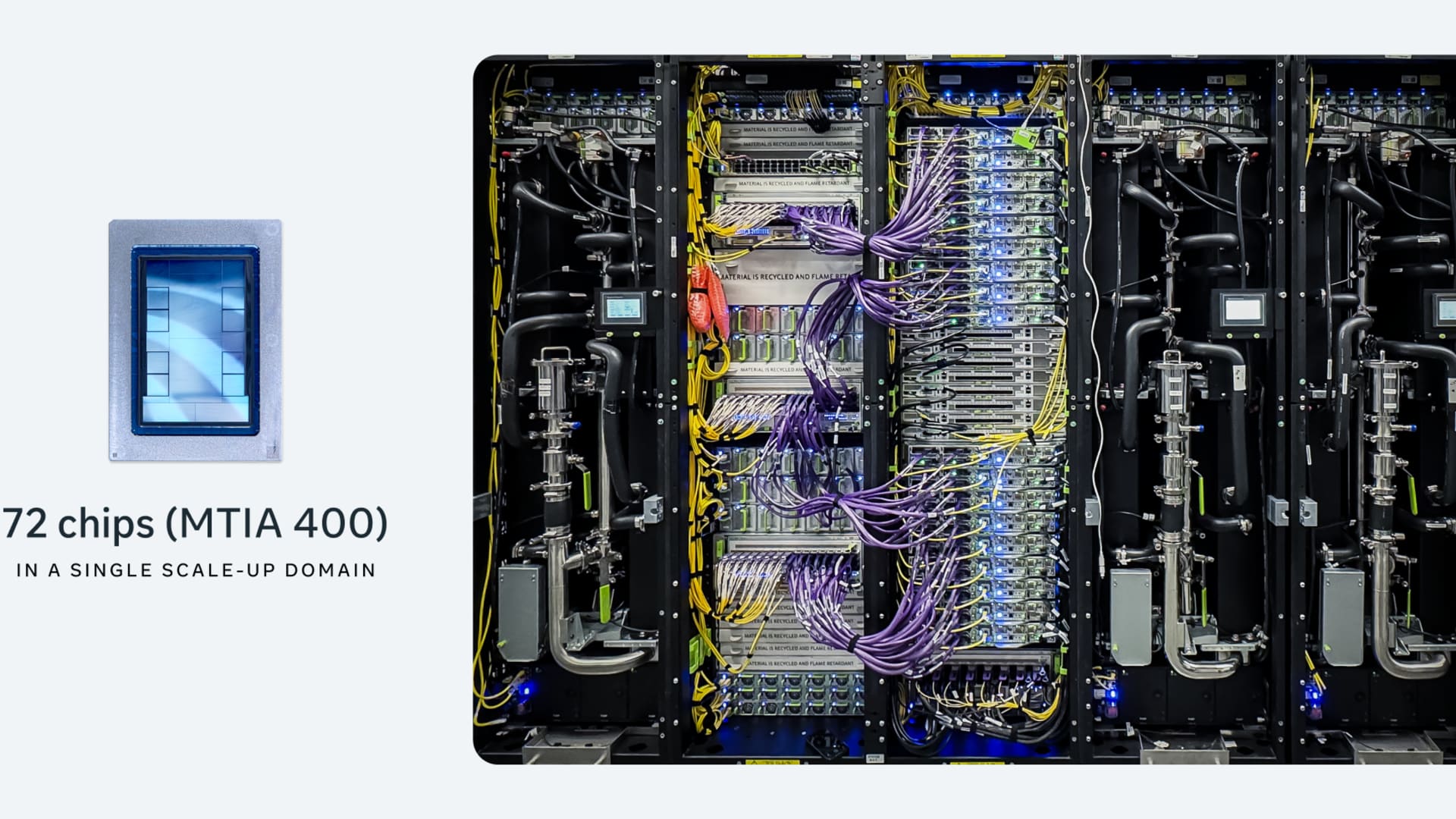
MTIA 300 is the first of Meta’s family of in-house training and inference accelerators optimized for training ranking and recommendation models.
We’re sharing how MTIA 300’s built-in NIC chiplets allow it to meet the communication needs associated with training recommendation models with superior performance over general-purpose GPUs.
By co-designing MTIA’s communication library, HCCL, alongside the chip we’ve taken a fundamentally different approach to chip design and made communication a first-class citizen.
Deep learning models may deliver personalized content—from short videos to friend posts—to people on apps. As these models have grown in complexity, so has the importance of the compute that trains them, and the network that connects those accelerators.
Training recommendation models is a unique infrastructure challenge. Unlike large language models, which need enormous floating-point throughput, recommendation models are bottlenecked by a need for fast and efficient communication between the accelerators that train them. Their embedding tables can contain over 99% of the model’s parameters, requiring hybrid parallelism that generates frequent AllReduce, AllToAll, and AllGather collectives across hundreds of accelerators. On chips like GPUs these communication operations compete with training computation for the same resources, often leaving expensive hardware underutilized.