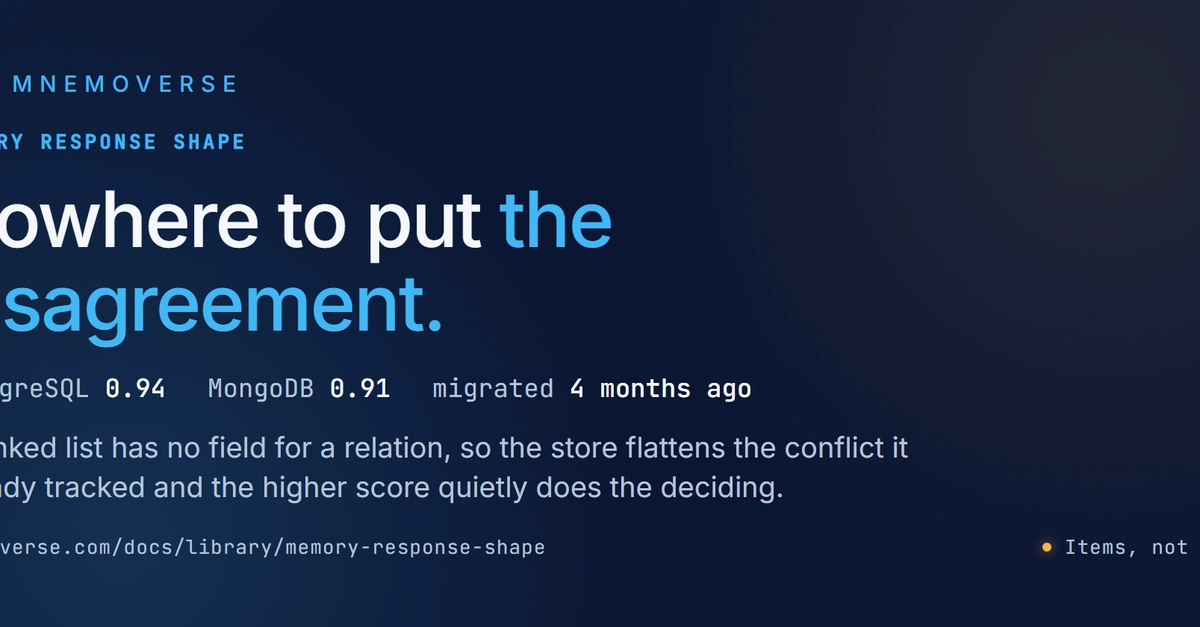
Ask a memory system what database production uses, and it can hand back two records that flatly contradict each other, each with a confident similarity score, and nothing else. Ken Alger opened his piece on this with exactly that shape: PostgreSQL at 0.94, MongoDB at 0.91, and a migration four months ago that neither number knows anything about.
He wrote it from the interface side. This is the same problem from the store side, and the uncomfortable part is that a store can hold everything it needs to see the conflict, both records and both timestamps, and still return it flattened. Disclosure up front: I work on Mnemoverse, a memory engine for AI agents, so read the parts about our own failures as the ones I am most sure of.
Why does a memory store hand back a contradiction without saying so?
Because the response has nowhere to put it.
A memory API returns a list of items with scores. That shape can express "here are five things, sorted by how well they match." It cannot express "these two are in conflict," "this one was superseded by that one," or "this is still true but no longer governs." Those are relations between records, and a flat list has no field for a relation.