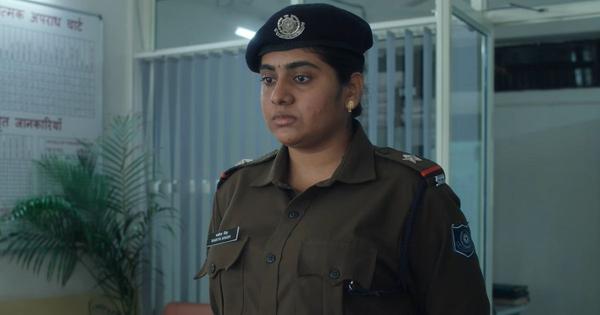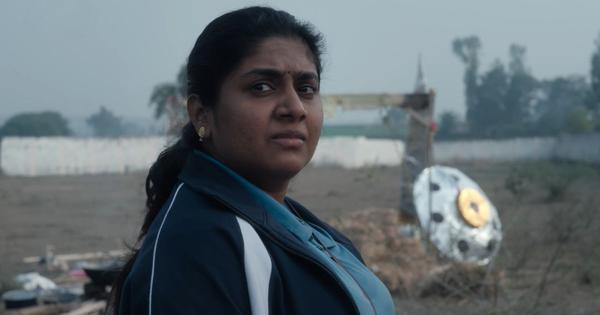
In the upcoming film Babita Singh Reporting, Nimisha Sajayan plays a pliant, under-confident assistant sub-inspector who is suspended for no fault of hers. Babita and her husband Sharad (Anshumaan Pushkar) travel to their home town Rewa, where Babita gets involved in solving the death of her childhood friend Bansi (Barun Sobti).Babita, who’s nicknamed Baby, continues her pursuit despite health problems and domestic tensions. The unofficial investigation reveals truths about Bansi, his wife (Priyanka Setia) and his brother (Nitin NS Goel), but most of all about Babita.Out on Prime Video on August 28, the Hindi movie marks the feature debut of Ambiecka Pandit, who has previously directed episodes of the series Black Warrant. Pandit gleaned in Amita Vyas’s script shades of a woman with whom she could closely identify.“I could see shades of Baby in myself, and I have met tonnes of Babys in my life,” Pandit told Scroll. “Baby is caught up in all these roles that define her and in that process, she has lost a grip on who she is. Amita has done this so smartly, through an investigative thriller.”Pandit described Babita as “specific, unique and fundamentally universal”. She added, “The film is about this universal female experience of being people-pleasing, of suffocating, of making yourself small and accommodating just to make other people comfortable. It’s a very interesting story of a woman who has so many roles in her life that she has supressed and forgotten herself. She makes a journey back home to herself.”Anshumaan Pushkar in Babita Singh Reporting (2026). Courtesy Amazon MGM/Film Squad/Act Three/Prime Video.The film’s co-producer, Sudip Sharma, was initially approached to direct the project. Sharma, the creator of Paatal Lok and Kohrra, turned down the offer.“I genuinely didn’t feel that I was the right person – my gaze as a director is much harsher,” Sharma said. “Amita’s script has a softer, feminine gaze. That made it important that we get a good female director. I wouldn’t have that same sort of sensitivity that Ambiecka was able to bring.”When, on Vyas’s nudging, Sharma watched Pandit’s previous short films, he was impressed by her handling of interpersonal relationships. “I also spoke to Vikramaditya [Motwane, co-creator and co-director of Black Warrant], who said, there are some scenes Ambiecka directed that even I couldn’t have directed.”Pandit flagged two standout sequences in the film, both of which revolve around Babita’s conflict with Sharad.“These scenes are markers of Babita’s graph,” Pandit explained. “The first scene tells you where Baby is at and how she’s trying to handle the conflict, and the second tells you how she’s no longer able to. I found them challenging to block and direct. I was trying to allow the characters to take centre stage, trying not to cut too much, give the viewers a sense of being in the room watching it happen around them rather than at them.”Among the surprise casting choices is Nimisha Sajayan, the acclaimed actor in such Malayalam films as Thondimuthalum Driksakshiyum, Malik and The Great Indian Kitchen. Sajayan, who also appeared in the Hindi web series Dabba Cartel, actually knows Hindi well, having grown up in Mumbai.“Nimisha’s Marathi is very good too,” Pandit said. “Nimisha is a brilliant actor. She is very precise. Her performances are incredibly layered, textured and immersive. It mesmerises me, the amount of layers she can play. That was what was required for Baby. Also, Nimisha has this naivete about her. She looks at the world with a kind of optimism, which Baby required. Nimisha isn’t jaded. Nor is the character.”Barun Sobti “didn’t need any convincing” to appear in what amounts to an extended cameo. “It was mighty kind of him to do this role,” said Sharma, who has previously worked with Sobti in Kohrra. “Barun didn’t even allow me to finish the pitch. He told me, I will do this film on one only condition – I won’t charge a single rupee.”Barun Sobti in Babita Singh Reporting (2026). Courtesy Amazon MGM/Film Squad/Act Three/Prime Video.Like Kohrra, Babita Singh Reporting uses the police procedural to frame an exploration of Indian family dynamics. “The family is the basic unit of politics – the family builds up into the state and then the nation, but the politics of the nation are reflected in the politics of the Indian family,” Sharma pointed out.Pandit added, “The family is a never-ending source of conflict and tension and different viewpoints. It is a microcosm of society, through which you can talk about universal things.”Babita Singh Reporting eschews the rapid-fire cutting and hasty transitions often seen on streaming, instead allowing the story to unfold organically. Having worked on slow-burning shows such as Kohrra, Sudip Sharma says that he has found a tolerance among viewers that isn’t always shared by studio heads.“Those viewers are there, and those viewers are us too,” Sharma observed. “We short-change ourselves into believing that people are losing patience. It’s believed that if something is slow-paced, audiences won’t watch it but no – they didn’t watch it because it wasn’t well-made. Sometimes, in the name of making a slow-paced show or a nuanced show, you bore the hell out of the audience. That’s criminal. You still have tell an engaging story and make it well.”Ambiecka Pandit added, “I don’t think the audiences have changed. It’s a confluence of economics, metrics and wrong inferences. A bad film is a bad film, whether it’s fast or slow.”
In ‘Babita Singh Reporting’, a cop ‘makes a journey back home to herself’
Director Ambiecka Pandit and co-producer Sudip Sharma talk about casting Nimisha Sajayan and Barun Sobti’s condition for being in the film.
915 words~4 min read