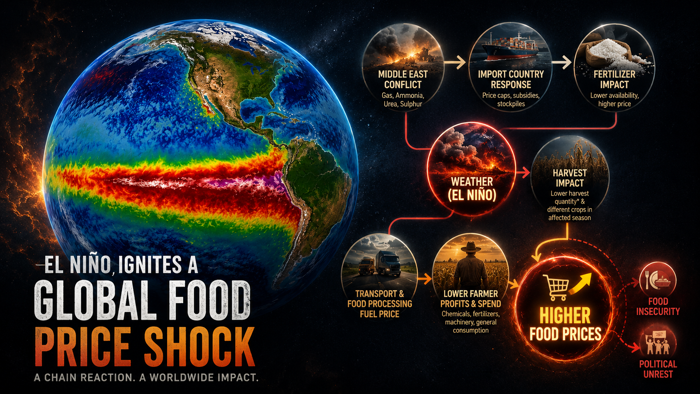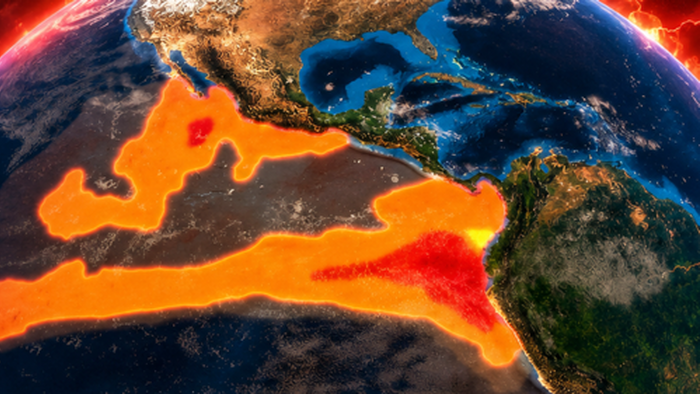
Macro strategists, commodity traders and central-bank risk committees may need to reassess the inflation outlook if an El Niño event intensifies faster than currently anticipated. An early-onset, high-intensity warming of equatorial Pacific could transmit through crop markets, shipping networks, energy systems and ultimately into headline inflation and monetary-policy decisions, according Michael Ferrari, US-based climate and commodities researcher.Moby MLR-ARX model Ferrari is Vice President and Head of Research at Moby, founder of Atlas Research Innovations and Senior Partner at AlphaGeo.While the International Research Institute (IRI) ensemble currently points to strongest impacts around October-November-December period, Moby’s updated MLR-ARX model indicates biological stress and precipitation anomalies could emerge across key South American and West African agricultural regions 30 to 60 days earlier.A faster trajectoryThe latest MLR-ARX model run indicates a rapid strengthening of equatorial and eastern Pacific sea-surface temperatures:July: +1.40°C, establishing a moderate El Niño signal
End-August: +1.70°C, moving into a strong-event range
End-September: +2.05°C, potentially taking the event beyond the +2°C level used by some frameworks to denote an exceptionally strong El NiñoMacro-economic shock If such warming occurs materially earlier than the prevailing consensus expects, the consequences could extend well beyond specialist energy and commodity markets. “An El Niño event of this magnitude and speed has the potential to create a macroeconomic shock well before the market has fully priced it,” Ferrari says.Historically, strong El Niño episodes have been associated with precipitation deficits across parts of South-East Asia, India, Australia and West Africa, alongside heavier rainfall in parts of southern South America. Significance for agricultural markets lies not simply in the eventual peak intensity of the event, but in when the climate signal intersects with critical crop-development windows. That timing could put commodities including sugar, cocoa, palm oil, rice and coffee under pressure, Ferrari notes.Crop stress to policyThe monetary-policy implications are potentially significant because food has a substantially higher weight in consumer-price baskets across emerging markets than in advanced economies. A renewed food-price shock could therefore feed more rapidly into headline inflation and inflation expectations.For central banks in Latin America and South-East Asia, that could complicate or interrupt prospective rate-cutting cycles. In economies where food and energy have a particularly large influence on household inflation expectations, policymakers could instead face pressure to maintain restrictive policy or resume tightening. Transmission mechanismA forecast error measured in weeks rather than months can translate into materially different decisions for commodity buyers, importers, fiscal authorities and central banks.Some models project substantially higher temperature anomalies, while the broader ensemble remains below those extremes. Statistical model projections generally respond more slowly to rapid changes in ocean-atmosphere conditions and therefore may dampen the signal of an accelerating event.MLR-ARX approachRather than relying principally on ensemble averaging or static linear relationships, the model places greater weight on active subsurface ocean heat and related precursor signals. Its latest trajectory therefore points to a potentially faster escalation than reflected in the broader consensus.The critical issue for markets is not whether every model converges on the same peak. It is whether the physical system begins moving faster than the consensus forecast cycle can absorb. When that happens, markets tend to adjust through abrupt repricing rather than a smooth, gradual deterioration.Supply-chain riskThe first transmission channel beyond agriculture could be logistics. A strong El Niño can contribute to drought conditions across parts of Central America and northern South America. Lower water levels in the Panama Canal system can constrain vessel draft and daily transit capacity, potentially forcing shipping operators to reduce cargo loads, reroute vessels or accept longer transit times.If restrictions intensify into the fourth quarter, maritime freight costs could become another source of cost-push inflation, adding to the supply-chain pressures already embedded in global goods markets. For commodity importers, the risk is therefore twofold: higher prices for underlying commodity and higher costs to move it.Hydropower, energyWater stress also creates an important second-round effect through electricity markets. Extended dry periods in economies such as Colombia, Brazil and parts of South-East Asia can reduce hydropower availability. Governments and utilities may then have to rely more heavily on thermal generation and imported fuels.The resulting increase in power-generation costs can feed into industrial production, transport and household energy bills .At the same time, extreme temperature anomalies can push electricity demand higher through air-conditioning or heating requirements, placing additional pressure on already-constrained power systems.Fiscal pressureFor emerging economies, the inflation shock may also become a fiscal problem. Governments facing sharp increases in food and electricity prices may expand agricultural support, disaster-relief programmes or energy subsidies to protect households from the immediate impact .That can cushion consumers in the short term but increase fiscal deficits and, even complicate the central bank’s effort to bring inflation back to target.Insurance marketClimate volatility can also widen the economic impact through insurance markets. More frequent or severe weather-related losses can raise property and casualty reinsurance costs, particularly in climate-exposed markets. As underwriting capacity becomes more expensive or constrained, businesses and households may face higher insurance premiums or reduced coverage.The immediate question for policymakers is therefore not simply how strong El Niño ultimately becomes. It is how quickly the signal reaches the real economy.Policy questionIf crop stress, water shortages and logistics disruptions emerge weeks earlier than anticipated, headline inflation could turn before central banks have completed expected easing cycles. Markets would then have to price a different policy path - fewer rate cuts, delayed easing or, in the most exposed economies, renewed tightening.Therefore, the greatest risk may not be an El Niño that is stronger than expected. It may be an El Niño that arrives faster than markets and policymakers are prepared to absorb.Published on August 24, 2026