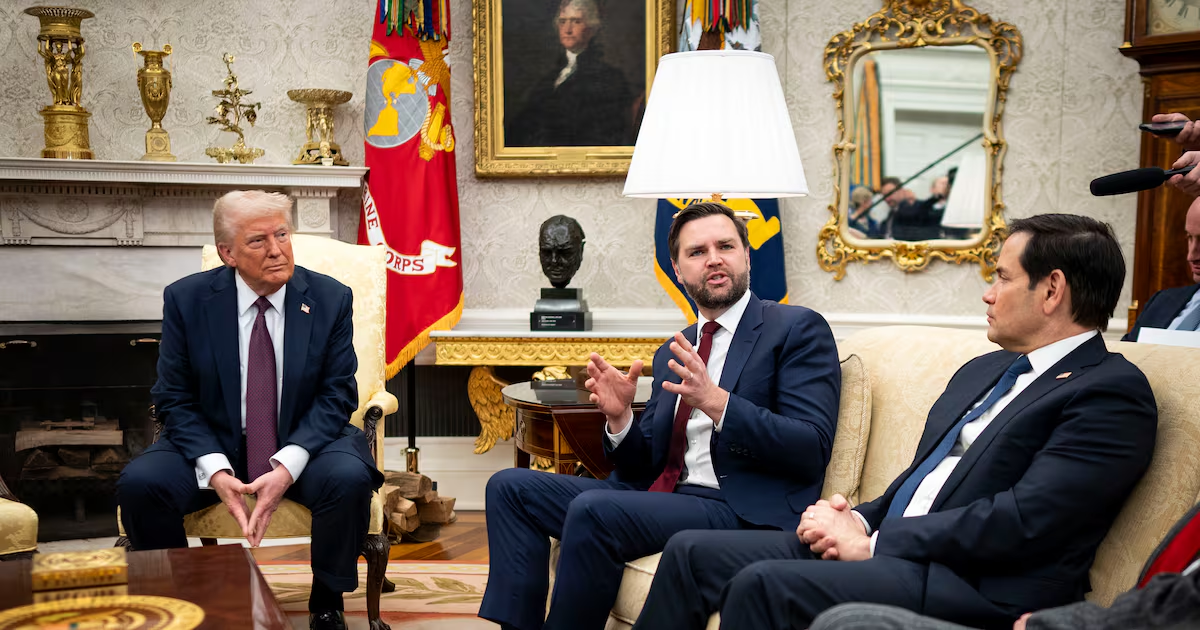
Electoral politics in its most basic form consists of just two actions: building an effective coalition and destroying the coalitions of your opponents. By this metric the US Republican Party has been remarkably successful. For decades, the Grand Old Party (GOP) held together the “fusionist” consensus, which allied social conservatism with a radical commitment to libertarian economics and an interventionist, warlike foreign policy. The modern conservative movement created to oppose the New Deal was at its apex under the Reagan administration. This governing ideology ran aground in the late George W Bush era, when the evidence of its failures – wars in Iraq and Afghanistan, the response to Hurricane Katrina, the sub-prime housing crash – mounted. Losses in the 2008 and 2012 presidential races created a crisis within the party. The party base, rather than tacking to the centre as expected, instead ejected the remaining elected moderates. But predictions of a genuine split have been made repeatedly over the years and have never come to pass. The party has always been a fractious coalition, not least between the old paleoconservative faction who are nativist and somewhat isolationist, and the neoconservatives, that wing of (originally ex-left) radicals who dreamed of making the world over in the image of the United States, one foreign invasion at a time. More recently a split has emerged between the libertarians, who favour the same market fundamentalism the GOP has governed with since the 1980s, and a putative “national conservative” tendency, who want more governmental intervention to encourage marriage, children and home ownership. There are also generational divides within a party whose younger apparatchiks flirt with open fascism. In the person of Donald Trump, the party has been able to effectively paper over these distinctions. Since he emerged seriously on to the political scene in 2015-2016, Trump has both exerted total control over the party and offered enough to each faction, both in symbolic and real terms, to avoid any serious infighting. He is a mercurial figure on to which many ideologies can be projected. He campaigns like a paleocon, promising no new wars, but governs like a neocon. His personal style offered to young radicals the promise of libertine chauvinistic excess, while his supreme court judges repealed the nationwide right to abortion and cemented a socially conservative interpretation of the constitution for decades to come. More to the point, he delivered the one thing every Republican president must: an enormous tax cut for the wealthy. Trump, however, is in physical and political decline. A recent poll had his popularity at just 32 per cent. As his authority gradually wanes, these party divisions have re-emerged and are threatening to fracture the GOP. Even the president’s overwhelming power as party kingmaker has seen some slight cracks appear with his handpicked candidates losing party primaries in Minnesota, Wyoming and Florida. This breakdown has been catalysed by the disastrous and unpopular Iran war which has again divided the neocons from the paleocons. Giving fire to the split is the fact that support for Israel is increasingly unpopular among Americans – and catastrophically so among younger voters of whatever party. Young people on the right, left and centre see this war as one fought on behalf of Israel for no tangible benefit and at the cost of lives, money and international legitimacy. There are even rumblings of serious discontent among American soldiers and sailors themselves. The cost-of-living crisis driven by this war is being openly discussed by the Republican grassroots, even while their politicians dismiss it in electorally disastrous ways. Some sections of the erstwhile Maga faithful like Tucker Carlson and Marjorie Taylor Greene are threatening to launch a third party. Right-wing commentators who once revelled in rabble rousing and conspiratorial thinking are belatedly sounding the alarm on how vicious and fratricidal intra-right discourse has become. [ Jon Ossoff might just be the Democrats’ best answer to the US decade of chaosOpens in new window ]The emerging figureheads for these necon and paelcon tendencies are secretary of state Marco Rubio and vice-president JD Vance, widely considered the overwhelming frontrunners for the 2028 nomination. Rubio is a dyed-in-the-wool neocon, and one of the main drivers behind the administration’s violent interventions in Latin America. Vance is close to the younger, more isolationist parts of the base. If polling is to be believed, the GOP is facing serious defeat in November. The scale of Republican losses (or otherwise) will likely determine how much this infighting intensifies.For those hoping for a total Republican crack-up however, it’s worth studying just how effectively the party has reformed and resynthesised itself over the decades, absorbing or marginalising critics and resolving contradictions one way or another. Dissenters may yet be bullied, cajoled or bought off. Concerned observers have for years been praying for some sort of fever break in the GOP, an expulsion of the radical right that would turn the party into a respectable centre-right coalition. This is a fantasy. The Republican Party has been thoroughly Maga-fied. The only question is what strain of far-right thinking will drive the next iteration of what is one of the world’s most consequential political organisations.
As Trump poll ratings slide divisions threaten to fracture Republican Party
World View: The party has always been a fractious coalition, but more recently a split has emerged between the libertarians and a putative ‘national conservative’ tendency
855 words~4 min read