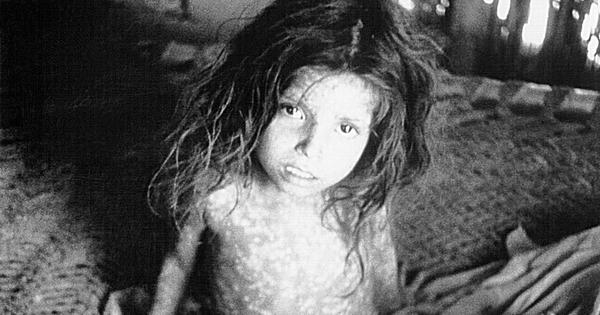
As we know, the fear of contagion predominated most British reports of infectious diseases in India. The tropical climate of the subcontinent was blamed once again and the dangers of the “miasmatic emanation” were discussed frequently. As sanitary improvements were introduced under the colonial regime, reflecting the hygiene consciousness of the mid-19th century in Europe, the dread of the miasmatic towns of India intensified, leading to the increased focus on social class as a determinant of smallpox. In fact, poverty was discussed as a key element; it became an important factor in the epidemics. Consequently, the filthy habits of people, yet again, acquired prominence in the diagnosis and treatment of the disease.Unfortunately for the British, while cholera and later plague were assigned to filthiness, smallpox did not particularly favour the black towns or the overcrowded chawls in the big cities. Once it struck, it quickly spread through the towns and villages alike, apparently without distinguishing between race and class. Still, administrative reports of the 19th century denounced the ignorant people of India for not being hygienic, and for dwelling in insanitary conditions, especially for living in “credulity and childish ignorance”. Given that miasmas continued to be blamed for contagion well into the 19th century, the stench from the bodies of smallpox victims – during their removal, as well as during their carriage to, and exposure on the banks of the river – was thought to “taint” the air with its malodours that were believed to carry the disease, and pass it to those who came in contact with it. This came to be understood as a cause of its diffusion.Robert Pringle, who was the superintendent of vaccination in the North-West Provinces of India, observed that in India, smallpox was universally present, especially where inoculation was not practised. He had conducted his observations based on his extensive research to throw light on the massive threat that the disease posed to the populace. In the Doab, or the districts between the rivers of Ganges and Yamuna, with a population of upwards of nine million, 95% of the population was attacked with smallpox. He attributed this to the long incubation period of the disease and the “wandering habits of the natives in search of sacred shrines”, causing the rapid spread of the contagion. In the second half of the 19th century, smallpox was so fatal that it was a saying among the people of all classes that children should not be regarded as permanent members of the family until they had survived smallpox. While visiting a village in the Himalayas where inoculation was practised, Pringle saw a stark demographic gap – an almost entire absence of children between the ages of eight to 12 years, due to smallpox mortality. He observed that in many regions, no prophylactic measures were undertaken whatsoever. People undertook pilgrimages to offer prayers to the smallpox deity, hoping to ward off the disease, but this led to the spread of the disease and triggered outbreaks. He also observed that the people were exceedingly fatalistic when it came to smallpox, considering it a matter of destiny or divine will. When he discussed the risks of exposure with a local, warning him against the dangers of letting children mingle when the infection was spreading, his concerns were dismissed with a hint of resignation.Significantly, since smallpox resulted in physical disfigurement, it was a visually gruesome disease, particularly with the presence of pustules and swelling of the face as characteristic symptoms of the disease. This reinforced the idea that the infection is spread through touch or direct physical contact. In 1850, The Report of the Smallpox Commissioners stated that the filthy clothing of the dead and dying, their furniture, the mats of their homes, and so on, if passed into the hands of the equally poor and wretched, led to further distribution of the disease.The report highlighted that the contagion spread through contact with the sick and was the reason for the spread of diseases among all classes. Indeed, as the century progressed, germ theory gained acceptance due to advancements in microbiology and bacterial science. This increased the concerns of the Europeans stationed in India because it meant that the invisible enemy did not just lurk in the dirty towns and villages, but could be carried into the very sanitary homes of British families in different outposts by the native subordinates who served them. This fear, though always on the minds of the British in case of any contagious disease outbreak, increased manifold due to the risk of smallpox epidemics. The Report of the Smallpox Commissioners categorically stated that transmission from natives to Europeans was highly likely. To support this claim, they cited the case of a large religious establishment, Loretto House, located on Middleton Street, which did not have any servants on its premises. This establishment did not have a single case of smallpox until 1850, and when it did, it was a mild case. The report went so far as to explain that since almost all Hindu and Muslim servants slept in their tiny homes in the bazaar, where the disease may be widespread, it was brought into the homes of their “masters”.By specific standard preventative measures, certain localities of the city had been identified as the storehouses of the most malignant form of smallpox. They were considered a great threat to public health. Since it was believed that contagion of smallpox occurred amongst the poorer natives living in the “miserable, small, filthy, ill-ventilated and much crowded buildings of the native town”, these spaces were deemed dangerous because the inhabitants resisted the safe removal of those who had died of smallpox, and even refused to move from the locations. In addition to that, segregation methods were employed to contain the spread of smallpox. In the garrison of Fort William, this was done by preventing the interaction of soldiers with the townspeople during an epidemic outbreak. This, along with proper sanitation and personal hygiene, likely prevented smallpox from destroying the troops. Like in the case of other epidemic outbreaks, when religious concerns hampered specific public health measures, smallpox control was intensely informed by the profound superstitions, so much so that the British government was averse to drastic preventative measures due to the sentiments around Sitala. Even in 1888, some Hindu residents of Kanpur came together to appeal to the authorities to rescind the rule of vaccination because they believed that smallpox was not “a malady that could be cured by medicine, and that any attempt to check its progress would enrage the Goddess, who could only be pacified by prayers and a simple diet”. The colonial government was aware that smallpox control measures could spark conflict in society. At the same time, they had to take actionable measures within the parameters of the religious belief system of the colonial masses, operating on limited resources. When vaccination drives began, the authorities had to consider the risk of sparking resistance and unrest among the masses. The situation was particularly complex because variolation was deeply entrenched in Indian culture. Most importantly, it was administered by professional inoculators who belonged to the Hindu high-caste of the Brahmin community. Pringle noted that initially, there was no formalised training-based profession of inoculation and that the practice was mainly in the hands of priests. This meant that the “profession” seemed to be hereditary rather than skill- and training-based, and became a form of caste-based trade or occupation. Over time, a more organised body of inoculators called tikadaars executed the operations. However, the procedure, elaborate as it was, went beyond the medical realms known to the Europeans. Even in the late 18th and 19th centuries, it was deeply ritualised; it included a series of rituals that had to be observed before and after the procedure for the successful recovery of the individual. The inoculators – tikadaars – enjoyed complete autonomy in these matters and could refuse it to anyone who did not adhere to or had not observed the preparatory course. The process was followed by more rituals for the successful recovery of the patient.The British had initially maintained a respectful distance from the practice, even encouraging it in some dire cases, especially since the Jennerian vaccines were not yet available. Over time, however, the dangers of the process became hard to ignore. For one, the work of inoculation began to be undertaken by low-caste Hindus, who either lacked the skill or were not obeyed by the general public. Secondly, the entire method of administering the smallpox materials into the body of the recipient was both rudimentary and fraught with risk. The indigenous inoculators used an instrument of seven needles bundled together, scratched the arm of the recipient and then bound it with cotton swabs smeared with the variola pus. This was particularly risky because the process could result in a violent attack of smallpox that could lead to an epidemic in the entire locality. To prevent this, the recently inoculated (variolated) individuals were put under quarantine until the inoculation process was completed in the whole village, although without adequate preventive measures of disinfection, this quarantine was not always beneficial.It was once discovered that, in many cases, the practice of opening the pustules of the smallpox patients was done by women who then sold the matter to inoculators to give to recipients internally when the cutaneous inoculation did not cause a fever. This was done because people believed that the inoculation worked only if there was a fever. The administration became increasingly wary of this. The alarming developments led Dr Cameron to declare in 1831 that “inoculation is the great means by which smallpox is kept in existence in Calcutta”.Excerpted with permission from In Sickness and In Death: How Faith, Medicine and Race Shaped British India, Ipshita Nath, HarperCollins India.
How illnesses like smallpox in colonial India exposed Britain’s myths of control and invincibility
An excerpt from ‘In Sickness and In Death: How Faith, Medicine and Race Shaped British India’, by Ipshita Nath.
1,641 words~7 min read