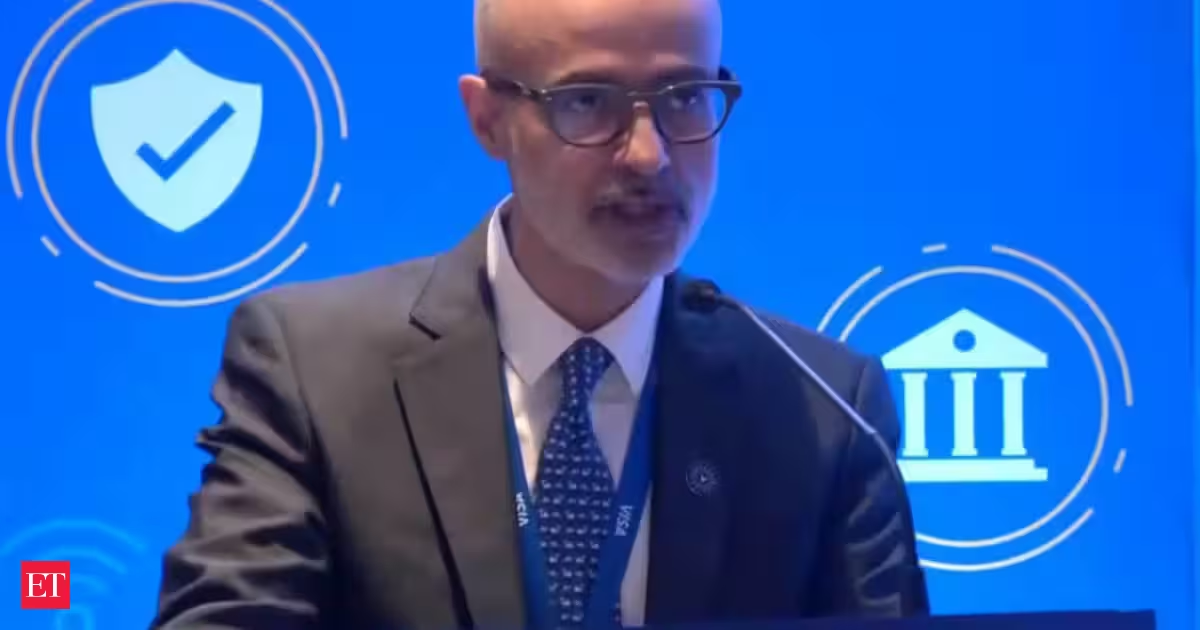
Artificial intelligence is set to move payments from digital commerce to "delegated commerce", where machines can discover products, negotiate as well as transact on behalf of consumers, making trust, intent, and real-time controls the new building blocks of the financial system, said top executives from JP Morgan, Standard Chartered, Visa and Coinbase at The Economic Times World Leaders Forum during a panel discussion titled 'AI, Trust, and the Future of Money'."Today, how people are discovering and purchasing stuff is going to be a very critical determinant as to how payments evolve," said Suresh Sethi, group country manager for India and South Asia, Visa. "We are talking about a time when the entire experience can be delegated. You have agents today going out, doing the purchase for you, and they are going to an extent of even enabling payments to happen," he added.That transition will require the payments industry to move beyond simply authenticating customers and payment credentials."Now, we are looking at a scenario where the trust has to be actually built into intent," Sethi said. "The human intent of whatever you are giving as the program decision and the permission has to stay corrected."Trust, he noted, will increasingly be "at the bedrock rather than just looking at how you make the journey faster."L-R: Suresh Sethi of Visa, Standard Chartered’s PD Singh, John O’Loghlen of Coinbase, and Madhav Kalyan of JP Morgan Asia PacificAccording to PD Singh, CEO-India & South Asia, Standard Chartered, AI will drive the next phase of payments, but safety will remain more important than sheer speed. "We want speed. We want a personalised experience. We do want the payment to happen at the cheapest possible cost," he said. "But the fact that your money needs to reach the right place safely, I think, is the first constituent, which is where AI comes in.""AI helps us with customising the experience. AI helps us with making sure that all the bad actors are weeded out of the system. They're using AI as well," noted Singh, adding financial institutions may consequently need to introduce some friction to distinguish legitimate transactions from fraudulent ones.He also said Standard Chartered trained 55,000 employees through 225,000 hours of AI training over the past 12 months and has seen a 30% improvement in technology implementation."Banks, as we know them today, may not be in the same form in the next three to five years," according to Singh. "What that form and shape is going to be decided by the speed of adoption."Consumers will increasingly be indifferent to whether money moves through bank accounts, cards, UPI, tokenised deposits or other rails."At a customer level, they don't really care about the rail or the tool that is being used. All they care about are outcomes," said Madhav Kalyan, managing director and head of payments, JP Morgan Asia Pacific. "What they care about is whether it is delivered speedily? Is it delivered in a reliable manner? Is it delivered in a cost-efficient way? Is it creating certainty? Is it taking care of trust?"The risk for financial institutions is therefore not that payment rails disappear, but that they become invisible and commoditised. "Controls can't be a post-facto bolt-on. You must do it as a part of the transaction," Kalyan said.Banks that can verify identity and authority, ensure settlement certainty, carry data and keep transactions auditable can move beyond being merely infrastructure providers. "You're no longer a mover of money and infrastructure, but you're a trusted value provider in the payments ecosystem," he added.John O'Loghlen, managing director for Asia-Pacific, Coinbase, said stablecoins could form another layer of this emerging machine-to-machine economy, rather than competing with India's existing payment infrastructure. "Stablecoins don't compete with UPI. UPI is a world-class platform... Stablecoins are complementary to UPI. They're the digital layer, the native kind of on-chain money that will allow all this AI to come to life."However, autonomous transactions will require stronger guardrails."When machines are talking to machines, there have to be guardrails in place," cautioned O'Loghlen, adding that Coinbase requires human confirmation for code touching customers, and that AI has increasingly been deployed internally across compliance, risk, payments and security.Sethi observed that AI will simultaneously make fraudsters more sophisticated and force payment networks to move from static fraud rules towards real-time behavioural intelligence."Static rules do not work. Static rules can only look backwards for you," he said. "Whenever you have a challenge, you slow the transaction, you take your time and make out whether it is true or not."
AI, trust, and the future of money: With AI making payments invisible, trust becomes the new currency
Artificial intelligence will shift payments from digital to delegated commerce, enabling machines to transact for consumers. Trust and real-time controls will become essential building blocks for the financial system. AI will enhance personalized experiences and help identify fraudulent transactions effectively. Consumers will focus on payment outcomes rather than the underlying transaction rails. New guardrails will be necessary as machines increasingly interact autonomously.
747 words~3 min read