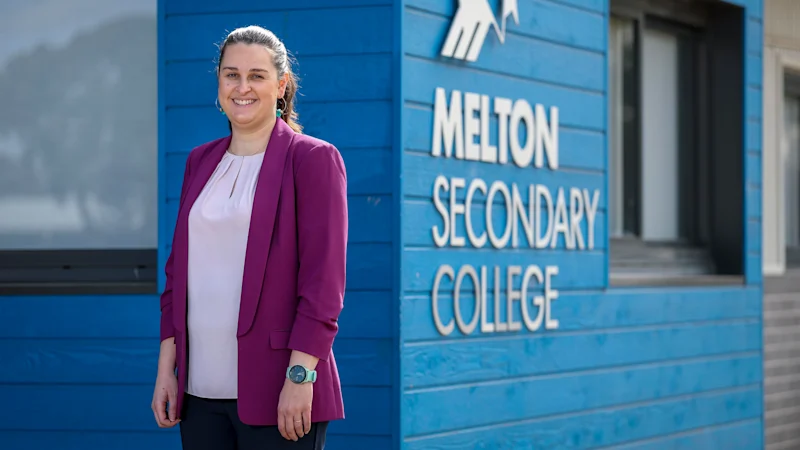
August 24, 2026 — 5:00amNearly half of teachers at a government school in Melbourne’s outer west are working from home one day every fortnight under a unique arrangement intended to give educators more control of time and prevent burnout.This semester, 81 of Melton Secondary College’s 190 staff have taken up the option to use the day to plan lessons, do marking and phone parents from home as part of a school-wide approach not offered at other large Victorian public schools.Melton Secondary College principal Kathryn Sobey found an innovative approach so teachers could regularly work from home. Eddie JimThe move comes after years of mounting workload pressure on Victorian teachers, who, on average, work an additional 12.4 hours unpaid each week, a 2024 survey of Australian Education Union members found.While working from home has become a normal practice for many white-collar workers, the option has been much rarer for teachers, whose schedules are often rigid because of timetables, face-to-face teaching and supervision.Melton Secondary’s principal, Kathryn Sobey, quietly formalised the fortnightly working-from-home arrangements for all staff last year, after considering for several years how to reduce on-campus hours for teachers.“I was looking to find a way to give teachers an opportunity to do some different kinds of thinking without them having to do work on the weekends,” she said.Teachers who have opted for the day have since reported it has allowed them to do deeper thinking, work more efficiently, and balance their own caring responsibilities.Sobey with teachers Raaziya Ahmed and Rob McIlroy, who work from home one day a fortnight.Eddie JimRob McIlroy, a senior school maths teacher, drives 40 minutes to the school each day to arrive by 8am. A day at home gives him time to drive his children to school and pick them up instead of his wife doing so.“What really helps is having that time when you can sit down and do marking or lesson plans, or call parents about various things, and not just have half an eye on the office door for what might disrupt your flow,” McIlroy said.“It means you have a day when you have things to do, but I can control the order in which I do them.”Many schools have faced teacher shortages in specific areas such as maths. McIlroy said the flexibility was one of the main reasons he wanted to continue working at Melton Secondary.“Part of the rationale when it was introduced was to avoid teachers who were burnt out saying, ‘I’m going to call in sick today.’”Under the school’s two-week timetable, teachers must be on campus to instruct all their classes face to face. A student’s schedule is never compromised to accommodate for a teacher working from home.If a full day is not available in the fortnight, the school can offer teachers two half days at home.Last week, Victoria’s state school teachers agreed in principle to a new pay and conditions deal with the state government, staving off a third strike.The agreement halves the number of after-school meetings and reduces face-to-face teaching to 18.5 hours from 20 hours a week. It states flexible work is a matter to be agreed between the employee and their employer and “may include the ability to work remotely”.Sobey welcomes the acknowledgment, but points out principals can already offer flexibility within the current agreement if they can ensure the timetable allows it.“I’ve learnt you can use what we’ve already got to introduce innovation.”Fiona Longmuir, an associate professor in education leadership at Monash University, surveyed 8000 of the Australian Education Union’s Victorian members in a 2024 report that found 65 per cent supported a four-day week.However, the report left the question open about what this could involve – a shorter week for teachers and students was also discussed. Then-premier Jacinta Allan said the government had no plans for a four-day week for teachers.Longmuir said a one-size-fits-all approach was not what she envisaged.“[But] when we had this conversation about the possibilities – whether it’s for teachers, whether it’s for students, whether it’s for some teachers – the response was hell no.”Longmuir said Melton’s approach came closer to what she had in mind.“What is going to fix it is having conversations with staff in local contexts about what’s going to work best for them, for the students in the school, for the communities, and being open to different ways of working,” she said.“That shows teachers that their health and wellbeing, and their experiences of their work, are important.”Since 2024, the Education Department has recorded 948 flexible work arrangements. There are more than 94,000 public school teachers and support staff.“We recognise the importance of flexible work arrangements and family-friendly work practices while keeping student wellbeing and continuity of care at the forefront,” a department spokesperson said.Start the day with a summary of the day’s most important and interesting stories, analysis and insights. Sign up for our Morning Edition newsletter. Jackson Graham is an education reporter at The Age. He was previously an explainer reporter.Connect via email.From our partners
Teachers can rarely work from home, except at this school
Nearly half of teachers at a Melbourne public school are regularly working from home in a bid to prevent burnout.
828 words~4 min read