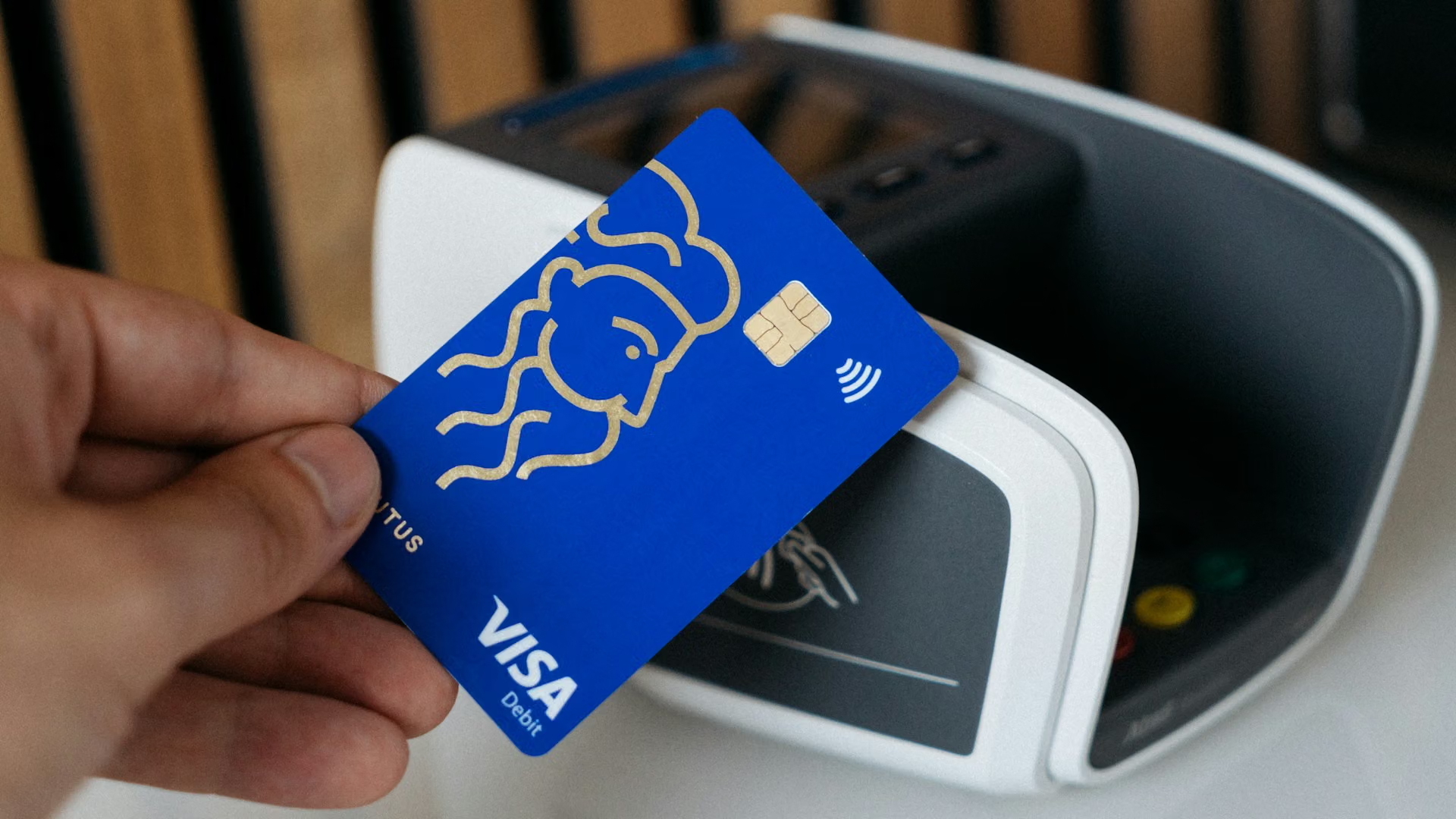
25 min ago4 min readPlutus card being used (CardMapr/Unsplash)SummaryCrypto card spending tripled to $1.04 billion in July, with dollar-backed stablecoins funding 70% of over 10 million transactions.Average payments rose to $86 per transaction from $59, year-over-year, signaling a shift toward frequent, everyday consumer purchases rather than large-scale crypto off-ramps.Emerging markets are driving adoption, with StraitsX reporting a 600% increase in gross transaction value in lower-GDP regions between early 2025 and 2026.Crypto card spending more than tripled over the past year, reaching $1.04 billion in July, driven largely by dollar-backed stablecoins and increasingly ordinary purchases such as groceries, ride-hailing and food delivery.Dollar-backed stablecoins funded 70% of the more than 10 million tracked transactions, according to Paymentscan data, cited by venture capital firm a16z. USDC accounted for 50.8% of July volume and USDT another 20.3%, compared with roughly 48% and 7%, respectively, a year earlier.Monthly volume, meanwhile, rose to $306 million in July 2025, according to the data. And the average payment rose to about $86 per transaction, up from $59 year over year. Data for August is not yet complete.The growth points to an important shift in how consumers use stablecoins. They have become popular as a way to hold digital dollars and move money across borders. “The real measure of crypto’s progress is not simply how many people own digital assets, but how useful those assets become in everyday life,” Thomas Gregory, VP of Payments and Fiat at Binance, told CoinDesk. “Stablecoin-funded cards are one example of how digital assets are becoming more deeply embedded in everyday life, giving users greater flexibility in how they spend, move and access their money.”Crypto cards let users spend stablecoins and other assets through existing payment networks without requiring merchants to accept cryptocurrencies directly. Depending on the product, users deposit funds with the issuer or keep them in a self-custody wallet, and the balance is converted at checkout so the merchant receives it in their local currency.This means stablecoins are not necessarily replacing Visa or Mastercard at checkout. Increasingly, they are becoming another way to fund the cards running over those networks.Visa said in June that it had more than 160 stablecoin-linked card programs live or in development globally. StraitsX, a Visa partner that helps other crypto firms launch cards, said transaction volume on its card infrastructure increased 40-fold between the fourth quarters of 2024 and 2025.However, that data comes with an important caveat. The market the data tracked remains concentrated. RedotPay generated $395.1 million of July volume, followed by EtherFi at $100.3 million and KAST at $89.6 million. Together, the three platforms accounted for about 77% of the tracked total. Paymentscan’s RedotPay figures are self-reported rather than observed onchain.Ether.fi CEO Mike Silagadze confirmed to CoinDesk that the platform’s $100.3 million represents card purchase volume, but excludes roughly $30 million of fiat transfers. Purchase volume was below $10 million in July 2025, two months after the product launched, he said.Most deposits are in USDC or USDT, while fiat transfers account for about 20%.RedotPay told CoinDesk that its customer base increased more than 33% over the past six months to more than 8 million.“Our customers use stablecoins to benefit their daily lives by protecting their savings from inflation while enabling them to purchase everyday goods and services,” a spokesperson said.Dollar-backed stablecoins have also rapidly displaced some earlier alternatives in Paymentscan’s tracked market. The euro-backed EURe stablecoin accounted for as much as 88% of tracked card spending in early 2024 but represented less than 2% in July.From savings to everyday spendingThe clearer evidence of consumers using these cards, beyond simple crypto off-ramps, comes from what users are actually buying. Operator data from Latin America shows where some of that money is going. Oobit said active Brazilian users spend about $400 across 20 transactions per month, while grocery stores accounted for 35% of its reported regional activity. In Argentina, 72% of Oobit payments used USDT, while food represented 41% of transactions, the company said.“Stablecoins are increasingly doing two jobs at once: helping people preserve value, then letting them use that same balance for everyday expenses,” Oobit’s managing director for Brazil and head of Latin America, Eduardo Prota, told CoinDesk.Binance said in an email that the average number of users of its card in Brazil increased 53% between its launch quarter and the second quarter of 2026, while average volume rose 80%. Leading uses included ride-hailing, food delivery, groceries, restaurants and online subscriptions. The card is also available in Argentina.Kraken also reported a similar pattern. The exchange told CoinDesk its ‘Krak Card’ saw weekly payments more than double over the past year to 8.3 per user. Retail and store purchases accounted for 59.3% of spending, while half of transactions were funded using an asset other than the card’s euro or pound denomination.‘Internet’s payment rail’The shift, however, isn’t uniform across the industry.For example, StraitsX saw faster card growth in less wealthy markets. Gross transaction value rose about 600% in lower-GDP markets between March 2025 and February 2026, compared with 150% in higher-GDP markets. Food and retail were its largest spending categories.Meanwhile, a Coinbase spokesperson told CoinDesk that about 16% of combined transaction volume across its credit and debit cards involved USDC.Active ‘Coinbase One’ cardholders at Coinbase spent about $3,000 a month, although that figure covers purchases funded through USDC, other crypto assets and bank transfers. That contrasts with the $20 billion of USDC held across Coinbase products, up 44% over the past year. The figures suggest customers still hold substantially more USDC than they spend through the company’s cards.“Stablecoins are becoming the internet’s payment rail, and this is increasingly reflected across our entire product suite,” Coinbase’s spokesperson said.This discrepancy suggests that stablecoins can dominate cards designed for crypto-native or stablecoin users, even though they are not yet the primary funding source on every major platform.However, the direction of use cases for stablecoins and crypto cards among everyday users is becoming clearer.Card networks and crypto companies are building more ways for stablecoin holders to spend their balances without requiring merchants to change how they accept payments.“What stands out most is how ordinary the spending has become,” StraitsX CEO Tianwei Liu told CoinDesk. “The underlying stablecoin balance is increasingly just another way to fund a familiar card experience.”12345678910Anvil: The Missing Collateral LayerAnvil: The Missing Collateral LayerAnvil is a shared on-chain collateral layer built on a programmable letter of credit: reserve assets as a guarantee -no loan, no interest, keep custody & yield.Jul 29, 2026Anvil is a shared on-chain collateral layer built on a programmable letter of credit: reserve assets as a guarantee -no loan, no interest, keep custody & yield.Why it matters:Anvil is a shared on-chain collateral layer built on a programmable letter of credit: reserve assets as a guarantee -no loan, no interest, keep custody & yield.View Full Report
Crypto card spending tops $1 billion as stablecoins move into everyday purchases
Tracked card volume more than tripled in a year, with USDC and USDT funding over 70% of spending as users increasingly paid for groceries, rides and subscriptions.
1,129 words~5 min read