Browser extensions are arguably the most powerful micro-SaaS channel in software development today. Unlike web apps that sit behind a URL wait step, Chrome extensions embed directly into the user’s primary workspace: the browser. They sit right next to the user's workflows, modify page behaviors in real-time, and run inside the world’s most used software environment—reaching over 3 billion active Chrome installations.
However, building extensions in the post-Manifest V2 world requires a structural mental shift. The migration to Manifest V3 (MV3) introduced ephemeral service workers, strict Content Security Policies (CSP), and tight context boundaries.
Whether you are building your first extension or hardening an enterprise tool, this guide dives into the structural mechanics, asynchronous messaging patterns, and state management techniques required to build zero-crash Chrome extensions.
1. The Anatomy of Manifest V3: Three Separated Environments
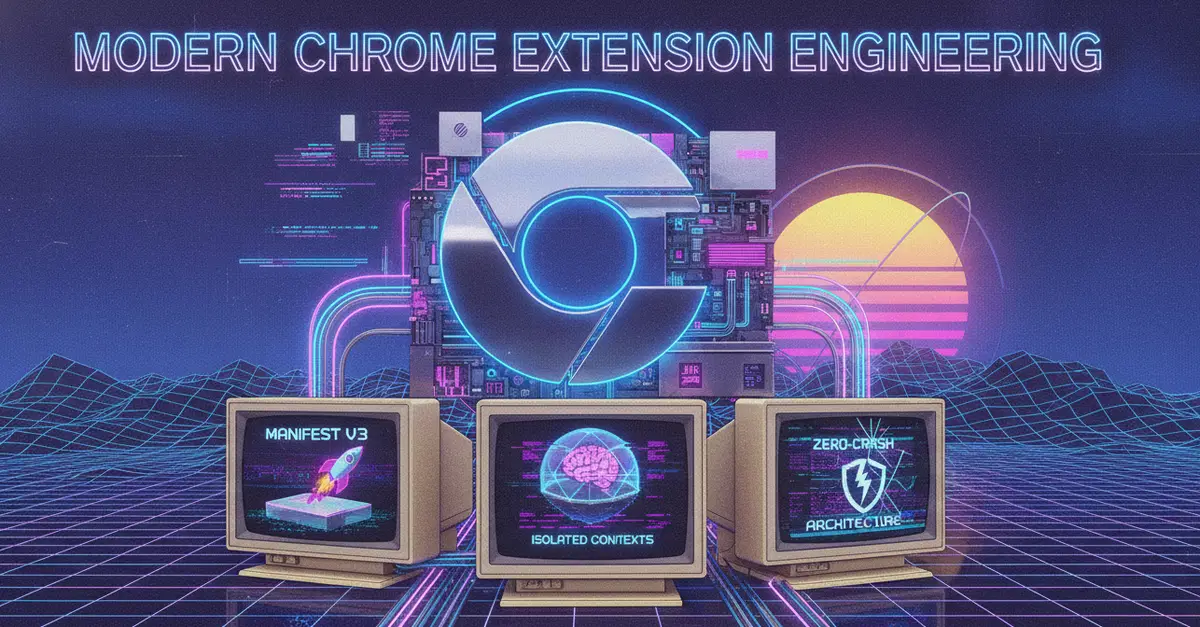
A common point of confusion when engineering extensions is assuming code runs in a single global runtime. A Chrome extension is actually a distributed system operating inside a single browser instance, split across three isolated execution contexts: