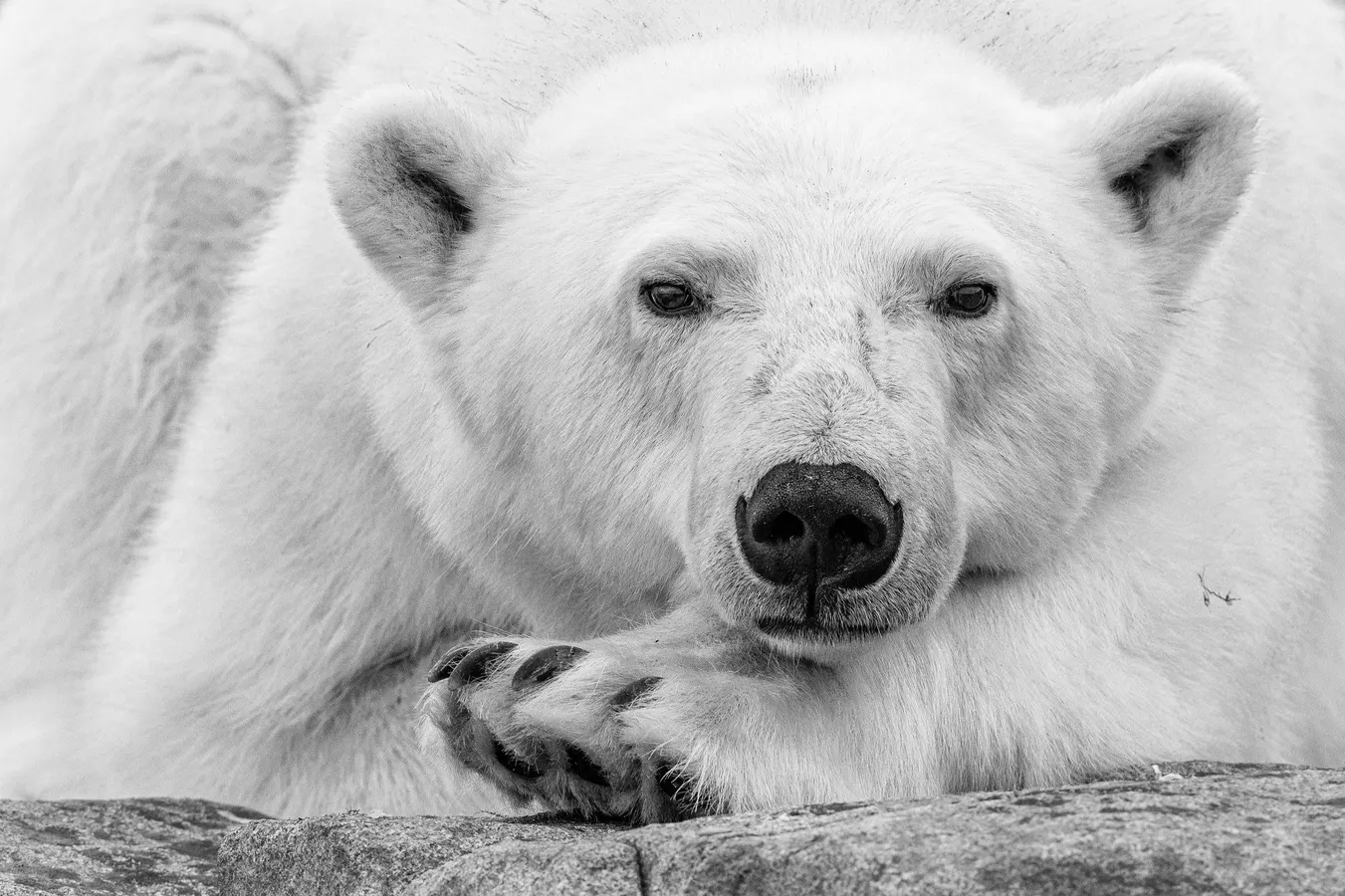
PENSIVE POLAR BEARPIET VAN DEN BEMDIt’s 3 am and I am standing in the Arctic watching a polar bear eating a seal. There is no darkness. At this time of year, Svalbard exists in 24 hours of daylight. Three in the morning looks remarkably like three in the afternoon, and now, through the mist, the “midnight sun” is casting an otherworldly glow across the pack ice.Out on the ice, a mother polar bear is feeding. Beside her are two small cubs, waiting their turn. They tumble around her, edging closer as she tears into the seal, teaching them what to do. It’s an incredible, brutal and extraordinary scene, and one that makes the scale of the Arctic seem suddenly very clear.A POLAR BEAR AND HER CUBS EATING A SEAL.SARAH KINGDOMThe cubs are young, and I wonder if this is their very first taste of meat, especially as they don’t really seem to know what to do. There’s no way of knowing, but the thought makes the encounter even more poignant. Everything here is about survival: ice, seals, bears, birds, currents, light and timing. This is Svalbard at its most compelling, and it’s into this world that Secret Atlas has brought us, aboard the MV Freya, a 12-guest expedition ship designed not simply to visit the Arctic, but to get properly into it.Svalbard And The High ArcticSvalbard sits deep inside the Arctic Circle, roughly halfway between mainland Norway and the North Pole. Its landscape is an improbable combination of mountains, glaciers, fjords, tundra and sea ice. In summer, the sun does not set; instead, it circles the horizon, bathing everything in a silvery, luminous light.There’s something disorienting about Svalbard’s summer light. At 3 am, the sun is still hovering above the horizon, turning the sea ice pink and gold. You lose all sense of time. Midnight looks like dawn, dawn looks like afternoon. The Arctic seems suspended between night and day, and you find yourself staying awake simply because the light is too beautiful to miss.That light changes everything. It means wildlife encounters can happen at virtually any hour, and a day of exploration has no obvious beginning or end. Secret Atlas’s 10-day Svalbard circumnavigation is built around this flexibility, taking travelers into the more remote corners of the archipelago, rather than simply following a conventional cruise itinerary. The emphasis is on exploration: finding wildlife, navigating sea ice, stepping ashore in places few people ever visit and responding to whatever conditions the Arctic presents. The Journey: Life Aboard FreyaFREYA IN THE ICE, VIEWED FROM ABOVEPIET VAN DEN BEMDVIEWS OF THE GLACIER FROM FREYAPIET VAN DEN BEMDThere is something wonderfully old-fashioned about Freya. She’s not a floating resort that’s masquerading as an expedition ship. Originally built for lighthouse work, she’s been transformed into a compact Arctic vessel with an ice-class hull, comfortable cabins, multiple observation areas and the character of a working ship. She carries just 12 guests, and that’s something that changes the entire experience.THE BRIDGE IS THE HEART OF THE SHIPPIET VAN DEN BEMDOn a large cruise ship, a wildlife sighting can become a logistical exercise. Hundreds of people have to be informed, moved and positioned. On Freya, the bridge becomes the nerve center of the small expedition team. Guests can spend time there watching the crew navigate, looking for wildlife and understanding how decisions are made.There’s a definite informality to life aboard. Meals are communal occasions. What began as awkward small talk with strangers quickly becomes conversations with like-minded people. Someone at the bridge has seen a whale, someone else has spotted an Arctic fox, the captain has changed course.OUT ON THE ZODIACSARAH KINGDOMTWO ZODIACS, TWO GUIDES, TWELVE GUESTS, THE PERFECT COMBINATIONPIET VAN DEN BEMDThen comes that familiar Arctic ritual: layers on, cameras ready, life jacket secured, onto the deck or down to the Zodiac. The two Zodiacs are crucial to the experience. Twelve guests and two guides means small groups, which means everyone gets a better view, and the expedition team can approach landscapes and wildlife quietly and responsibly.OUT ON THE ICEGIANCARLO GALLINOROTHE AUTHOR WATCHING A WALRUS HAUL OUTSARAH KINGDOMLearning From Dr Geir Wing GabrielsenOne of the highlights of our journey was spending time with Dr Geir Wing Gabrielsen, a Norwegian polar scientist whose work has focused, for more than 35 years, on the Arctic environment and the impact of pollutants on its wildlife.DR GEIR WING GABRIELSENSECRET ATLASWith Dr Gabrielsen, the landscape became a classroom. Rather than simply looking at Svalbard as a spectacular wilderness, we began to examine what was happening beneath the surface, and what was being washed up on its shores. During our journey, we collected plastic and other marine debris from remote beaches, sorting through what the ocean had delivered and considering where it might have come from. It was sobering work.A piece of fishing rope can look insignificant until you consider what it can do to a seal or seabird. A fragment of plastic can seem harmless until you understand that birds may mistake it for food, filling their stomachs with material that provides no nutrition and can cause injury, blockages or starvation.Dr Gabrielsen brought scientific perspective to these discoveries, connecting what we found on the beaches with the much bigger changes taking place in the Arctic. Picking up waste washed up on the shore and carrying it back to Freya made you realize that even here, in one of the remotest places on Earth, there is nowhere beyond the reach of human activity. It also changed the way we looked at the wildlife.The WildlifeA WALRUS WITH HIS LONG TUSKS AND TWITCHING WHISKERSPIET VAN DEN BEMDAN INCREDIBLE WALRUS HAUL OUTPIET VAN DEN BEMDA walrus hauled out on a beach is astonishingly large, its whiskers twitching as it breathes, its long tusks catching the light and its enormous body seeming almost comically out of proportion with the stark landscape around it. Then there are Arctic foxes, reindeer and beluga whales, each perfectly adapted to a world that can appear almost impossibly hostile to life.ARCTIC FOXGIANCARLO GALLINOROA BEARDED SEAL ON THE ICEGIANCARLO GALLINOROBut the polar bear is different. Seeing one on land is remarkable, seeing one on sea ice is something else entirely. Polar bears are intimately connected to the frozen ocean. Their lives depend heavily on seals, and the pack ice provides the platform from which they hunt. A successful seal kill can be a critical part of a bear’s annual survival strategy, and that made the mother and her cubs at 3 a.m. more than a spectacular wildlife encounter, it was a glimpse right into the Arctic food chain.As the cubs played beside their mother on the pack ice, their small bodies were almost camouflaged in the whiteness around them. There was something almost tender about watching them, despite the graphic sight of blood, smeared crimson across the snow. But beneath it all was the uncomfortable truth, that the Arctic is changing rapidly.A POLAR BEARPIET VAN DEN BEMDThe BirdsAt places such as the massive sea cliffs of Alkefjellet, 60 million year old basalt cliffs become crowded with birds, the air filled with calls and the constant movement of wings. Their abundance can initially make the Arctic seem limitless. But seabirds are also among the clearest reminders that this ecosystem is vulnerable. Plastic pollution is a particularly disturbing threat.IVORY GULLS ON AN ICEBERGGIANCARLO GALLINOROBrünnich's guillemot, also known as the thick-billed murrePIET VAN DEN BEMDSeabirds can mistake floating plastic fragments for food. Once swallowed, plastic can cause physical injury, blockages, reduced feeding and poor nutritional condition. Sharp pieces can damage internal organs, while stomachs filled with plastic can leave birds feeling full without providing any nourishment.Fishing line, rope and abandoned nets create another danger. Birds can become entangled and injured or drown. Marine mammals face similar risks, with discarded fishing gear capable of trapping seals and other animals.Plastic Waste, Global Warming, And Leaving Nothing BehindSecret Atlas incorporates beach clean-ups into its Svalbard expeditions, allowing guests and crew to collect marine debris from remote shorelines. On our own expedition, the work with Dr Gabrielsen made the issue of plastic pollution impossible to ignore. We walked beaches that appeared untouched at first glance, only to discover fishing nets tangled in rocks, ropes entwined in seaweed, plastic containers weathered by salt, ice and time.BEACH CLEAN UPSECRET ATLASFor wildlife, this is not simply ugly. Fishing gear can entangle seals and other marine mammals, causing wounds, restricting movement or even drowning. Birds can become trapped or ingest fragments. Even terrestrial animals are not immune; plastic can enter the food chain, and has been found in the stomachs of Arctic wildlife. And plastic is only part of the bigger story.A DEAD ALBATROS WITH A STOMACH FILLED WITH PLASTICChris Jordan Wikimedia CommonsThe most profound environmental change is happening invisibly. Climate change is altering the very structure of the Arctic, and that is why responsible tourism here means more than simply admiring the scenery. The best expedition is not simply the one that gets you closest to a polar bear, it’s the one that leaves you understanding why the polar bear needs the ice in the first place.The Luxury Of TimeThere is a particular kind of luxury in travelling on Freya. Not luxury in the traditional sense, although Freya is certainly comfortable. The real luxury is time, the kind of time that travelling on a boat with only a dozen or so people affords. Time to wait for the fog to lift. Time to watch a walrus colony without rushing. Time to stand silently on deck while a whale surfaces. Time, at 3 am, to watch a mother polar bear feed her two cubs beneath a sun that refuses to set. HARBOUR SEALGIANCARLO GALLINOROFor ten days, Svalbard was not a statistic or a headline about melting ice. It was a place we travelled through, walked across, and sailed around. The Arctic does not need us to romanticize it, it needs us to pay attention, and that perhaps, is the greatest argument for travelling here with Secret Atlas; not simply to see the High Arctic before it changes, but to understand what is at stake, and to return home carrying more than photographs.A trip with Secret Atlas can be booked direct, or through Arctos Travel, who can help you find the right ship and right destination.
10 Days At The Edge Of The Earth
CIRCUMNAVIGATING SVALBARD ON A MICRO EXPEDITION CRUISE WITH SECRET ATLAS
1,712 words~8 min read