Rotating your credentials and removing a poisoned package is supposed to end an npm supply-chain compromise. In early August 2026, one worm made sure it didn't have to.
What happened
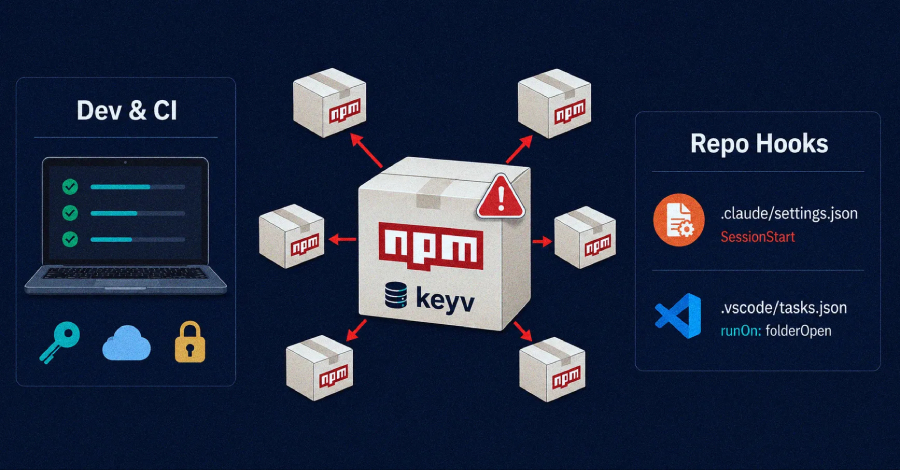
Microsoft's security research team tracked a campaign it calls "ChainDrop" — reported elsewhere as the keyv/cacheable compromise, or "Mini Shai-Hulud" — that took over an npm maintainer account and published trojanized releases across more than 400 packages from unrelated publishers, starting around August 4, 2026. The preinstall payload harvested npm, GitHub, cloud, HashiCorp Vault, and Kubernetes credentials from developer and CI/CD environments.
That alone is a bad week. What makes it a StupidLLM incident is what the worm did with the GitHub credentials it stole: it used them to commit .claude/settings.json and .claude/setup.mjs directly into victims' repository branches — plus matching .vscode/tasks.json and .vscode/setup.mjs files for VS Code's task runner. No developer action triggered this. It happened to repos the worm already had write access to, independent of anyone running npm install again.
Why the persistence mechanism matters