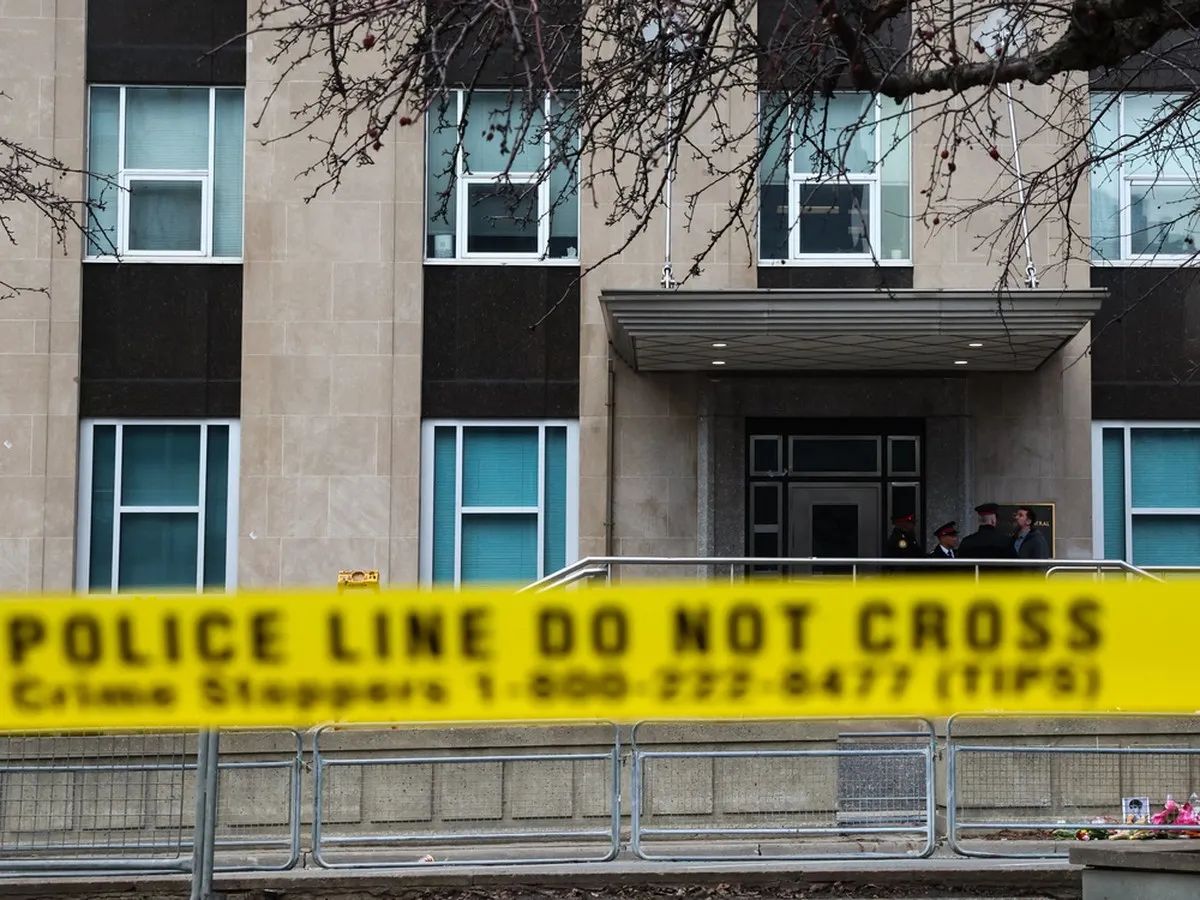
Skip to Content Subscribe My Account Manage My Subscriptions FAQ Newsletters Canada Canadian True Crime Canadian Politics Health World Israel & Middle East Financial Post NP Comment Longreads Puzzmo Diversions Comics NP News Quiz New York Times Crossword Horoscopes Life Eating & Drinking Style Sponsored Play for Ontario Travel Travel Canada Travel USA Travel International Cruises Travel Essentials Culture Books Celebrity Movies Music Theatre Television Business Essentials Advice Lives Told Tails Told Shopping Buy Canadian Home Living Outdoor Living Kitchen & Dining Tech Style & Beauty Personal Care Entertainment & Hobbies Gift Guide Travel Guide Amazon Prime Day Deals Savings National Post Store More Sports Hockey Baseball Basketball Football Soccer Golf Tennis Driving Vehicle Research Reviews News Gear Guide Obituaries Place an Obituary Place an In Memoriam Classifieds Place an Ad Celebrations Working Business Ads Archives Healthing Epaper Manage Print Subscription Profile Settings My Subscriptions My Offers Newsletters Customer Service FAQ Newsletters Canada World Financial Post NP Comment Longreads Puzzmo Diversions Life Shopping Epaper Manage Print Subscription HomeNP CommentGary Mar: Governments need a co-ordinated response to hate and violent extremismIn a healthy democracy, public confidence comes from the actions of governmentsLast updated 11 minutes ago Toronto Police officers work around the scene of a shooting at the U.S. Consulate in Toronto on March 10, 2026. Police reported another incident of gunfire outside the University Avenue building on Monday, July 27. Photo by COLE BURSTON/AFP via Getty ImagesCanada is confronting a level of organized hate, extremism and violent attacks that is testing the strength of our institutions and our ability to uphold the rule of law.Enjoy the latest local, national and international news.Exclusive articles by Conrad Black, Barbara Kay and others. Plus, special edition NP Platformed and First Reading newsletters and virtual events.Unlimited online access to National Post.National Post ePaper, an electronic replica of the print edition to view on any device, share and comment on.Daily puzzles including the New York Times Crossword.Support local journalism.Enjoy the latest local, national and international news.Exclusive articles by Conrad Black, Barbara Kay and others. Plus, special edition NP Platformed and First Reading newsletters and virtual events.Unlimited online access to National Post.National Post ePaper, an electronic replica of the print edition to view on any device, share and comment on.Daily puzzles including the New York Times Crossword.Support local journalism.Create an account or sign in to continue with your reading experience.Access articles from across Canada with one account.Share your thoughts and join the conversation in the comments.Enjoy additional articles per month.Get email updates from your favourite authors.Create an account or sign in to continue with your reading experience.Access articles from across Canada with one accountShare your thoughts and join the conversation in the commentsEnjoy additional articles per monthGet email updates from your favourite authorsSign In or Create an AccountorTwice this year, the U.S. Consulate in Toronto has come under gunfire. In between those attacks, synagogues, Jewish schools, neighbourhoods and even cemeteries were targeted. A recent federal government report found that 95.7 per cent of Jewish students on Canadian campuses experienced or witnessed antisemitism over the past year.Toronto police Chief Myron Demkiw has described a guns-for-hire economy, in which young people are recruited through encrypted apps, paid as little as $600 to $1,000 to carry out attacks and asked to film the acts as proof of completion. These are organized networks exploiting weaknesses that cut across federal, provincial and municipal responsibilities.The National Post newsletter that doesn’t hold back, giving readers the unvarnished truth on media, politics and culture.By signing up, you consent to receive the above newsletter from Postmedia Network Inc.A welcome email is on its way. If you don't see it, please check your junk folder.The next issue of Right? will soon be in your inbox.We encountered an issue signing you up. Please try againSimilar situations have arisen elsewhere in Canada, such as extortion related shootings in British Columbia targeting South Asian businesses and personal residences. The Bishnoi gang, designated a terrorist entity by Canada in 2025, has publicly claimed it has more than 1,000 members operating in Canada to intimidate citizens and the police. Police say these organized criminals are a mix of foreign nationals and Canadian citizens and are not one group or individual but multiple groups threatening public safety.The Canada Border Services Agency (CBSA) has approximately 550 investigators responsible for roughly 33,000 outstanding deportation warrants. Organized crime has taken notice. To be clear, none of the individuals charged in the Toronto consulate or synagogue shootings are known to be immigration cases. But if organized criminal groups believe Canada’s enforcement capacity is overstretched, and that our laws on hate, extremism and violent attacks are too weak, it is reasonable to ask whether those same vulnerabilities can be exploited by extremist actors.The federal government’s response, Bill C-9, created new offences for intimidation at places of worship and schools. The Canada Community Security Program (CCSP) received an additional $75 million over five years, and the Ministerial Advisory Council on Rights, Equality and Inclusion was established in June. Although these are positive steps, they are not a strategy.Months after police described antisemitism as systemic, and after repeated attacks on a foreign mission and the death of Toronto Police Service Constable Marc Pinizzotto, the Council’s first responsibility is to reassess the problem. Canadians should expect governments not only to reassess threats but to act decisively to reduce them.This requires co-ordinated action across jurisdictions.Federally, Ottawa should establish a national hate/extremism crime reporting system that follows cases from complaint to disposition. This would allow governments and the public to measure enforcement outcomes rather than just incident counts. The federal government should also strengthen oversight of charitable organizations with confirmed links to extremist activity and ensure digital platforms face meaningful consequences when they consistently facilitate organized hate and incitement. On top of that, a systematic overhaul of the Criminal Code and bail system is urgently needed.Provincial governments have an equally important role. They should lead by strengthening Holocaust education and broader anti-racism/anti-hate instruction within K–12 curricula and require post-secondary institutions to enforce clear campus safety standards that distinguish lawful protest from intimidation and harassment. Hate speech is not free speech.According to B’nai Brith Canada, across the country, a record 6,800 antisemitic incidents were recorded in 2025 alone, including assault, arson, vandalism, gunfire and more. Jewish schools, businesses, places of worship and entire neighbourhoods have been targeted, leaving many Jews to feel unsafe in their own homes and communities. So far in 2026, violent antisemitic incidents have more than doubled, with 27 recorded incidents compared with 10 in all of 2025.Alberta’s own experience demonstrates why this matters. Following October 7, Calgary and Edmonton saw significant increases in antisemitic incidents. In 2025, the provincial government allocated $200,000 to the Jewish Federations of Edmonton and Calgary to fund educational programs, security and engagement with law enforcement across the province. Incidents in Alberta decreased from 916 in 2024 to 677 in 2025, and more work needs to be done. This is not simply a challenge facing Toronto or Montreal.Municipally, governments should have the flexibility to establish narrowly tailored security perimeters around synagogues, schools, community centres and businesses that face credible threats. They should also have faster access to federal security infrastructure funding so that vulnerable institutions are not left carrying the financial burden of protecting themselves. Less siloed and more responsive and proactive municipal policing is also needed.In a healthy democracy, public confidence should come from the actions of governments, not from citizens who feel compelled to fill a leadership vacuum.History shows that democracies rarely weaken because of a single incident. They weaken when repeated attacks on targeted citizens, public institutions, diplomatic missions and religious communities are treated as disconnected events instead of symptoms of a broader problem.Canada has ample evidence that organized hate and extremism are becoming more sophisticated and more co-ordinated. The question is no longer whether the challenge exists or if a reassessment is needed. It is whether governments at every level are prepared to respond with the degree of urgency, coordination and resolve needed. This will be the real test of Canada’s democratic resilience.National PostGary Mar is president and CEO of the Canada West Foundation. Join the Conversation This website uses cookies to personalize your content (including ads), and allows us to analyze our traffic. Read more about cookies here. By continuing to use our site, you agree to our Terms of Use and Privacy Policy.
Gary Mar: Governments need a co-ordinated response to hate and violent extremism
In a healthy democracy, public confidence comes from the actions of governments
1,394 words~6 min read