Korea’s plan to expand semiconductor, physical AI and data-center industries is colliding with rising electricity demand. A government assessment says peak power demand could reach 158.4 to 165 gigawatts in 2040, about 27 gigawatts above a forecast made four months earlier. The editorial argues that Korea needs a stronger mix of generation, storage and transmission, with nuclear power and renewables both playing roles. It says power infrastructure must be built ahead of demand, not after shortages begin.
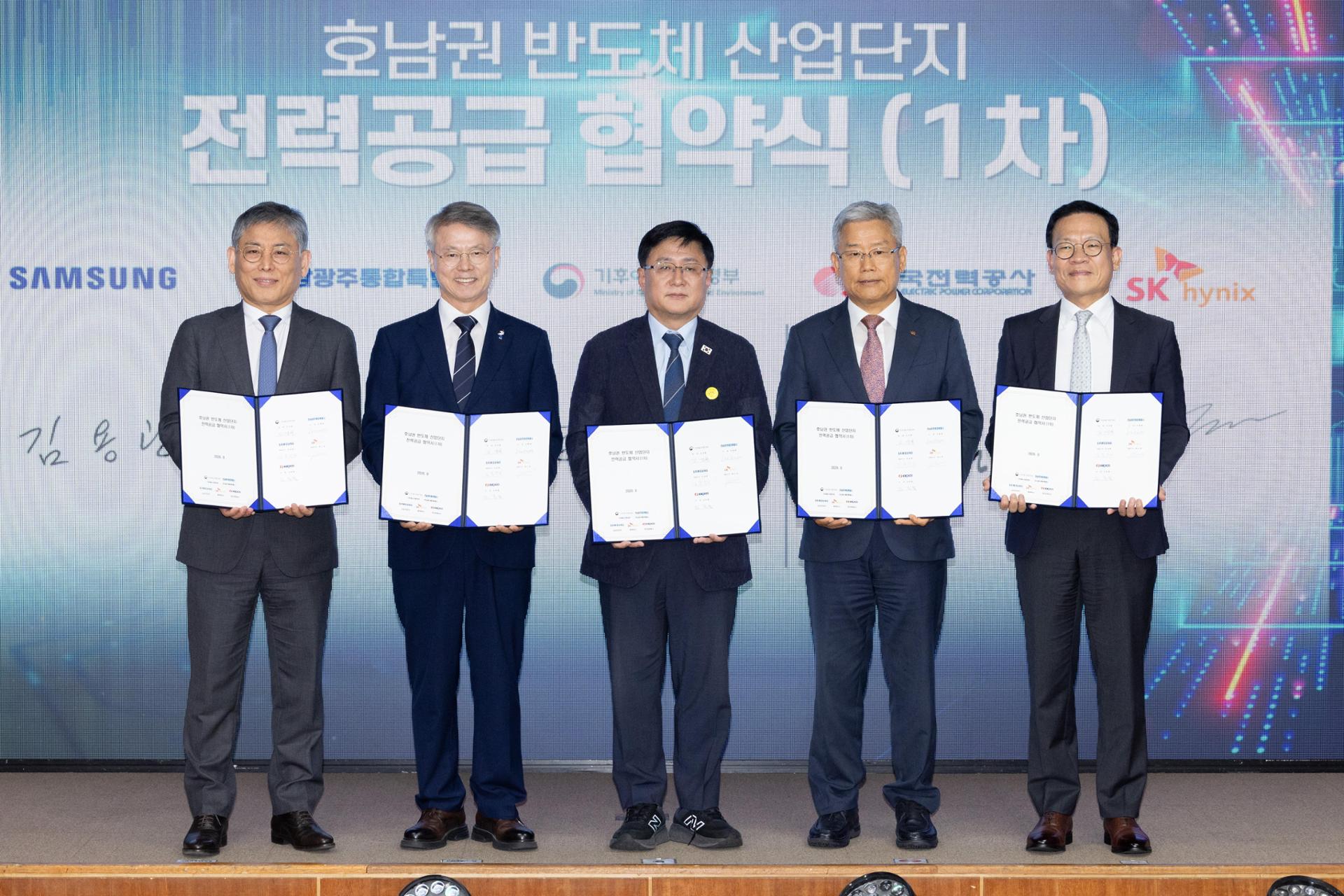
From left, Kim Yong-kwan, president of management strategy at Samsung Electronics' device solutions division, Gwangju Mayor Min Hyung-bae, Climate Minister Kim Sung-whan, KEPCO CEO Kim Dong-cheol and Yeom Seong-jin, president of SK hynix's communications division, pose after signing a power supply deal for the planned Yongin and Honam (Jeolla) chip clusters at KEPCO's office in Seoul, Wednesday. Courtesy of Ministry of Climate, Energy and Environment
Korea’s ambition to build a new generation of semiconductor, physical artificial intelligence (AI) and data-center industries is running into a basic but formidable constraint: electricity.
A government assessment incorporating demand from its three “mega-projects” estimates that peak power demand could reach 158.4 to 165 gigawatts (GW) in 2040. That is roughly 27 GW higher than the projection made just four months earlier — equivalent to the capacity of about 19 large 1.4-GW nuclear reactors.