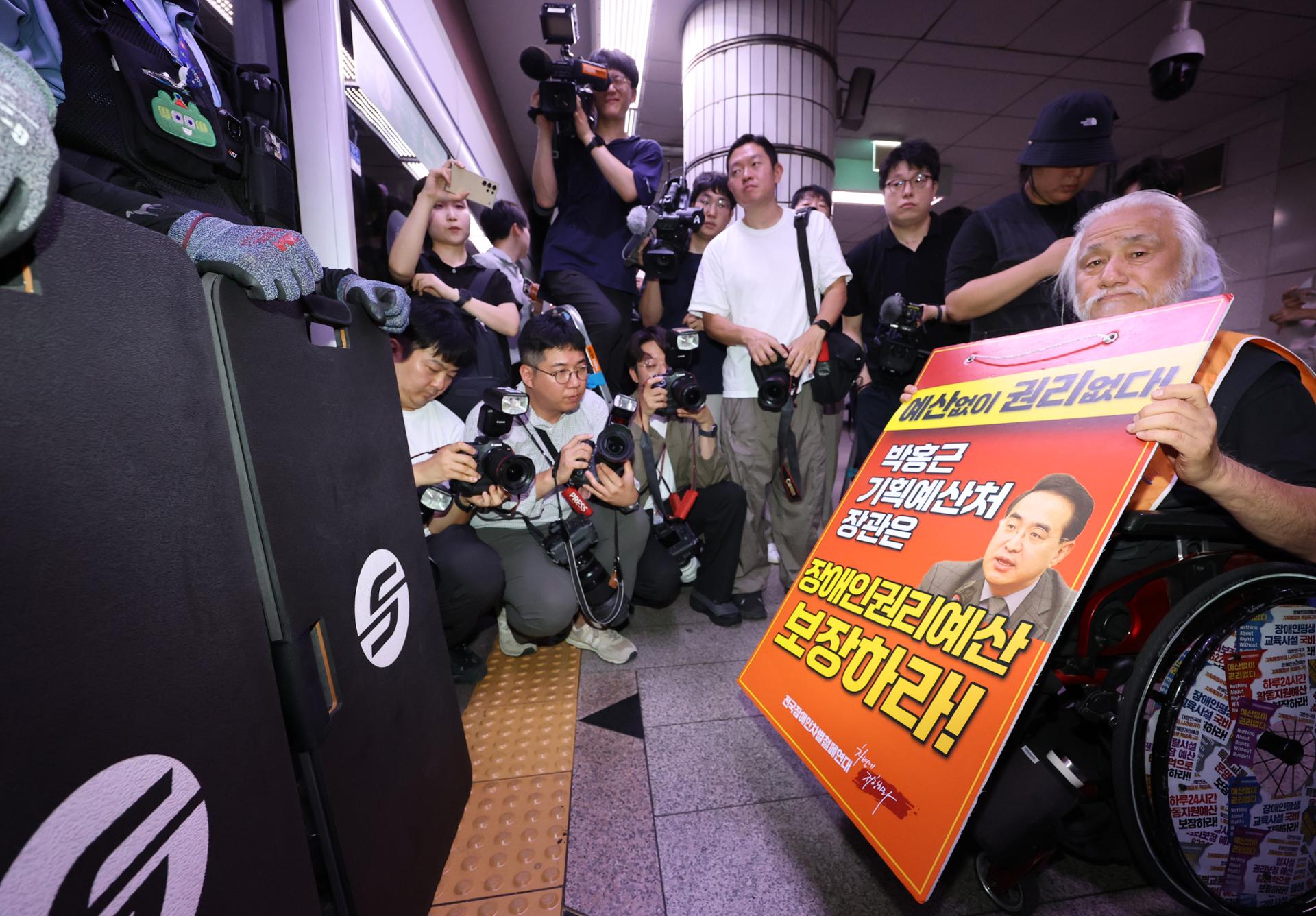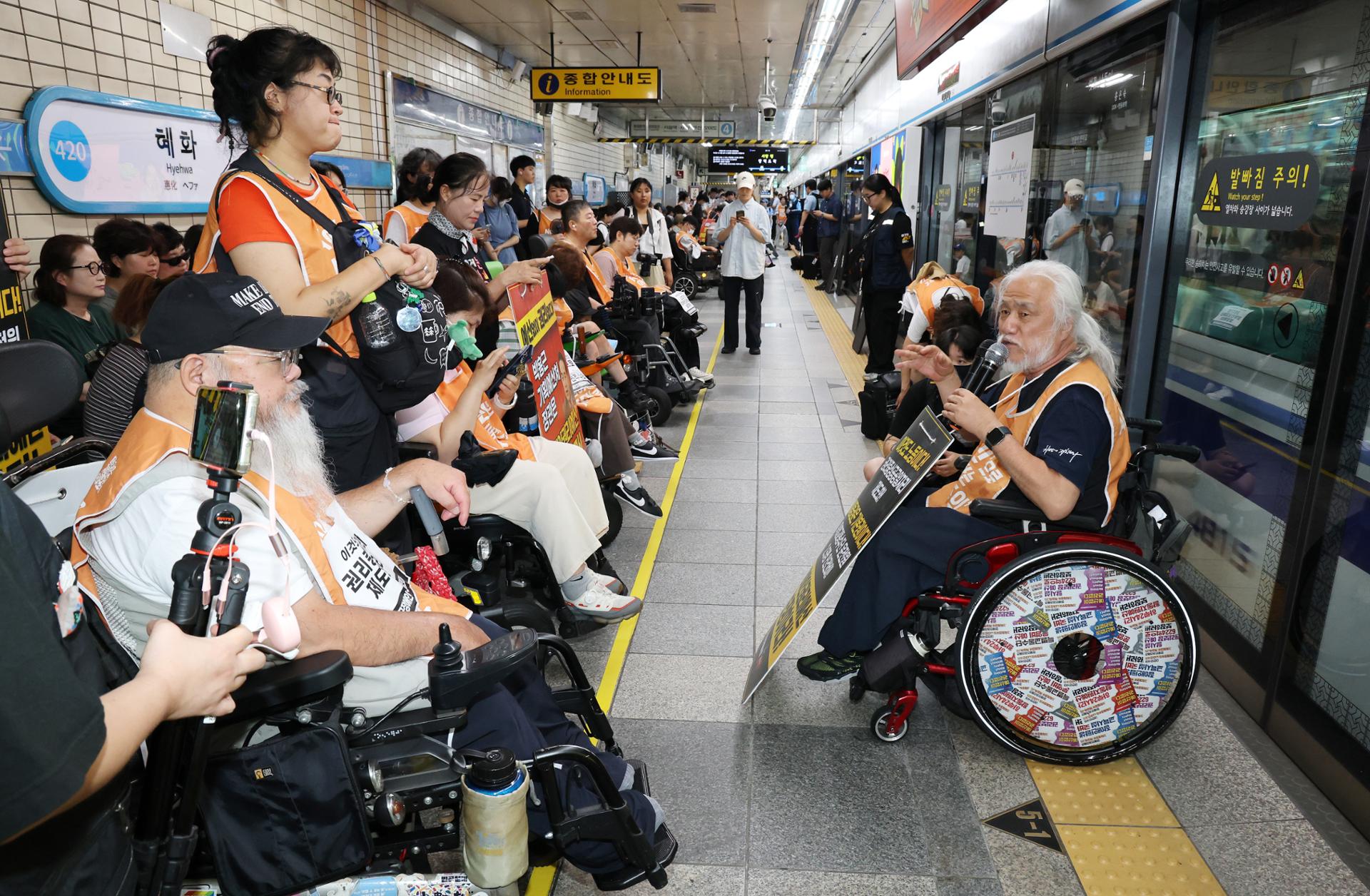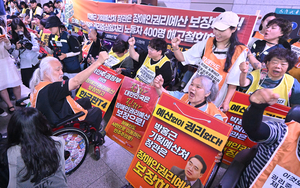
In this unrelated photo, Solidarity Against Disability Discrimination activists stage a demonstration on July 2, calling for better mobility rights at Seoul Metro Line 1's City Hall Station in Jung-gu, Seoul. (Im Se-jun/ The Korea Herald) An appellate court has acquitted a disability rights activist who pushed and injured a police officer during a demonstration, ruling that the activist acted in lawful self-defense because the police dispersal order was unlawful, according to legal circles Sunday.The activist, affiliated with disability rights group Solidarity Against Disability Discrimination, had been charged with injuring a police officer while resisting their attempt to remove a disabled protester from a roadway during a rally in November 2023.A lower court had found the activist guilty and imposed a fine of 4 million won ($2,900).The Seoul Central District Court’s appellate division, however, overturned the conviction, finding that the police had failed to follow proper procedures in ordering the protesters to disperse and that the defendant’s actions therefore constituted lawful self-defense.The defendant, a social welfare worker, was assisting another activist with severe disabilities when the two participated in an annual rally organized by the Korean Confederation of Trade Unions calling for improved workers’ rights.During the rally, the disabled activist was moving in a wheelchair along Taepyeong-ro in Jung-gu, central Seoul, when police ordered demonstrators to disperse.The activist got out of the wheelchair and lay on the road in protest of the dispersal order. When police officers attempted to lift the activist from the roadway, the defendant helped the activist resist, making physical contact with officers and causing injuries.The lower court had ruled that the police action was legitimate, finding that SADD members had occupied part of the road beyond the area covered by the group’s advance rally notification.It also found that the defendant bore criminal responsibility for the injuries.Although the defendant had not actively sought to injure the officers, the lower court found that the activist had acted recklessly despite knowing the resistance could result in injuries.“Even if social movements seek to protect human rights, they must respect law and order and take place within its boundaries,” the lower court said.The appellate court rejected that reasoning, finding it difficult to conclude that the dispersal order had been lawfully issued.It noted that police records cited an “unreported demonstration” as the grounds for ordering the protesters to disperse, even though a rally notification had been filed in advance.The court also found fault with the police decision to treat SADD demonstrators and members of other groups participating in the broader rally as a single group.It acknowledged that the SADD march may have been delayed because other demonstrators were occupying the roadway, but found that police nonetheless issued a blanket dispersal order covering the various groups without sufficiently distinguishing between them.Prosecutors argued that the separate demonstrations had effectively merged.The appellate court said that even if they had, police still failed to follow the required procedure because they issued only two dispersal orders before attempting to forcibly remove the protesters.Under the law governing assemblies and demonstrations, police may forcibly disperse protesters only after ordering them to disperse at least three times and they fail to comply.“Whichever way it is viewed, it is difficult to find that police informed the two activists of specific and legitimate grounds for dispersal, or that the order was issued in accordance with due process and for justifiable reasons,” the appellate court said.“It is also difficult to conclude that the demonstration participants posed a direct threat to public order or the lawful rights of others,” it added.The court therefore ruled that the defendant’s resistance to the police action fell within the bounds of lawful self-defense and acquitted the activist.
Disability rights activist acquitted after court finds police dispersal order unlawful
An appellate court has acquitted a disability rights activist who pushed and injured a police officer during a demonstration, ruling that the activist acted in
610 words~3 min read