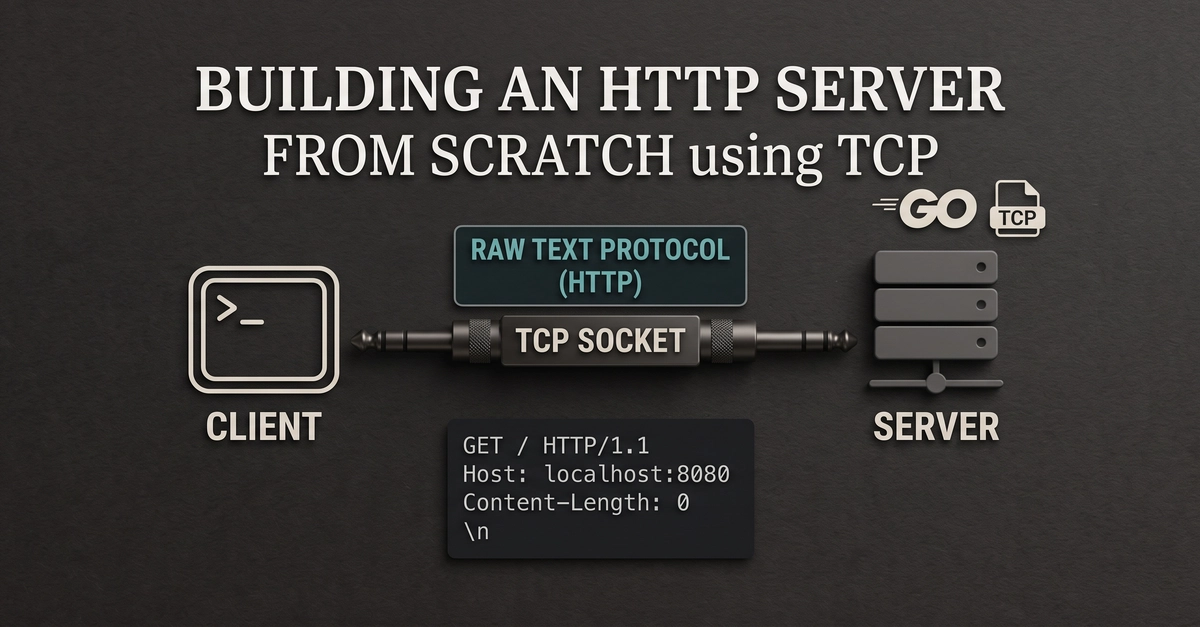
HTTP is something I interact with every single day, whether I am fetching data on the frontend or building backend APIs. But for a long time, if you had asked me how it actually worked under the hood, I wouldn't have had a good answer. I always treated HTTP like this intimidating, hyper-complex black box that would be miserable to understand, let alone rebuild from scratch. Once I actually dug into the internals, though, I realized the core mechanics are surprisingly straightforward.
I am using Go for this project, but the concepts are entirely language-agnostic. You can follow along in C, Rust, Python, Node, or whatever language you like; as long as it can open a network socket (sorry, HTML and CSS won't cut it here).
To understand HTTP, we first have to talk about TCP/IP, because HTTP is just a text-protocol riding on top of TCP/IP stack.
The Internet Protocol (IP) has one basic job: move raw data from Machine A to Machine B across the world. But it doesn't dump a massive file across the wire all at once. If you download a 10 GB file, IP chops that data into tiny pieces called packets, usually around 1,500 bytes each. It does this because network hardware has physical transmission limits, routers need to share bandwidth fairly among thousands of users, and resending one dropped 1.5 KB packet over flaky Wi-Fi is painless compared to re-downloading an entire 10 GB stream.