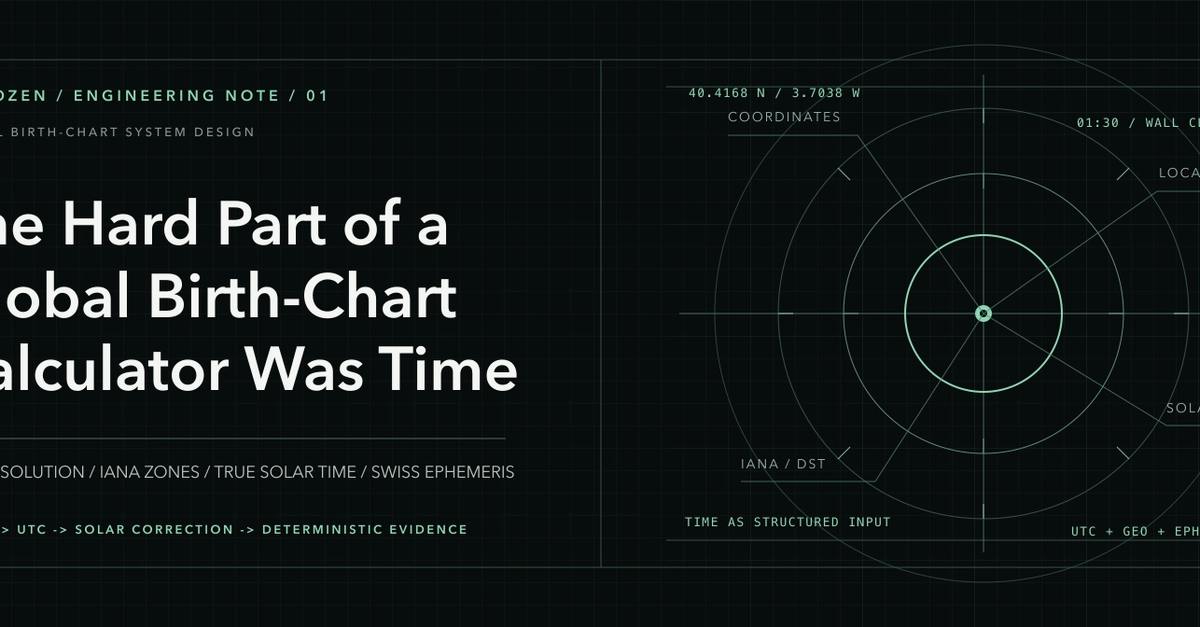
I built a calculator for BaZi — Chinese "Four Pillars" birth charts. Whatever you think of the interpretive tradition (and I'll get to that), the input math turned out to be a genuinely deep time-zone problem, and that's what this post is about. If you've ever thought "time zones, how hard can it be" — this is a tour of exactly how hard, with working TypeScript.
The problem
BaZi divides the day into twelve two-hour "branches", so your birth hour is one of the chart's four pillars. Get the hour wrong and you get a different chart — not slightly different, categorically different.
Every calculator I could find feeds the system the wall-clock time from your birth certificate. But the tradition predates time zones by about two thousand years; it obviously means solar time — where the sun actually was over your birthplace. Clock time and solar time differ by more than most people think, and the difference decomposes into exactly three parts:
1. Daylight saving time — and it's historical. You need the DST rules in force on the birth date, not today's. China ran a now-forgotten DST experiment from 1986–91; Harbin kept its own zone before 1949. If you were born in Beijing in July 1988, your certificate is an hour ahead of standard time and no modern-day lookup will tell you that.