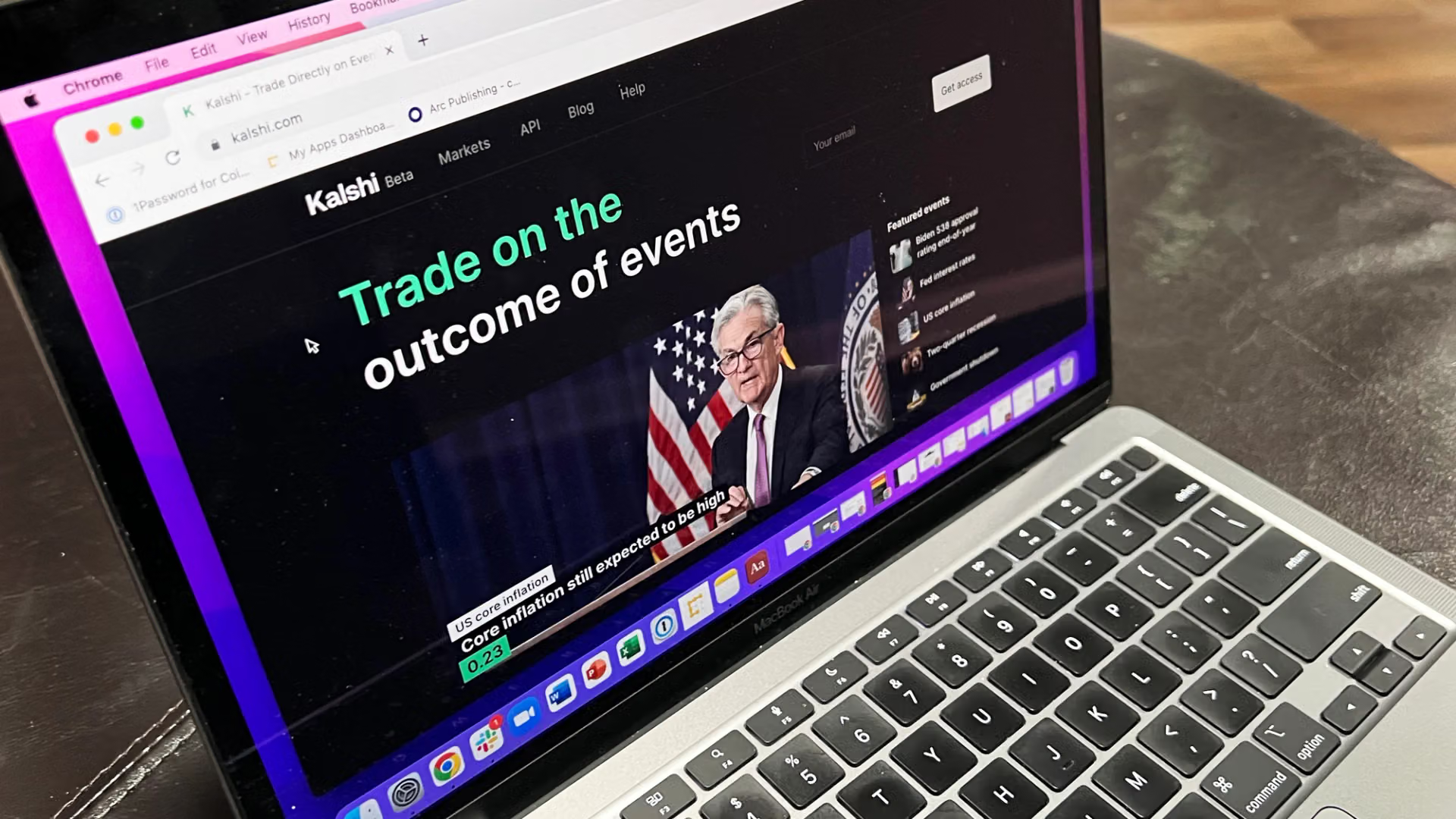
21 min ago4 min readWashington state customers have joined the ranks of those currently unable to use Kalshi. (Jesse Hamilton/CoinDesk)SummaryA busy week for prediction markets saw Kalshi forced to cut off its Washington state customers while making a larger case for the industry alongside other firms at a government-hosted event in Washington. The Commodity Futures Trading Commission, which has emerged as the industry’s most loyal ally, held a sometimes-contentious innovation meeting at which the rise of prediction markets was among the main topics. And ongoing legal clashes between the industry and state regulators saw some court action in matters involving Connecticut and New York. Kalshi customers in Washington state, Michigan and Nevada are currently out of luck, blocked from the prediction market platform as the industry's destiny is worked out in courts and on the federal regulatory stage.A legal dustup in Washington state is the latest development of many state-level fights, but the industry is getting a robust defense from its federal regulator, the Commodity Futures Trading Commission, which is also simultaneously hatching a number of rule proposals to formally govern prediction markets in the U.S.In Washington, a statewide ban of Kalshi emerged from a local court last week in a dispute in which authorities accused the company of operating an illegal gambling business there. So Kalshi sent an email to customers this week, beginning: "The Washington state government has blocked your right to trade freely on Kalshi."Washington's take: “Kalshi has gotten rich promoting wagers on sports, elections, natural disasters, events related to the Iran War, and more. Under this order, Kalshi is banned from offering wagers on most of those topics in Washington,” according to state Attorney General Nick Brown.But Kalshi is pursuing a new legal argument in the state, with the Thursday filing of a motion asking the court to reconsider its position in light of state authorities letting Crypto.com operate in the state under the same terms that were outlawed for Kalshi. "The state has formally agreed not to attempt timely enforcement of Washington law in an identical context," Kalshi said in its latest motion, which argued that six days after the court ordered Kalshi's halt, the state said it wouldn't enforce the law against Crypto.com until appeals are resolved in a higher court. "The very event contracts that the state deemed intolerable from Kalshi are now freely available for Washington residents — with the blessing of the state — from Kalshi’s identically situated competitor."While Washington's dispute continues, so do legal clashes in many other states, including Massachusetts, Minnesota, Ohio, Maryland, Utah, Arizona and New York. In some of those states, the industry could face consequential restrictions or punishments, most often targeting sports betting. Connecticut regulators have gone back and forth with Kalshi in federal court this week as the state tries to apply its gambling laws to the business, and New York was also further disputing the CFTC's recent emergency action to keep Kalshi activity going there.But the industry's bright side comes from CFTC Chairman Mike Selig, who has made it a priority of his tenure to defend what he argues is his agency's sole authority over prediction markets, and also to write a series of formal rules to institute U.S. regulations.At this week's inaugural Innovation Advisory Committee meeting of CEOs and other senior executives from crypto, artificial intelligence and prediction markets, Selig revealed his near-term intentions for Kalshi and its competitors, saying the agency's leaders had previously "put their heads in the sand" or tried to outlaw this event-contract activity."The CFTC never instituted a comprehensive regulatory framework to address the unique policy considerations associated with these products," said Selig, who is the lone member of what's meant to be a five-person commission, meaning he can act unilaterally on policy decisions at the moment.In addition to some of his recent forays into proposing new rules for the industry, he told attendees at the CFTC's Washington headquarters that the agency will also act soon to modernize regulations for event contracts and "institute consumer protection requirements.""We’ve heard the concerns of public commenters about inadequate consumer protections for retail loud and clear," he said. "These amendments would also establish clear expectations for product governance, market design, and incentive programs."Jaret Seiberg, a policy analyst for TD Cowen, said in a Friday client note that the CFTC pursuing consumer safeguards may head off efforts in Congress to press restrictions on prediction markets."Promising consumer protection relief may reduce the risk that senators try to attach prediction market amendments to the farm bill or other legislation that Congress will try to enact in September," he wrote.The explosion in popularity of the prediction markets has spurred increased lawmaker attention, and it's also drawn some ire from traditional financial firms that find themselves in competition.Both Selig and the chief operating officer of Kalshi, Luana Lopes Lara, clashed at the committee meeting with Terry Duffy, who heads derivatives giant CME Group."There's a lot of things that are susceptible to manipulation," Duffy said of the prediction markets. "That is horrible for our industry. We're not a bunch of carnival barkers at the circus."He cited recent high-profile manipulation incidents including those involving the White House teleprompter and the U.S. military action in Venezuela that was tied to Polymarket bets. Selig interrupted him to say, "This occurred off-shore, and that's fake news," though the agency is reportedly investigating the teleprompter matter that involved Kalshi bets. "Terry, has CME never had any issues with any market manipulation?" Lopes Lara asked."I have more people in my regulatory department than you do in your entire company," he responded.Her retort: "Maybe you should learn a bit about efficiency then."Then, before the moderator quelled the exchange, Duffy added, "Maybe you should learn about credible markets."Read More: Kalshi and prediction market sector embroiled in mixed bag of legal fights across U.S.12345678910Anvil: The Missing Collateral LayerAnvil: The Missing Collateral LayerAnvil is a shared on-chain collateral layer built on a programmable letter of credit: reserve assets as a guarantee -no loan, no interest, keep custody & yield.Jul 29, 2026Anvil is a shared on-chain collateral layer built on a programmable letter of credit: reserve assets as a guarantee -no loan, no interest, keep custody & yield.Why it matters:Anvil is a shared on-chain collateral layer built on a programmable letter of credit: reserve assets as a guarantee -no loan, no interest, keep custody & yield.View Full Report
Kalshi off-limits in multiple states as prediction markets, CFTC team up for battle
Washington state is cut off for Kalshi customers while the company combats the development in court and its federal regulator keeps pursuing new rules.
1,058 words~5 min read