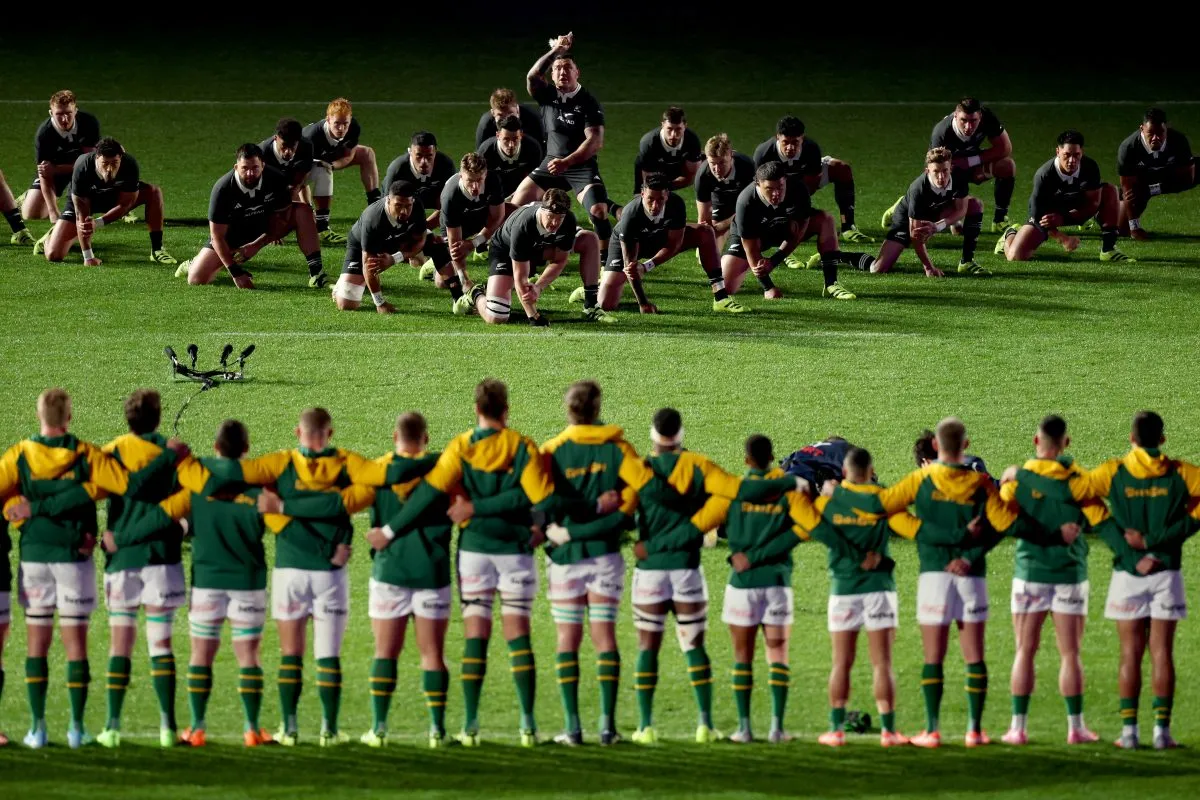
Nature of competitive rugby could be at stake as rivals put their focus on the bottom lineThe All Blacks perform the haka before facing South Africa at Eden Park in Auckland, in 2025. Photograph: Phil Walter/Getty Images Sat Aug 22 2026 - 06:00 • 5 MIN READIn some ways, rugby is pining for the bygone era of when the amateur days merged with the early years of professionalism. Leinster have released a new kit harking back to the strip worn during the 2001 Celtic League triumph. This after Munster last year released a kit inspired by their first Heineken Cup win in 2006. Rugby’s calendar is also starting to look that bit more nostalgic. For the first time since 1996, the All Blacks are in South Africa for a three-Test tour. A fourth match between the sides will take place in Baltimore in September. Not to mention the series of warm-up games that have been and gone against South Africa’s URC sides. “Rugby’s Greatest Rivalry,” is the moniker bestowed upon this tour. Not without good reason. Anyone remotely interested in rugby will be fascinated to see how Dave Rennie’s new-look, more expansive All Blacks take on the immovable object that is Rassie Erasmus’s Springbok side. These two were separated by just one point in the last World Cup final. This will be a compelling, month-long spectacle that could well decide the moniker of the world’s greatest side – albeit the French might have something to say about that. As World Rugby moves away from multi-game tours – July’s Nations Championship replacing what used to be three-match tours – two of their biggest brands are moving in the opposite direction. The Rugby Championship, the traditional competition between New Zealand, South Africa, Australia and Argentina has been scrapped for this year. And in 2030 the Boks return the “greatest rivalry” favour and travel to New Zealand. Unmissable rugby? Certainly. Two of the sport’s biggest sides going it alone, maximising their own value at the expense of global altruism? Perhaps. Picture the parallel hypothetical of Ireland and France foregoing the Six Nations in favour of a multi-match series. You could imagine the reaction of the other northern hemisphere countries. Pure notions. Clearly, New Zealand and South Africa have identified the commercial appeal of pitting themselves against each other in a narrative-rich series – even if a fourth game in America leaves open the possibility of an unsatisfying series draw. If that commercial value, be it through TV deals, ticket sales or both, was not greater than the Rugby Championship, why make a change?Damian Willemse of South Africa scores against the All Blacks on September 13, 2025, in Wellington. Photograph: Hagen Hopkins/Getty Images With its warm-up matches and much-hyped main event, this series walks and talks like a Lions tour. That almost certainly is not a coincidence. Last year, Rugby Australia turned a $70.6 million (€43 million) profit, helping to wipe out their debt thanks largely to the visit of Andy Farrell’s band of Brits and Irishmen. The year previous, with no red-clad visitors from the north, they lost $36.8 million.With one iteration staring on Saturday and the second coming in 2030, the Boks and the All Blacks have made their own version of a Lions tour. Add into the equation the real Lions touring New Zealand in 2029 and South Africa in 2033. [ Empty seats and faded aura show how Springboks outgrew the All BlacksOpens in new window ]It doesn’t take long to connect the financial dots. New Zealand media outlet Stuff obtained a Deloitte report that warned of an aggregate loss of $20 million (€10 million) for the Kiwi Super Rugby franchises over the next five years. If Rugby’s Greatest Rivalry continues on its current four-year cycle, round three will come in 2034, meaning neither of the southern hemisphere’s juggernauts will be without a financially lucrative Lions equivalent or real Lions tour for longer than three years.Penny for the thoughts of Rugby Australia and the Argentine Rugby Union. Rugby’s Greatest Rivalry isn’t exactly the all-consuming selfish entity that spells their doom. The Rugby Championship will return in 2027, 2028 and 2029. The Bledisloe Cup, the annual competition between Australia and New Zealand, will still take place this year – albeit it has been pushed back to October. South Africa played Argentina earlier this summer.In the UK and Ireland, Sky Sports has agreed a multimillion deal to show all Sanzaar (southern hemisphere rugby’s governing body) matches between now and 2030, including matches featuring Argentina and Australia in non-Rugby Championship years. Presumably, this bundle was made more commercially attractive by the guarantee of two mega series between the All Blacks and the Springboks. Rising tide and all that. Yet it remains true that both Australia and Argentina are playing less rugby this year than last. In 2025, Argentina played six Tests against southern hemisphere opponents (including a one-off match against Uruguay). This year, they have just three.Cheslin Kolbe of South Africa tackled by New Zealand's Jordie Barrett in Wellington, 2025. Photograph: Joe Allison/Getty Images In 2025, Australia had eight Tests in the same period. Thanks to Bledisloe, they fare better this year than Argentina with seven, albeit two of those are against Japan. Ask new head coach Les Kiss if he’s happy with a shrinking Wallaby dance card just over 12 months out from a home World Cup.“This new calendar for southern hemisphere rugby is all about bringing to the fans the highest level of world-class rugby and action,” said Brendan Morris, the chief executive of Sanzaar, when the fixture list for the next five years was announced.“Indeed, after listening to what supporters, broadcasters and our stakeholders want, we’ve worked with the unions to craft a bold and dynamic schedule designed to deliver unforgettable moments every year.”With the notable exception of the Six Nations, global rugby continually tinkers with the format of various competitions. With South Africa and New Zealand maximising the value of their rivalry, creating a more lucrative TV rights deal for the hemisphere while still playing the Rugby Championship three years out of four, Sanzaar looks to be hoping that this balance keeps Argentina and Australia competitive, all while adding revenue where it matters. That balance will be tested until 2030, the timeline for this current cycle that ends with South Africa touring New Zealand. Thereafter, if Rugby’s Greatest Rivalry brings the desired success, does that diminish the incentive to keep this series as a four-year event while sticking to Sanzaar solidarity the rest of the time? That could well depend on how competitive Argentina and Australia are. If fewer games against their top rivals leads to dwindling performance, do broadcasters become less interested? It will take particularly benevolent administrators, focused on the wider game than the bottom line of individual nations, to ensure this is not the beginning of the end of competitive rugby across the southern hemisphere. IN THIS SECTION
All Blacks mega tour of South Africa promises plenty, but is it good for the game?
Nature of competitive rugby could be at stake as rivals put their focus on the bottom line
1,152 words~5 min read