Skip to content
The Hammond organ is an early form of electronic– or perhaps electromechanical– musical instrument. It solved the very real problem of organs normally being the sort of thing you built into a cathedral, allowing a similar sound to fit into a piano-like form factor. Their workings are a so simple that it’s hard to wrap your head around it actually working– which is why [Uri Tuchman] built one on YouTube. Also for a gift exchange, but we’re not Santa, here– we’re here to learn, and [Uri] does not disappoint.
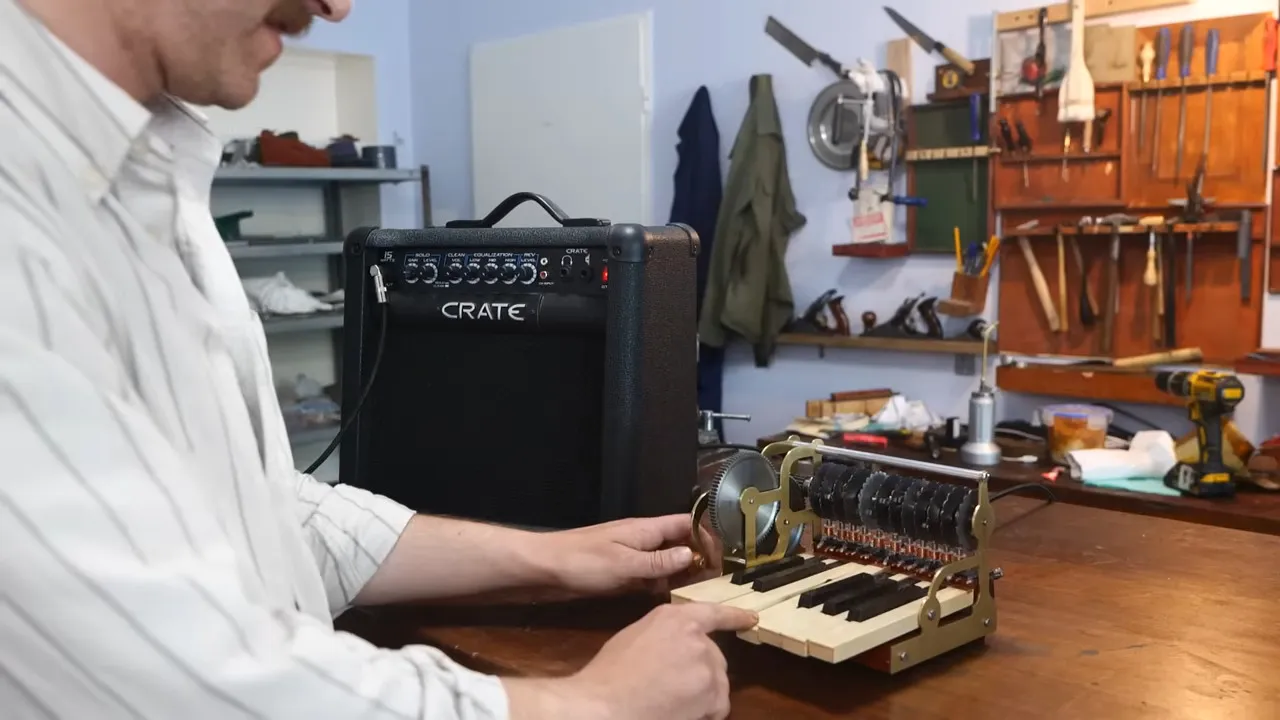
[Uri]’s organ is a bit smaller than what the Hammond corporation was putting out back in the day, just one hand-cranked octave– and it lacks the distinct spinning speaker in favour of plugging into any old guitar amp. It’s enough to get the idea across. Each of the twelve keys acts as a simple switch, wired to a pickup made from a coil of wire around a steel rod– much like a magnetic pickup on an electric guitar. The pickup faces the tone wheel, which is the part that feels like magic: the tonewheel spinning past the pickup acts exactly like the steel string vibrating in an electric guitar, its ferroelectric motions inducing a tiny current. The tonewheels smooth teeth are spaced to create sine waves at the frequencies corresponding to each key, so it has to be exact. That’s why while the rest of the brass-and-wood build is [Uri]’s beautiful craftsmanship, the iron tonewheels are CNC’d.