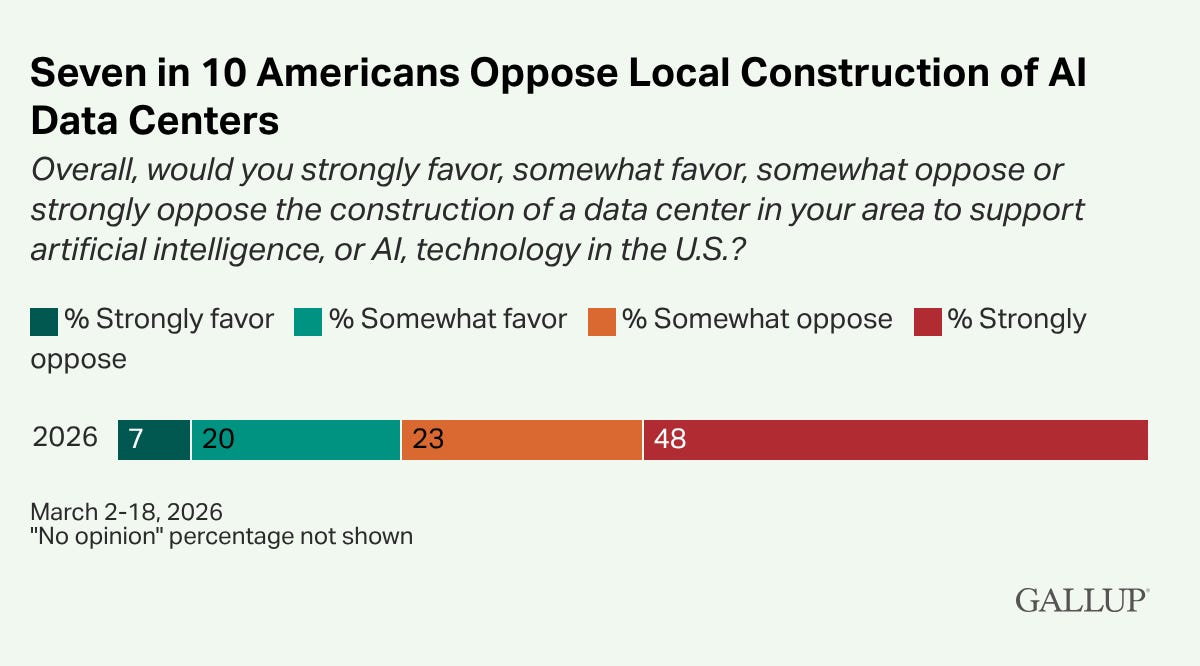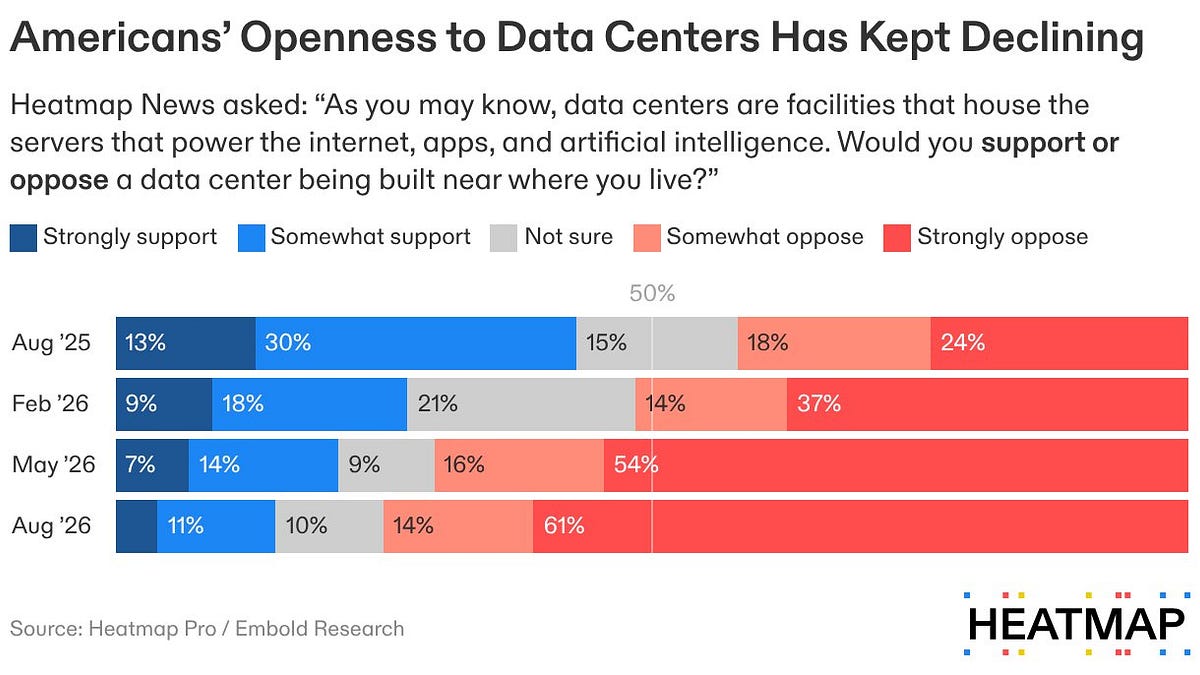
Hey, Alberto here! 👋 I publish long-form AI analysis covering culture, philosophy, and business. Paid subscribers get Monday how-to guides and Friday news commentary. If you’d like to become a paid subscriber, here’s a button for that:I’m preparing a long post on the recent news about frontier AI agents wreaking havoc, but in the meantime, I’ve written this 3,000-word post after the news that “75% of Americans Now Oppose Local Data Center Development.” The story has gone super viral, and everyone is chiming in. So here are my two cents.Some say that if you oppose data centers, then you should not enjoy the services they provide, including but not limited to social media, search, email, cloud storage, streaming, online banking, e-commerce, AI, and cat videos. Fair. Reasonable even. But let's invert the responsibility here: we should only build data centers in the backyards of those who stand to benefit from them financially. In other words: Why are there 49 large data centers in Loudoun County, Virginia—more than 700 across America—and the striking total of zero in San Francisco? Let’s build one behind Sam Altman’s $27 million sprawling Russian Hill compound and see how he likes it. I’m not even joking: when a growing majority of citizens in your country oppose your project for a “better future”—up to 75%, with tiny, if any, differences across gender, age, socioeconomic status, political party, etc., according to the latest surveys—then your only chance at vindication is to lead by example.Data centers are these big, ominous buildings that often occupy landscapes otherwise covered in greenery and blue sky. On the one hand, they stand there as solitary fingerprints of human presence on Earth; on the other, as the clearest proof that utility is no longer subordinated to aesthetics. You might find them across America, but also scattered throughout the world. There’s one under construction in Kvandal, outside Narvik, in northern Norway, where scraped earth and server halls meet a lush valley opening onto a fjord, surrounded by mountains that remain snow-covered well into the year. There’s one in Huesca, Aragón, Spain, not far from where I live: a blank industrial slab on the open Aragón plain, with the Pyrenees immediately to the north. And there’s one in Culpeper County, Virginia: rolling farmland, woods, the Blue Ridge visible in the distance, and in the middle of it all an industrial rectangle sitting amid green fields, as out of place as a shipwreck on the ocean floor. In a fantastic piece of investigative journalism, Jasmine Sun aptly writes that, “In those halcyon environs, the data centers land like a spaceship crash.” The name “data center” is composed of two concepts that make one immediately wary: data implies they know everything about you, and center means concentration of power. They’re alien, strange even for an urbanite, like the Giza Pyramids must have appeared before the awestruck eyes of ancient Egyptians. Like an altar to an unknown god, a data center is a hyperobject, incapable of fitting inside your mind. And so it’s trivial to project onto them whatever you want—or fear: a digital utopia, the next gold rush, or a monster with such thirst it must surely be a son of Poseidon. Do data centers truly consume tons upon tons of water? It doesn’t ultimately matter because they look like they could. And so on.Data center in Narvik. Credit: NscaleData center in Stevensburg, VA. Credit: Hugh Kenny, PECExecutives in the AI industry often wonder what went wrong with data centers or how they could fix this. I’m handing them the recipe for free; the bare minimum is to stand behind their words with their body as collateral: build on your backyard. If they are so great for the world—and these people presumably want to make it as great as possible—then what is this tiny sacrifice in the name of prosperity and progress? If they’re not willing to pay this measly tribute for their utopia, why do they expect us to do it on their behalf? Stopping the fear-mongering about how their technology will destroy our future is no longer enough. (For some reason, aggressive lobbying or “hysterical condescension” won’t cut it either.) To use their own expression: there’s an overhang of anti-AI hate; they may shut up today, and the reactionary sentiment will still linger in the air for another decade. We, The Mob, have emitted our judgment: we have learned what bots are made of—just chips and wires inside huge, ugly Brutalist hangars that perfectly serve as the physical manifestation of an otherwise elusive technology and also as a symbol against which to imprint our discontent—so let’s now see what nerds are made of.Unfortunately, it won’t happen. First, nerds are not martyr material. Second, politicians are not fond of taking risks. Dario Amodei might eventually join his “country of geniuses inside a datacenter,” and live there forever, but not even that would serve as an assurance to win people’s votes. I was rather delusionally optimistic when I implied this is solvable at all. Maybe people are so tired, feel so betrayed by the tech elites that the only compromise they will accept is none. They won’t stop until they topple these sanctuaries devoted to the machine god in which they believe their livelihood, their creativity, their cognitive freedom, and their freshwater are being sacrificed. Only an indefinite moratorium will suffice to turn the tide before the next election. And so politicians, stoic in peaceful times, instantly fold during wartime.Greg Abbott (R, governor of Texas) tweeted today that his directive has “halted up to 1,800 data center projects.” Republicans (also Democrats) were loudly supportive of the AI industry not even a few months ago, so this change of mind responds not so much to a true-hearted realization as to a newfound terror: no one likes the AI industry, including their voters. And because losing the elections is the ultimate failure, he’s willing to sell both his coherence and his principles. And so is the rest of the GOP. Mike Rogers (Senate nominee in Michigan) “backs one-year data center moratorium.” Stacy Garrity (candidate for governor of Pennsylvania) made an ad attacking Governor Josh Shapiro (D) over data centers. Tom Barrett (congressman for Michigan) tweeted that “Michigan water, Michigan land, and Michigan’s future belong to Michiganders.”Tom Barrett@tombarrettmi7Michigan water, Michigan land, and Michigan's future belong to Michiganders.
How America Turned Against the AI Industry
Is this the final chapter of the story?
TL;DRAI
75% of Americans oppose data center deployment; Texas governor halted 1,800 AI projects as political support collapses. Public sentiment now drives regulatory decisions—infrastructure expansion faces systematic blockade regardless of technical viability.
2,720 words~12 min read