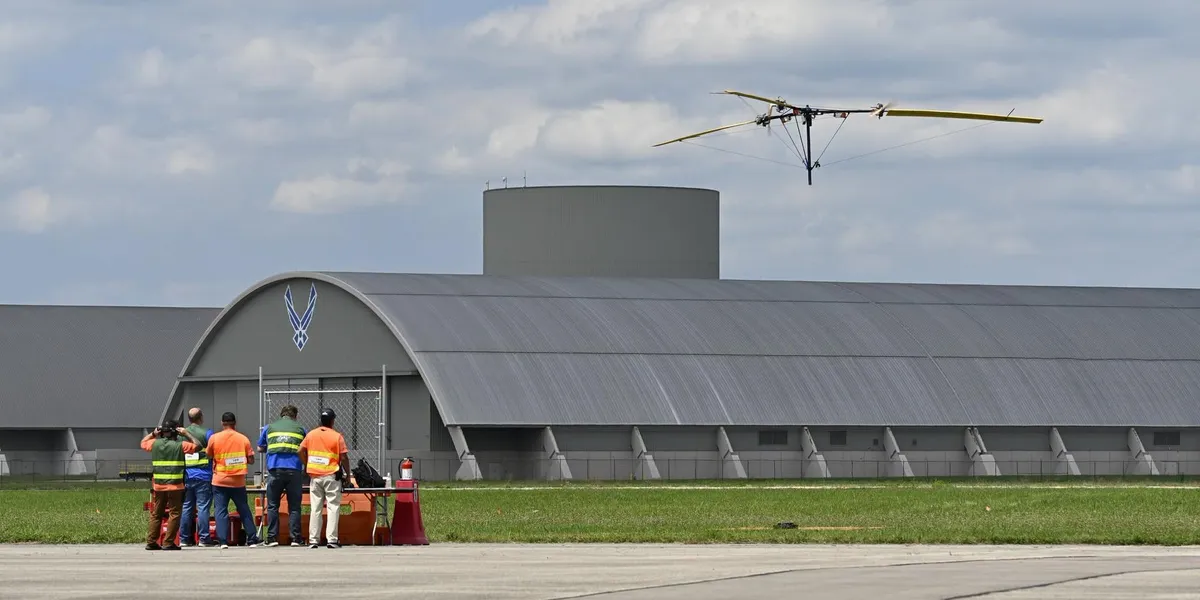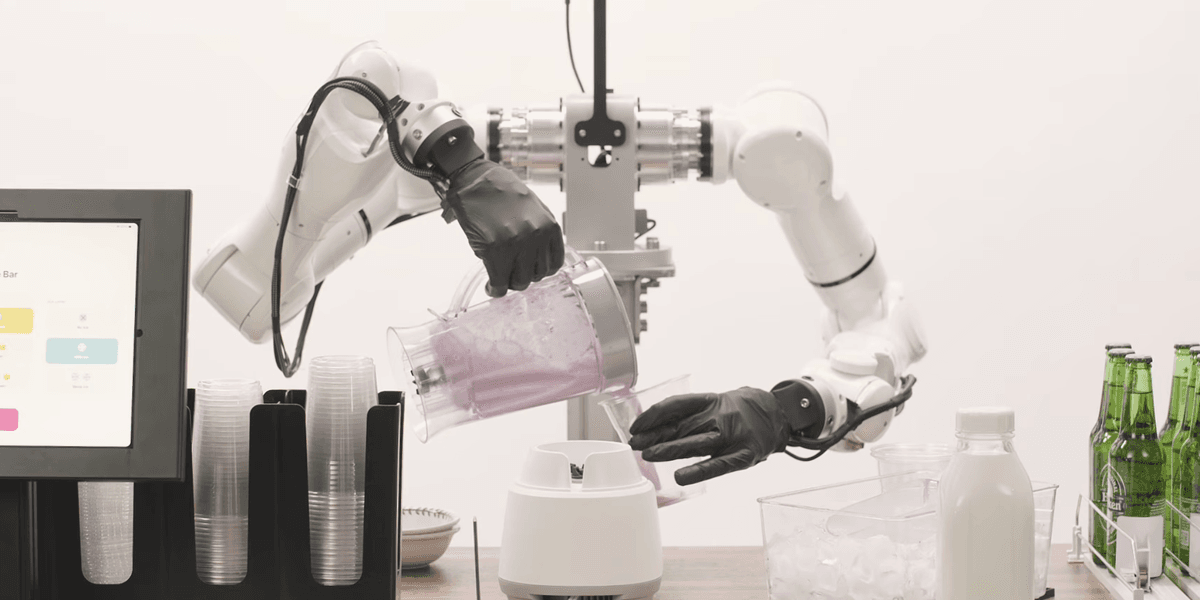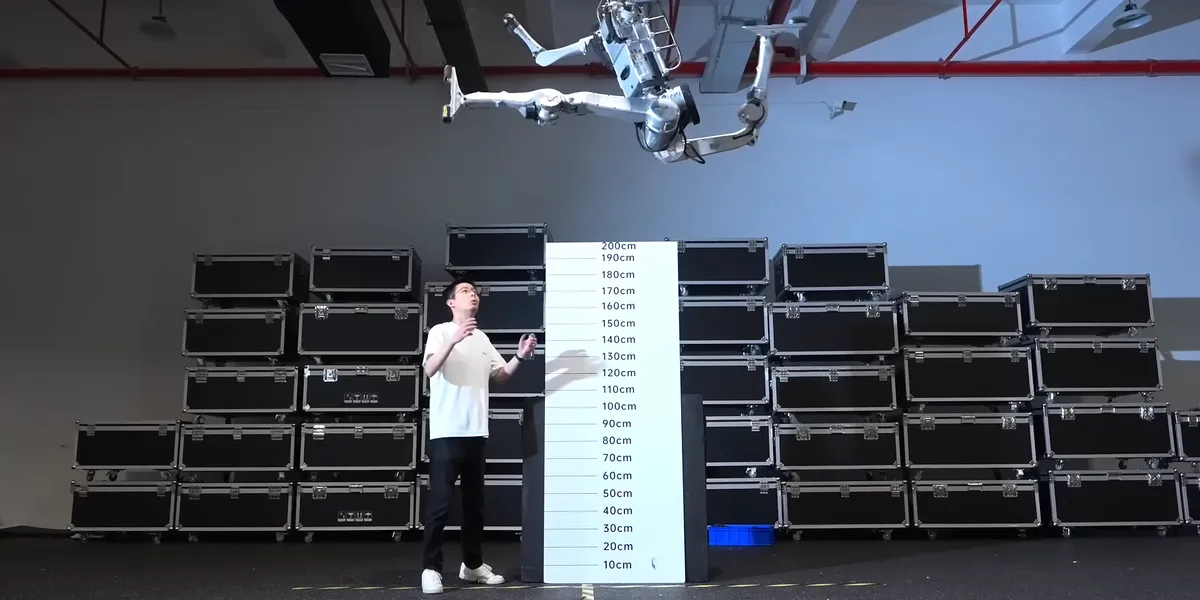
Video Friday is your weekly selection of awesome robotics videos, collected by your friends at IEEE Spectrum robotics. We also post a weekly calendar of upcoming robotics events for the next few months. Please send us your events for inclusion.Humanoids Summit Seoul: 22–23 September 2026, SEOULIROS 2026: 27 September–1 October 2026, PITTSBURGHCoRL 2026: 9–12 November 2026, AUSTINEnjoy today’s videos!This is very, very cool. But I’m trying to think of what the commercial use case will be, you know? I guess, high speed, incredibly dangerous package delivery to second floor windows or something...?[ Unitree ]Humans have a remarkable ability to perform new physical skills from only one or a few examples. Our latest robot foundation model, GEN-1.5, exhibits the beginnings of that same ability: it can learn a new task in seconds, from a single example, without gradient updates or fine-tuning. It displays broad capabilities across one-shot and few-shot learning from demonstration, as well as zero-shot physical generalization. Although the tasks are simple and short-horizon, this is the first model we know for which one-shot and few-shot learning of physical skills have emerged at scale. We view these results as a significant step towards our mission of building general intelligence for the physical world.I will make the cautionary point that for many of these “the model figured it out” tasks, the blog post can only say that there was no relevant pretraining data “to the best of our knowledge.”[ Generalist ]BeanBot is a robot inspired by Mexican jumping beans, and I need say no more.[ IIT ]As a professional bagpiper who definitely pays very close attention to whatever that annoying tapping noise is coming from the back of the band, I can attest to this group of robot drummers being absolutely top-notch.[ AgileX Robotics ]What does it take for an aerial robot to move through a sequence of arbitrary poses—fast, precisely, and continuously? Rather than teaching the robot a behavior from data, we asked how far a first-principles analytical model could take us. Through a collaboration between the AIMS Group at The Hong Kong Polytechnic University and DRAGON Lab at The University of Tokyo, we developed the first sequential-convex-programming-based trajectory optimization framework for generalized multirotors, covering both conventional and omnidirectional platforms.[ DRAGON Lab ]Thanks, Moju!This is a nifty idea that adapts a kind of interface frequently used for robot training and uses it for human training instead.[ MIT ]Gravis Robotics brings robotic intelligence to heavy construction machines. Our retrofit kit, the Gravis Rack, turns off-the-shelf hydraulic machines into robots. Cameras, LiDAR and onboard compute lets your machine see and understand its surroundings, and learning-based control lets it work close to its limits, moving more dirt with full, fast cycles.[ Gravis Robotics ]Robust brachiation requires precise hand movements to grasp and release bars together with highly coordinated whole-body motion. To address this challenge, we propose a learning-based framework centered on Waypoint-Guided Reinforcement Learning (WGRL). WGRL guides the end-effector through waypoints while allowing RL to explore and generate dynamic whole-body behaviors. With this approach, the learned policy demonstrated robust brachiation across diverse courses with different bar heights, spacings, and orientations in Sim-to-Sim experiments. In the real world, our life-sized dual-arm robot successfully traversed four consecutive bars.[ EVARL ]Thanks, Ayumu!Well, here’s a different approach to welding in shipyards with robots.[ Kawasaki ]We should have a lot more robots in agriculture, if only they’d lettuce.[ Flexiv ]We’ve all had refs like these.[ PHYBOT ]I got stuck after the first 15 seconds of this video trying to imagine what any of these home humanoids would usefully do if they dropped a glass.[ Zhejiang Humanoid ]Shakey the Robot doesn’t get enough love.[ SRI ]This work introduces a novel approach to physical Human-Robot Interaction (pHRI) by leveraging the joint torque sensors of standard collaborative robots. By mounting a passive, uninstrumented plexiglass touchpad to the robot’s flange, we transform the robot into a handwriting-based input interface.[ TS-Robotics ]
Fun to Watch, but How Does a High-Jumping Humanoid Help Humanity?
Your awesome selection of videos this week shows robots that drum, weld, farm, play soccer, help at home, operate heavy equipment, and more
649 words~3 min read