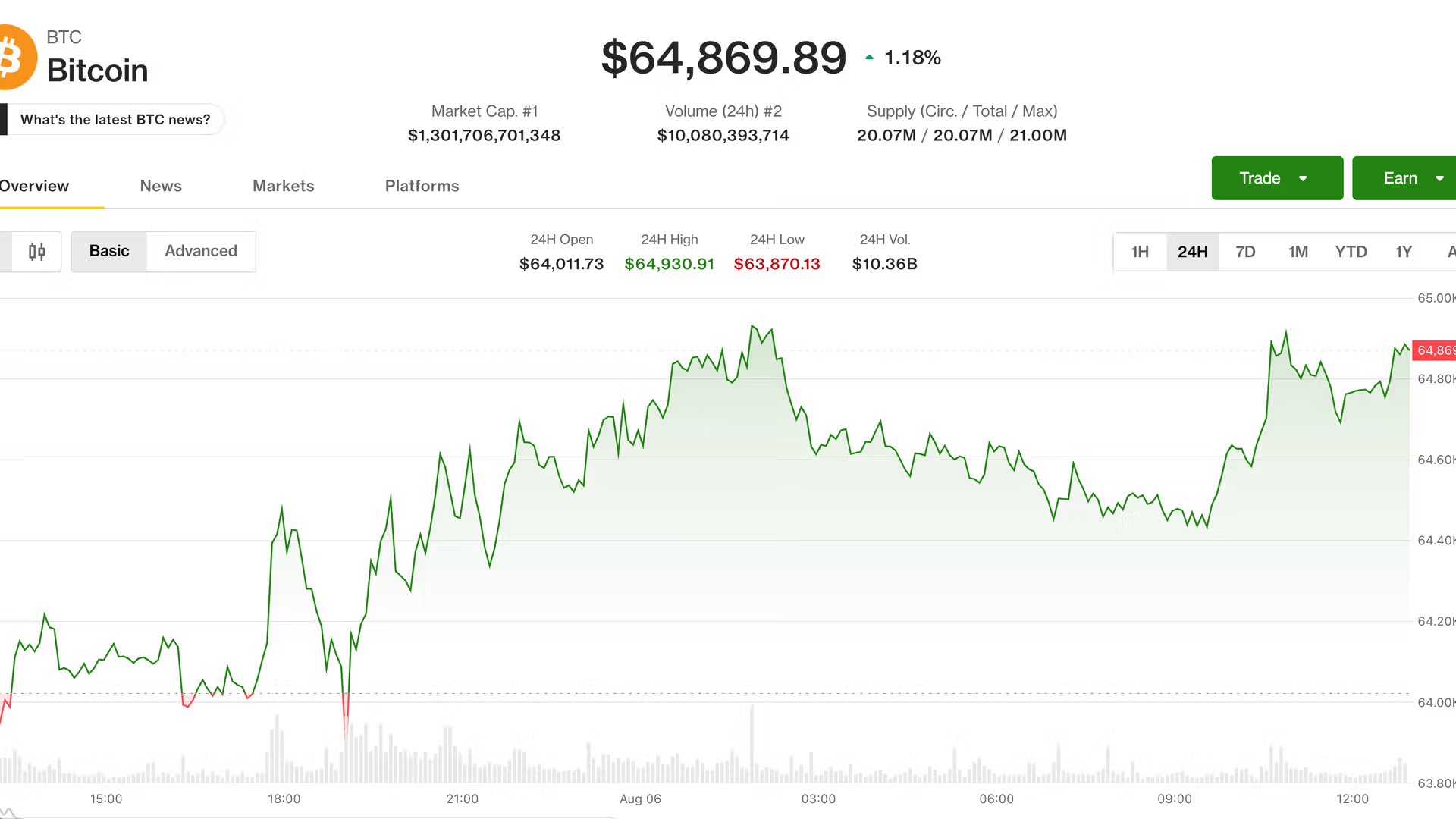
US futures rebound from Thursday's slump, and trade at session highs on. As of 8:15am ET, S&P 500 futures were 0.4% higher with Nasdaq 100 contracts up 0.6%, while Bitcoin headed for its best week in more than three years, rising just shy of $80,000 before reversing. S&P 500 futures jerked higher and yields extended declines as oil edged lower shortly after 7am ET on this headline: *IRAN’S PRESIDENT SAYS BETTER TO END WAR TODAY WITH DIGNITY:ISNA, and while the market erroneously viewed this as a sign of de-escalation, he has made many similar comments in the past. Among Iranian officials, Pezeshkian has long been one of the most vocal proponents of ending the war with the US through diplomacy. In any case, tech is again making headlines, with Broadcom in talks with lenders to raise as much as $100 billion in an off balance sheet SPV financing deal that would benefit Anthropic and other companies. Pre-market, Mag 7 are all higher led by META (+0.9%) and TSLA (+1.1%). Today is the monthly option expiration day so expect low volume volatility around key pin levels. TSY yields are down 1-2bps across the curve although the 10Y remains just around 4.70%. The slide in the greenback is continuing, with the Bloomberg Dollar Spot Index down 0.3% and at a three-month low. Commodities are mixed: base metals ad ags are all lower, while gold is 1.6% higher this morning; oil is unchanged. Overall, the overnight news flow was mostly quite as investors are waiting for today’s Global PMI release. Today's US economic data calendar includes Bloomberg US economic survey for August, and S&P Global US manufacturing, services and composite PMIs. No Fed speakers are scheduled for the sessionIn premarket trading, Mag 7 stocks are all higher (Tesla +1.3%, Meta +0.7%, Alphabet +0.7%, Amazon +0.6%, Nvidia +0.5%, Apple +0.1%, Microsoft +0.1%)Cryptocurrency-linked stocks are rallying as Bitcoin rises, putting it on track for its best weekly gain in more than two years. Strategy (MSTR) climbs 8%, Coinbase (COIN) rises 5%.Mining stocks are rising as gold is on track for a third weekly gain after the US Treasury’s unexpected ramp-up in buybacks of long-dated government debt underscored concerns about its burden. Newmont (NEM) rises 3%.Flowers Foods (FLO) falls 4% after the maker of Wonder Bread cut its adjusted earnings-per-share forecast for the full year.O-I Glass (OI) rises 5% after Citi upgraded the packaging products company to buy, saying shares appear to be “meaningfully oversold.”OSI Systems (OSIS) falls 13% after the medical device maker’s forecast for fiscal 2027 revenue fell short of the average analyst estimate.Parsons Corp. (PSN) rises 2% after Baird upgraded the IT services company to outperform, saying guidance looks conservatively set.NetEase ADRs (NTES) rise 6% after the company’s core gaming business was seen as resilient and forecast to keep growing steadily.Ross Stores (ROST) climbs 8% after the off-price retailer boosted its earnings per share forecast for the full year.In other corporate news, Samsung Electronics said it expects to return as much as 110 trillion won ($79 billion) to shareholders this year, joining rival SK Hynix in handing investors a chunk of the windfall generated by the AI rush. Anthropic PBC expects to match or beat the size of SpaceX’s record-setting initial public offering, according to Bloomberg. SpaceX and AST SpaceMobile are among companies expressing interest in acquiring a swath of 800 MHz-band spectrum held by Grain Management that’s valuable for providing wireless phone services directly from space. Virtu Financial is said to be considering a potential sale of its agency brokerage and technology division to free up capital to invest in its core market making operation. Nvidia is in early discussions with the Korean AI chip designer Rebellions about possible collaborations. Banca Monte dei Paschi di Siena SpA is seeking to buy two separate banks for a combined price of €34 billion ($40 billion) as it wants to prevent being taken over by rival Intesa Sanpaolo SpA. Broadcom is in talks with a group of lenders to raise as much as $100 billion in debt for an AI chip financing deal that will benefit Anthropic PBC and other companies, according to people with knowledge of the matter.After days of swings that saw long-dated yields hit their highest levels in decades, Treasuries were little changed on Friday. Brent crude struggled for direction, while gold hit the highest level since May. Investors are now assessing the fallout from a week that saw bond yields spike on worries about inflation and spendthrift governments, a surge that prompted the Treasury to intervene to curb long-dated borrowing costs. They are now awaiting a promised new initiative from Treasury Secretary Scott Bessent aimed at fiscal consolidation. “Equity markets are vacillating between concerns about the tech sector and rising bond yields, though today, both seem to have declined,” said Joachim Klement, a strategist at Panmure Liberum. “Fact is that the US Treasury can do little if anything to turn the trend in long-term bond yields for good.”The surprise decision by the Treasury Department to increase its repurchase program this week “sent the clear message to investors that rising yields matter now,” notes JonesTrading chief strategist Mike O’Rourke. “While the Treasury market has been soft since the election, we do not view it as dire. The Treasury drawing attention to it may turn it into a problem,” O’Rourke adds.Bitcoin rallied as much as 9.4% and headed for its best weekly advance since 2023. A short squeeze triggered by Bessent’s midweek announcement of bigger buybacks of long-dated bonds remains a major driver of the gains.In hedge funds, Hamza Lemssouguer’s Arini Capital Management is said to have lost roughly 8% in July on soured credit bets. The drawn out Evergrande saga underscores the inherent perils of short selling, said Andrew Left.Nearly $29 billion flowed into US equity funds in the week through Aug. 19, the largest inflow in three weeks, according to BofA's Michael Hartnett who said if US intervention in the bond market fails to “drag 30-year yield below 5%,” that would fuel a slump in the dollar and cause asset allocation to shift to short risk, short leverage and short cyclicals into midterms.Stronger-than-expected manufacturing data helped pushed the the Stoxx 600 up 0.1% and snapped a seven-day losing streak for European equities, the longest in a decade. Still, the Stoxx 600 is less than 2% below its record high, and Goldman Sachs and JPMorgan remain among the most optimistic about the region’s prospects, a Bloomberg survey showed. “Europe has done much better than almost everybody would have expected at the outset of this year,” said Sharon Bell, senior European equity strategist at Goldman Sachs. “There’s been so much attention on a handful of companies in the US and Asia that I just don’t feel Europe has had its proper due.” Here are the biggest movers Friday:Nibe shares gained as much as 10%, the most since May, after the Swedish heating and climate solutions group posted strong earnings, that SB1 Markets predicted could trigger single-digit upgrades to consensus estimatesSiegfried shares rose as much as 9.3%, briefly hitting their highest level since February, after the maker of active pharmaceutical ingredients delivered results ahead of expectations in the first halfBavarian Nordic shares rose as much as 9.1%, the most since July 2025, after the Danish vaccine maker boosted its Ebitda margin forecast for the full year and announced a new share buyback programDomino’s Pizza Group shares rose as much as 4% after Shore Capital upgraded its recommendation on the UK franchise of the world’s biggest pizza company to buy from hold.Hunting Plc shares fell as much as 20%, the most in four years, after the energy services provider cut its full-year profit guidance by 7%Straumann shares fell 3.5% after being downgraded to hold from buy at Deutsche Bank, which says increasing risks and the CEO transition “cloud the outlook” for the Swiss dental implant makerCTS Eventim shares slid as much as 9.5% after reporting results for the second quarterAsian stocks advanced as heavyweight Samsung Electronics’ plan to return some of its windfall AI profits to shareholders lifted the technology sector. The MSCI Asia Pacific Index rose as much as 1%, with chipmakers among the biggest contributors. Samsung plans to return up to 110 trillion won ($79 billion), in what would be one of the company’s most significant capital-return initiatives. Benchmarks advanced in South Korea, Hong Kong, mainland China and Taiwan. Samsung’s payout plan follows SK Hynix’s announcement of a $29 billion buyback. Hopes for more AI-fueled shareholder returns have been a bright spot amid mounting concerns over rising bond yields and fading prospects for a US-Iran peace deal. The MSCI Asia index is down 0.3% for the week, poised to snap four-straight weeks of gains.In FX, the dollar headed for its worst week this month before US manufacturing PMI data that may give investors more insight into the health of the world’s biggest economy. A Bloomberg gauge tracking the dollar against peers fell 0.3% to its lowest level since May 12 as it continued to face a backlash from investors after Wednesday’s announcement that the US Treasury would boost purchases of longer-dated government bonds. USD/JPY drops 0.4% to 158.36; Japan’s consumer price index excluding fresh food rose 1.8% in July from a year earlier, accelerating for a second month. EUR/USD on course for a third daily advance and a fourth weekly gain, for the first time since April 2025. GBP/USD rises as much as 0.3% to 1.3676; Britain’s private sector expanded at the fastest pace in four months, as sunny weather and a strong service sector prompted households and businesses to turn on the spending taps. Japan’s benchmark Topix pared an earlier loss to flip to gains, finding support from bank stocks and the marine transportation sector. “If you look at the sectors, money is still flowing into areas such as resources and domestically-oriented stocks,” said Shuutarou Yasuda, a market analyst at Tokai Tokyo Intelligence Laboratory. In rates, treasuries opened higher in a belly-led move; 30-year USTs underperformed with yields about 1bp lower at 5.24%. Wings of the curve are lagging ahead of US services and manufacturing reports. Choppy trading session overnight with oil prices lower and UK gilts and European front-ends outperform Treasuries. US yields higher by less than 0.5bps across belly, with the 2-year yield slightly lower and 30-year unchanged. 2/10’s and 2/30s are flatter by around 0.5bps vs. Thursday close. US 10-year yields trade around 4.70%, richer by 1bp on the day with bunds slightly and gilts up 1 bp in the sector. Market pricing for Federal Reserve rate hikes was steady ahead of US PMI data, September OIS around 9bps of a rate hike priced. IG dollar issuance slate is quiet. On Thursday three companies raised a combined $3.25 billion in the US investment-grade bond market. Next week is expected to be light for issuance, before the seasonal rush begins after Labor Day “As the buyback announcement effect fades, we expect yields to resume their upward drift and the curve to maintain a steepening bias,” fixed-income strategists at Societe Generale SA wrote in a Thursday noteIn commodities, WTI futures lower by around 1.1%, and have been trading below Thursday’s close during the overnight session. Brent crude futures are down 0.5% but on track for a roughly 5% rise this week as the ongoing Middle East conflict drives prices higher. The dollar’s loss is supporting gold, up 1.5% and briefly trading on a $4,600/oz handle for the first time since mid-May. The rally in Bitcoin has garnered further momentum, up over 7% and closing in on the $80k mark. Today's US economic data calendar includes Bloomberg US economic survey for August, and S&P Global US manufacturing, services and composite PMIs. No Fed speakers are scheduled for the session. Next week’s key events include Nvidia earnings and the Jackson Hole symposium. Investors will also be focusing on a heavy slate of results in Asia, including the first report from newly public chipmaker CXMT.Market SnapshotTop Overnight NewsTreasury secretary Scott Bessent’s bid to prop up the US bond market has been dismissed by investors as a “band-aid on a bullet hole”, as concerns mount over Washington’s $40tn debt burden and smoldering inflation. FTThe market is treating the Treasury’s buyback announcement as a pure dollar negative, and Fed Chairman Kevin Warsh’s speech next week at Jackson Hole could be the catalyst for another round of greenback weakness: BBGBroadcom Inc. is in talks with a group of lenders to raise as much as $100 billion in SPV debt for an AI chip financing deal that will benefit Anthropic PBC and other companies. BBGSurging healthcare costs are walloping U.S. workers, and they will only worsen next year. For 2027, employers may be facing the biggest health-insurance increase in at least two decades. WSJChina will roll out additional fiscal policy measures in response to economic developments, Vice Finance Minister Liao Min said on Friday, as growth slows in the world's second-biggest economy. China will maintain the continuity and stability of macroeconomic policies and plan and allocate fiscal resources over a longer time horizon, Liao told a press conference. RTRSEver since President Trump’s return to office, America’s allies have been fretting about Washington’s intentions. Now, after the inconclusive war against Iran has eroded U.S. weapons stockpiles and laid bare the limits of American hard power, they also worry about American capabilities. WSJJapan’s consumer inflation picked up last month as the energy shock caused by the Middle East conflict rippled out across goods, firming expectations that the next interest-rate hike is around the corner. WSJSamsung Electronics expects to return as much as $80 billion to shareholders this year, joining rival SK Hynix in sharing the AI windfall and fueling optimism across the tech sector. Nasdaq futures led gains. BBGUnprecedented shareholder-return plans by South Korea’s two chipmaking giants are emerging as a key swing factor for the won, potentially extending its recent rally if the firms tap local currency markets to fund the payouts: BBGEurozone flash PMIs were solid in Aug, with manufacturing coming in at 52.8 (vs. the Street 51.8) and services at 51.7 (vs. the Street 51.5), as the economy demonstrated healthy growth and easing inflation pressure. S&PBritain posted a surprise budget deficit in July, underscoring the fragile state of the public finances as Chancellor of the Exchequer John Healey begins to draw up his crucial autumn budget: BBGBitcoin topped $78,000, on track for its best week in more than three years. BBGSeptember and October in midterm election years is when volatility picks up and S&P returns fade ... and that’s usually followed by a post-event bounce: GoldmanA more detailed look at global markets courtesy of NewsquawkAPAC stocks were mixed as the region attempted to shrug off the broadly negative handover from Wall Street, where risk sentiment was dampened amid a rebound in yields and Walmart's weak sales growth. ASX 200 traded with mild losses amid another deluge of earnings and mostly softer flash PMI data. Nikkei 225 retreated at the open but is well off today's worst levels, with participants digesting the latest inflation data from Japan, which mostly matched estimates and remained below the 2% price target, but accelerated from the previous and could support the case for further BoJ rate hikes. KOSPI clawed back early losses with price action driven by the tech heavyweights, with SK Hynix considering building a memory chip plant in Japan's Miyagi prefecture and with Samsung Electronics expected to announce a KRW 100tln shareholder return plan today. In addition, the comments from BoK's newly appointed Senior Deputy Governor Kwon were less hawkish than his predecessor, in which he stated that cautious and flexible policy decisions are needed. Hang Seng and Shanghai Comp were somewhat mixed, with the Hong Kong benchmark in the green and its biggest movers driven by recent earnings releases, while the mainland struggled for direction despite China's Vice Finance Minister flagging incremental policies and the PBoC resuming 7-day reverse repo operations for the first time in more than a week.Top Asian NewsChina's Vice Finance Minister Liao said they will roll out additional fiscal policy measures in response to economic developments. Liao added that a greater share of fiscal spending will be directed towards households and consumption.PBoC reportedly to "survey" some mutual funds regarding long-dated bonds, sources suggested.Japan's Finance Ministry is considering setting an assumed interest rate at 3.8% for calculating debt servicing costs in the FY27/28 budget request, Nikkei reported.Japanese PM Takaichi said an economy that is growing will experience a certain level of inflation. Japan has the lowest inflation among G7 nations due in part to the effect of government steps.Japan's LDP cabinet reshuffle is likely to occur in the latter half of September, Kyodo reported citing sources. Chief Cabinet Secretary Kihara is expected to retain their positionEuropean bourses begin the final trading session of the week with broad gains, with the blue chip EuroStoxx 50 set to break its 5-day losing streak. Volumes remain light as the Summer season. On the data front, despite mixed French and German PMIs, the EZ figure printed stronger-than-expected across the board, with clear strength in the manufacturing sector. Commentary by S&P highlighted the effect of the heatwave on the services sector. For the ECB, S&P stated that the hawkish bias should remain giving the solid Q3 GDP growth, renewed hiring and elevated inflation. Sectors highlight the positive bias. Basic Resources is the clear outperformer, given the resurgence of precious metals (spot gold +1.5%). Construction and Autos round out the outperformers. To the downside is Health Care, with Media and Financial Services completing the sector laggards.Top European NewsECB Consumer Expectations Survey (Jul): 1-year inflation expectation: 2.9% (prev. 3%), 3-year inflation expectation: 2.7% (prev. 2.8%), 5-year inflation expectation: 2.4% (prev. 2.4%).European Negotiated Wage Growth (Q2) 2.44% (Q/Q Rev. 2.56%, Prev. 2.48%).Germany's VDMA said German Machinery exports fell 0.8% Y/Y in H1'26. Geopolitical crises, tariffs, and weak demand in certain countries are collectively weighing on foreign trade in the machinery sector.UK Chancellor Healey has been warned by investors and analysts to limit budget borrowing and not to relent in efforts to reduce the UK's fiscal deficit amid bond sell-off, according to FT.FXG10s are entirely firmer against the Buck with Antipodeans the clear outperformers after China signalled further fiscal measures; CAD and NOK helped by oil prices which eke gains.DXY sits at the lower end of its 98.56-98.84 range, with the recent move lower coinciding with the gradual downside seen in global bond yields. In the prior session, Buck saw some modest weakness after Bessent hinted at further measures to temper yields, action which was reversed through the US afternoon, but an area which DXY has returned to this morning.As expected, July's UK Retail metrics were weak, echoing the BRC monitor for the same period. And despite the 3M commentary around the weather, the ongoing heatwave and end of the World Cup appear to have hit activity. For the BoE, the print does not change the narrative, and instead we look to Flash PMIs later today. Cable saw around 8 pips of downside after the data, action which was swiftly pared in choppy trade. Flash PMIs failed to spur a reaction, despite broadly printing further into expansionary territory. With GBP/USD breaching the resistance at 1.3654, chartists will be focused on the next resistance high at 1.3712.EZ flash PMIs supported the bullish EUR bias today as figures indicating solid third quarter GDP growth, a return to hiring by companies for the first time this year, and inflation remaining elevated by historical standards. EUR/USD looks to Thursday's 1.1710 high, thereafter, resistance around 1.1750.Antipodeans outperform after China’s Vice Finance Minister pledged to roll out additional fiscal policy measures, remarks which follow similar rhetoric from July’s Politburo meeting. Attention will be on further measures to be released in the coming days, which could continue to help the Antipodes. AUD and NZD each firmer by 0.6% against the Buck, with Aussie looking to 0.72, Kiwi eyeing 0.5980, thereafter 0.60.Fixed IncomeGlobal fixed benchmarks are mixed this morning, but with price action tentative and trading on either side of the unchanged mark. Earlier action was muted, though US30yr has been gradually falling as the morning progressed. The US 30yr resides at 5.23% vs yesterday’s peak at 5.26% and off near-term highs at 5.33%.USTs (+3 ticks) hold within a very narrow 108-14 to 108-17+ range. The lack of news flow and the ongoing summer lull have led to thin ranges, but later markets will have US PMI metrics to digest, as well as an appearance from President Trump. Elsewhere, the US10yr (4.68%) also moves lower this morning, lacking a clear catalyst. A factor which has led to a decline in the USD, whilst spot gold and Bitcoin have moved to highs.Bunds (+2 ticks) are also trading steady this session. The European benchmark has had regional and EZ-wide PMI metrics to digest this morning, whereby the French and German releases were subject to poor Services components, whilst Manufacturing topped expectations.Elsewhere in Europe, the EZ Negotiated Wage Growth (Q2) figure fell from the prior, which will be welcomed by policymakers at the ECB – but unlikely to push away calls for a September hike. On the inflation front, the latest ECB SCE saw 1- and 3-year expectations fall from the prior.Gilt (-4 ticks) price action essentially echoes the above. UK Retail Sales were weak, whilst the PMIs mildly topped expectations. The accompanying report, “the data suggest the Bank of England looks likely to keep a hawkish bias but will stay cautious, holding off any rate hikes until the growth and inflation trajectories become clearer”. The release saw downticks of c. 7 ticks, but this proved fleeting.CommoditiesWTI and Brent futures trade on a softer footing amid a pullback from yesterday’s surge, and as geopolitical headlines quieten down, for now, heading into the weekend. Major updates have been light this morning. Reports via the Jerusalem Post suggested security officials see a lower near-term risk of an expanded war with Iran, with Trump’s new economic sanctions intended to buy time until after the US midterms. Meanwhile, the report added that Israel is increasing military preparedness in case strikes resume. Near-term catalysts remain dependent on US-Iran developments, with the next inflection points likely coming from any surprise weekend military action, Iran’s response to US economic pressure, or any updates on diplomacy.WTI Oct currently resides around session lows in a USD 85.95-86.94/bbl range, after printing USD 85.23-87.69/bbl range yesterday. Brent Oct sits in a USD 92.97-94.00/bbl range after printing a USD 91.47-94.71/bbl range yesterday. Dutch TTF, conversely, keeps rising, with European storage replenishment also on traders’ minds. Dutch TTF has risen to a current high above EUR 66.50/MWh from levels under EUR 65/MWh earlier this morning.Metals are higher across the board and are cheering continued weakness in the USD, with woes for the Buck this week compounded by the mid-week US Treasury buyback announcement. Spot gold found support at its 200 DMA (USD 4,514/oz) and currently trades towards the top of a USD 4,509-4,602/oz range, with the next upside level the psychological USD 4,600/oz. Spot silver topped its 100 DMA (USD 68.50/oz) and eyes USD 70/oz to the upside in a USD 67.91-69.92/oz range. Base metals are similarly firmer across the board, with 3M LME copper towards the upper end of a USD 14,050.90-14,194.08/t.Offers of Iranian crude to Chinese buyers have reportedly declined, Reuters reported.Central BanksECB's Kazaks said he sees wage growth gradually slowing and that the ECB is well placed to act, if needed.BoK's new senior deputy governor Kwon said growth is improving more than expected, inflation is exceeding target and financial stability risks remain, while he added that cautious and flexible policy decisions are needed due to FX volatility and geopolitical risks. Kwon stated he doesn't want to define himself as a hawk or dove, and will make decisions based on circumstances and data.Geopolitics: IranSecurity officials reportedly see a lower near-term risk of an expanded war with Iran, with Trump’s new economic sanctions intended to buy time until after the US midterms, Jerusalem Post reported. The report added that Israel is increasing military preparedness in case strikes resume.US President Trump said on Michael Cohen's podcast that the US is essentially and soon controlling the strait, while he said Iran has some missiles and drones, but low capacity to build.US VP Vance responded that their main focus is not really on that, when asked how long Iran could withstand economic pressure, while he added that Iran is under a lot of pressure, which helps achieve our goal of making sure that Iran does not get a nuclear weapon.Iranian Parliament speaker Ghalibaf said Iran must draw up plans to overcome unjust sanctions in order to defeat them.Yemen's Houthis said they targeted a Saudi airport and an Aramco facility.Yemeni Armed Forces announce the targeting Houthi heavy equipment and fortifications, according to Al Arabiya.Geopolitics: Ukraine/OtherUkrainian President Zelensky said Ukrainian forces struck an oil refinery in Russia's Perm and a military base in Marinovka.North Korea reportedly fired about 10 short-range ballistic missiles in its third missile launch this month, hours after rejecting US President Trump's overtures.Japan, US and South Korea held a phone call regarding North Korea missile launch.China and Indonesia will expand joint-military exercises and will work together to accelerate the modernisation of their respective armed forces, according to Indonesia’s Defence Minister.US Event Calendar9:45 am: Aug P S&P Global US Manufacturing PMI, est. 53.9, prior 53.99:45 am: Aug P S&P Global US Services PMI, est. 54, prior 54.69:45 am: Aug P S&P Global US Composite PMI, est. 53.95, prior 54.5DB's Jim Reid concludes the overnight wrapThe past 24 hours saw renewed pressure in bond markets as the rally following the US Treasury's announcement on Wednesday that it would expand its buyback operations faded. That meant 10yr Treasury yields rose by +5.8bps to 4.71%. The sell-off in rates was reinforced by the continued rise in energy prices, with Brent crude (+2.36%) advancing for a fifth consecutive session to $93.78/bbl, amid continuing concerns over US-Iran tensions. The backdrop of higher yields and oil prices led the S&P 500 (-0.87%) to post its biggest decline of August so far. Market sentiment has stabilised somewhat overnight, though yields are mostly drifting higher in Asia while the US dollar is trading near three-month lows.Yesterday’s rise in yields came despite US Treasury Secretary Bessent’s attempts to ameliorate the market situation in an interview on CNBC. Bessent said that the buybacks previously announced could be bigger than the $4bn per issue, and that Treasury had a “big toolkit” for the treasuries market. Intriguingly, he also said that the administration would be announcing an increased focus on fiscal consolidation, “probably at the end of this week, beginning of next week”, although he provided little other detail. Long-end yields did stabilise as the session went on, but 10yr yields still fully reversed Wednesday’s rally (+5.8bps after -5.7bps Wednesday), while 30yr yields (+5.7bps and -9.2bps) reversed most of theirs.So for now investors are viewing the Treasury’s steps more as a band-aid than a structural solution to rising yields. Indeed, as we argued in our note dedicated to the 250-year anniversary of the US (see here on the DB Research Institute), while financial repression could play some role in managing the US debt burden, it needs to be combined with genuine fiscal consolidation to have a sustained impact.Meanwhile, the stagnant situation in the Middle East also added pressure on rates yesterday, as markets digested Trump’s threat from Wednesday night that Iran would face the “most crushing economic operation ever”. In his CNBC interview yesterday, Bessent also said that oil markets were “misinterpreting” what this economic pressure means, and that he would hold a press conference on Monday to discuss the next steps. With lingering questions of whether the US could target countries economically supporting Iran, China’s Foreign Ministry spokesman said “sanctions and pressure will not help resolve the issue”. As prospects of resolution remained distant, Brent crude crossed $93/bbl to its highest level since late July. Brent is a marginal -0.32% lower this morning.With oil prices moving higher against the uncertainty, that put renewed pressure on inflation expectations, with the US 1yr inflation swap rising +16.0bps, its largest daily move since March. 5yr inflation swaps (+6.4bps) also posted a decent gain to its highest level since June at 2.51%. In turn, expectations of Fed hikes edged higher with pricing of a September hike up from 32% to 36% and 23bps of hikes being priced by year-end (+1.6bps on the day). Staying on the Fed, St. Louis Fed President Musalem reiterated his view that inflation remained too high due to shocks and persistent demand. Musalem had supported a hike in July, although he is a non-voter this year.Yesterday’s US data also did nothing to push back against the move higher in yields, with the Philadelphia Fed Business Outlook for August rising to its highest level since April 2021 (47.4 vs 41.4 prev., 24.8 exp.). Even more impressively, the capex expectations reading within the survey saw its highest reading since the 1970s. Meanwhile, initial jobless claims for the period ending in August 15 were a little lower than expected (206K vs 210k exp.), signalling that the labour market remains stable.The bond sell off has spread to Asia overnight, with yields on 10yr Japan (+3.3bps) and Australia (+5.1bps) bonds moving higher, while 10yr Treasuries are stable. For JGBs, the move comes as Japan’s flash August composite PMI rose to a 6-month high of 53.4 (from 52.7) with both manufacturing and services activity accelerating. Meanwhile, Japan’s July national CPI rose from 1.6% to 1.9%, in line with expectations, with core-core (ex. fresh food and energy) inflation rising from 1.7% to 1.9%. The data has underlined market expectations of a September BoJ hike, with its pricing rising from 79% to 82% this morning.We’ll also get flash PMIs across the Eurozone, UK and US today, which will give us a further sense of whether the economic resilience seen so far this summer has continued. In a sign of positive momentum continuing, the UK’s GfK consumer confidence reading (-14 vs -18 expected) released overnight unexpectedly rose to its highest level in two years.Equities struggled yesterday in response to the unwinding of fixed income gains, with the S&P 500 (-0.87%) posting its biggest decline of August so far. The Nasdaq (-1.00%) and the Mag-7 (-1.11%) saw larger losses, even as the Philly Semiconductor index (+0.53%) reversed some of its losses from earlier this week. Sentiment also wasn’t helped by earnings from Walmart (-9.15%), whose shares slumped after the company saw its slowest US sales growth since 2020 at +2.6% yoy. So that renewed questions about the health of the US consumer amid the backdrop of high energy prices, rising interest rates and a low saving rate.The equity mood has improved a bit overnight, with both the S&P 500 (+0.06%) and NASDAQ (+0.20%) edging higher, while Asian markets are mixed. The Nikkei (-0.30%) is underperforming, but the Hang Seng (+0.72%) and CSI 300 (+0.52%) are advancing. Korea’s KOSPI is also up +0.89% following on a +5.89% surge yesterday. That’s been helped by a +2.10% gain for Samsung Electronics as Bloomberg reported that the company plans to announce a new package of dividends and buyback of up to 110trn won ($79bn).Over in Europe, sovereign bonds also mostly lost ground yesterday. While 10yr bunds (-0.2bps) were little changed, the 10yr OAT yield (+1.5bps) reached a new post-2008 high of 4.12%, with BTP (+1.4bps) yields also higher. Meanwhile, 10yr gilts (+2.3bps) underperformed, in part following a better-than-expected August CBI Trends survey. That said, the relatively modest bond moves came despite European gas prices (+3.36%) rising to their highest level since January 2023 at €65.50/MWh, as worries of an energy shock continued to permeate markets. Indeed, the Euro 1yr inflation swap rate also rose +3.4bps to its highest level since late July. In the equity space, Europe’s Stoxx 600 (-0.12%), DAX (-0.42%) and CAC 40 (-0.57%) declined, whilst the FTSE 100 (+0.04%) inched up.Turning to FX, with yields rebounding, the dollar index (+0.06%) stabilised yesterday after Wednesday's decline but is -0.14% lower overnight. Gold (+0.02%) was also little changed at $4,517/oz after having its best day since February on Wednesday. Conversely, Bitcoin (+5.25%) rose for a 4th consecutive session to its highest level since late May. It is another +2.64% higher, nearing the $75k level this morning, though that still leaves the cryptocurrency down about -15% this year.Finally, Sweden’s Riksbank left its policy rate unchanged at 1.75% as expected. In the comments, the bank said that the probability of a rate hike later this year still holds. Money markets are now pricing 23bps of Riksbank hikes by December, down from 28bps the day before.Turning to the day ahead, the data highlight will be the flash August PMIs across France, Germany, Eurozone, UK and US. Other data include July retail sales in the UK, France August business confidence, the ECB’s July consumer expectations survey, Eurozone August consumer confidence and Canada June retail sales.
Futures Rise On Opex Day As Yields Stabilize; Bitcoin Almost Tags $80,000
“Equity markets are vacillating between concerns about the tech sector and rising bond yields, though today, both seem to have declined. Fact is that the US Treasury can do little if anything to turn the trend in long-term bond yields for good.”
TL;DRAI
Equities rally (S&P +0.4%, Nasdaq +0.6%), Bitcoin near $80k (best week in 3yr). Broadcom raises $100B for AI chip financing (Anthropic). Samsung, SK Hynix windfall signals AI chip demand durability; bond-yield volatility signals cost pressures on AI infrastructure budgets.
5,486 words~25 min read