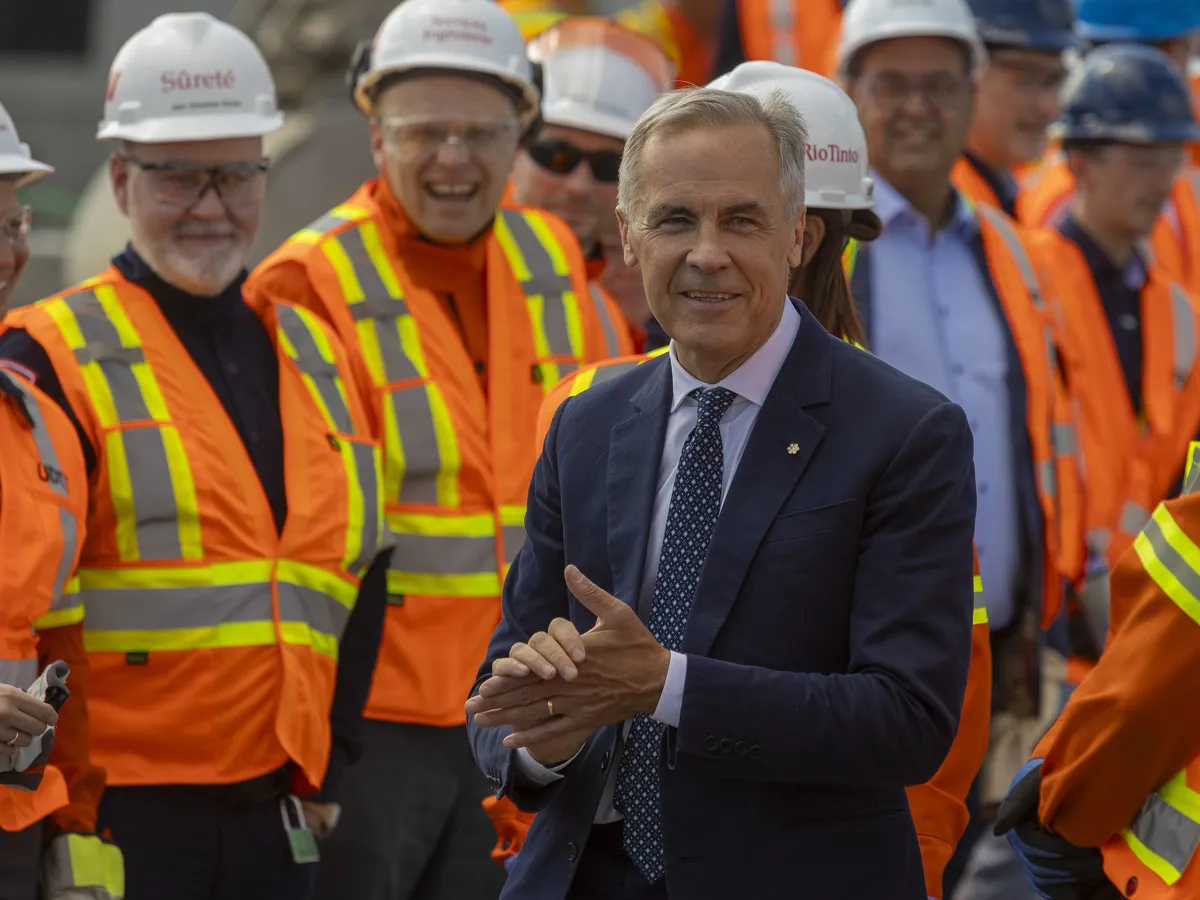
Skip to Content News Archives Economy Energy Oil & Gas Renewables Electric Vehicles Mining Commodities Agriculture Real Estate Mortgages Mortgage Rates Finance Banking Insurance Fintech Cryptocurrency Work Wealth Smart Money Wealth Management Investor Personal Finance Family Finance Retirement Taxes High Net Worth FP Comment Executive Women Puzzmo Newsletters Financial Times Business Essentials More Innovation Information Technology FP500 Podcasts Small Business Lives Told Tails Told Shopping Financial Post Store Obituaries Place a Notice Advertising Advertising With Us Advertising Solutions Postmedia Ad Manager Sponsorship Requests Classifieds Place a Classifieds ad Working Profile Settings My Subscriptions My Offers Newsletters Customer Service FAQ News Economy Energy Mining Real Estate Finance Work Wealth Investor FP Comment Executive Women Puzzmo Newsletters Financial Times Business Essentials HomeNewsEconomyCarney bets Canada can live with tariffs to unlock investmentCarney’s government, working with two large pension managers, has organized an investment summit next month in TorontoAuthor of the article:Prime Minister Mark Carney shakes hands with employees at Rio Tinto, a major aluminum smelter in Saguenay on August 6, 2026. Photo by Francis Vachon/PostmediaPrime Minister Mark Carney is on the brink of a trade pact with the U.S. His next challenge will be convincing his country that swallowing some tariffs is worth the greater economic certainty that a deal would bring.Subscribe now to read the latest news in your city and across Canada.Exclusive articles from Barbara Shecter, Joe O'Connor, Gabriel Friedman, and others.Daily content from Financial Times, the world's leading global business publication.Unlimited online access to read articles from Financial Post, National Post and 15 news sites across Canada with one account.National Post ePaper, an electronic replica of the print edition to view on any device, share and comment on.Daily puzzles, including the New York Times Crossword.Subscribe now to read the latest news in your city and across Canada.Exclusive articles from Barbara Shecter, Joe O'Connor, Gabriel Friedman and others.Daily content from Financial Times, the world's leading global business publication.Unlimited online access to read articles from Financial Post, National Post and 15 news sites across Canada with one account.National Post ePaper, an electronic replica of the print edition to view on any device, share and comment on.Daily puzzles, including the New York Times Crossword.Create an account or sign in to continue with your reading experience.Access articles from across Canada with one account.Share your thoughts and join the conversation in the comments.Enjoy additional articles per month.Get email updates from your favourite authors.Create an account or sign in to continue with your reading experience.Access articles from across Canada with one accountShare your thoughts and join the conversation in the commentsEnjoy additional articles per monthGet email updates from your favourite authorsSign In or Create an AccountorSo far, the emerging details of a draft agreement between Carney and U.S. President Donald Trump suggest Canada will accept reduced U.S. tariffs on its aluminum, steel and autos, and will remove its own retaliatory levies on those same products.Carney has said that no deal is better than a bad deal. But the former central banker is now betting that making concessions in return for more stability — even if it means facing persistent U.S. tariffs in some sectors — will help his longer-term goal of attracting more capital to Canada.SUBSCRIBER EXCLUSIVE: FP West: Energy Insider brings you behind the oilpatch’s closed doors with exclusive insights from insiders every Wednesday morning.By signing up you consent to receive the above newsletter from Postmedia Network Inc.A welcome email is on its way. If you don't see it, please check your junk folder.The next issue of FP West: Energy Insider will soon be in your inbox.We encountered an issue signing you up. Please try again“Dialing down the threat of ever-escalating tariffs and counter-tariffs has to be a plus for the investment environment in Canada, even if we still have residual uncertainty over trade with the U.S.,” Avery Shenfeld, chief economist at Canadian Imperial Bank of Commerce, said in an interview.Business investment in Canada has been soft for years. Excluding housing, gross fixed capital formation accounts for roughly 11 per cent of gross domestic product, down from about 14 per cent at the end of 2014.That weakness has hurt Canada’s wealth and productivity, and a revival in business investment has been a cornerstone of Carney’s economic plan since he was elected last year. His government’s 2025 budget pledged to “enable” $1 trillion in investments by 2030, a figure that includes government projects.Constant uncertainty has sapped business optimism, and greater stability in the U.S. relationship might provide a spark. Carney’s government, working with two large pension managers, has organized an investment summit next month in Toronto. The event — which will lay out a dealbook of potential opportunities for foreign investors to deploy capital in Canada — has a better chance of success if U.S. trade tensions have been quelled.“Assuming that the deal coincides with a lasting reset in relations, we think businesses would feel more confident to invest if they have stable access to the U.S. market,” Dominique Lapointe, a macro strategist with Manulife Investment Management, said by email.André Giguère, chief executive officer of Canadian furniture maker Canadel Inc., said the high level of uncertainty has plagued his decision-making.“We want clear rules of the game. We don’t want the rules to change halfway through the first period,” he said in an interview. “We want to be able to make a game plan for the coming years.”With Trump in the White House, stability is a relative thing. Even if a deal is done, the president has repeatedly shifted course on trade, delaying or changing tariffs and largely ignoring the terms set out in the Canada-U.S.-Mexico Agreement, which he signed during his first term.But even a limited agreement between Canada and the U.S. might narrow the range of possible outcomes enough to give businesses more confidence to invest. It would also remove the immediate threat of another damaging escalation.Trump’s threat of Section 338 tariffs targeted about US$20 billion of Canadian exports to the U.S., or more than five per cent of the total, according to economists at Desjardins. Trevor Tombe, a professor of economics at the University of Calgary, said those tariffs, should they take effect and remain in place, would cost about 90,000 jobs in Canada.The trade war has hit some sectors harder than others. Employment payrolls have fallen sharply in furniture, motor vehicle parts, forestry and wood product manufacturing — all sectors affected by trade actions. There has been less significant damage in steel, autos excluding parts, and aluminum.The government has already been pulling fiscal levers to stop the bleeding. It has ramped up budget deficits as part of an economic restructuring and diversification push. Carney could still boost fiscal support for the sectors that will face continued pressure from U.S. duties, especially given the solid international appetite for Canada’s federal debt.Various loan and job-sharing programs have been extended, helping to mitigate employment losses. This month, Transport Minister Steven MacKinnon announced rebates for companies moving Canadian steel between provinces, a measure aimed at boosting purchases of domestic steel.Trump has set an end-of-day Friday deadline to reach a deal, and Canada-U.S. Trade Minister Dominic LeBlanc said Thursday the countries were “very close.” Should an agreement with concessions come to pass, it would also mark the latest example of Carney’s willingness to take short-term political pain in exchange for longer-term economic gains.Some of the major infrastructure projects his government says are key to unlocking new economic growth — including a crude oil pipeline from Alberta to the west coast — have cost him support within his own political party.Those projects also won’t be completed for years, meaning any boost to growth and real incomes will also take time to materialize. For now, Carney has managed to gain public support as a strong economic manager, despite soft growth over the past year.“Facing another round of escalating U.S. tariffs and a continuation of very elevated tariffs on the affected sectors was not going to be a good outcome,” Shenfeld added, “even if it’s not a return to the free-trade world we’d like to see.”With assistance from Mathieu Dion Join the Conversation This website uses cookies to personalize your content (including ads), and allows us to analyze our traffic. Read more about cookies here. By continuing to use our site, you agree to our Terms of Use and Privacy Policy.
Carney bets Canada can live with tariffs to unlock investment
Prime Minister Mark Carney's challenge will be convincing Canadians that swallowing some tariffs is worth the economic certainty. Read more.
TL;DRAI
Canadian PM Carney negotiates U.S. trade deal accepting tariffs on auto/steel/aluminum to attract $1 trillion in foreign investment by 2030. The agreement targets Canada's weak business investment (11% vs 14% of GDP pre-2014), betting stable U.S. relations will restore investor confidence.
1,380 words~6 min read