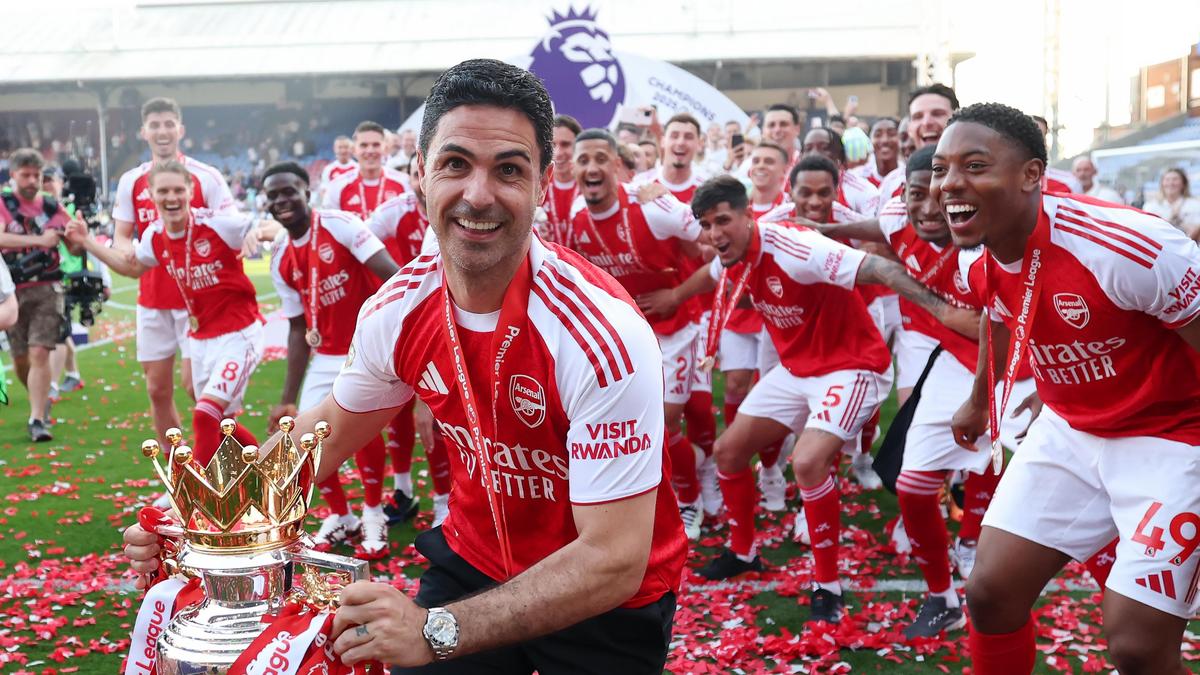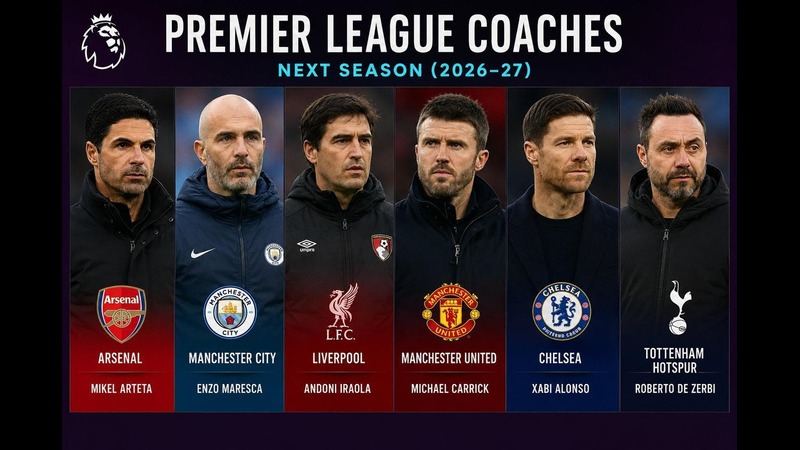
Only five weeks have passed since the World Cup final culminated at MetLife Stadium in New Jersey but the most popular domestic football league on the planet returns tonight in England.This is a Premier League season as fascinating for those who have departed as for those who have arrived.It was tricky enough to imagine Manchester City without Pep Guardiola but what on earth do they become without the lynchpins of his best years? Rodri, Bernardo Silva and John Stones all followed him through the exit door, and it is hard to envision that the master-planners in east Manchester hoped that Elliot Anderson, for all his potential, would be the sole arrival of substance for the opening weekend of the season.As for Enzo Maresca, he looks a little bit like Pep and plays a little bit like Pep, but can anyone really come close to Pep?As for when or what may happen with those 115 alleged breaches of Premier League regulations, we are now over three years on since the Premier League, in announcing the charges, pitted itself directly against its most successful team of the past decade. City have always denied wrongoing, saying they have a “comprehensive body of irrefutable evidence that exists in support of its position.”If Manchester City appear confusing, then what to make of the puzzling turn of events at St James’ Park? Eddie Howe walked out in pre-season and has been replaced by Matthias Jaissle, a 38-year-old coach whose previous experience was in Austria and Saudi Arabia. Oh, and he will be doing it without Newcastle United’s best two midfielders, Sandro Tonali and Bruno Guimaraes, who have departed for Tottenham Hotspur and Arsenal, while Anthony Gordon swapped Tyneside for Catalonia when he headed to Barcelona at the start of the summer. Newcastle go into their opening game with six new signings, four of whom are 20 or younger.Enzo Maresca has the unenviable task of succeeding Pep Guardiola at Manchester City (Carl Recine/Getty Images)There is unpredictability and nervous intrigue across much of the Premier League. Nine clubs have new managers, while Michael Carrick only joined Manchester United in January and Roberto De Zerbi has coached seven games at Tottenham Hotspur, so they feel pretty new too.Andoni Iraola played the most exhilarating football in the division last season but how will he cope with the step-up in scrutiny from Bournemouth to Liverpool? Will his intense brand of football survive the rigours of European competition?Are Aston Villa a team being ripped apart, picked off by Manchester United, Chelsea and Arsenal for Youri Tielemans, Morgan Rogers and now Ezri Konsa, or a team in exciting transition and ripe for reinvention under Unai Emery?Fulham have swapped five years of stability and growth under Marco Silva for a punt on Alvaro Arbeloa, whose five months in interim charge of Real Madrid left a dressing room in disarray but apparently provided enough encouragement for a passport to the Premier League.Nottingham Forest have hired Oliver Glasner, a coach who won an FA Cup and the Conference League at Crystal Palace, as well as a Europa League at Eintracht Frankfurt, but how will he fare as the club’s fifth coach in 12 months under demanding owner Evangelos Marinakis?Manchester United ended last season in title-competing form under Carrick, and, while incomplete, they appear to be building wisely. But how will the players respond now his position is permanent? Do they have the depth to compete when the demands extend to four competitions, having only competed in the Premier League during Carrick’s previous half-season in charge?Three storylines to watch ahead of this seasonGeorge Edwards and Rachael TindeBrighton & Hove Albion’s model is proven — developing well-scouted talents to produce big profits — but will they repeat the trick once more after selling Jan Paul van Hecke, Danny Welbeck and quite possibly Carlos Baleba and Yankuba Minteh?Promoted teams Hull City and Ipswich Town have recruited at least 11 players apiece, and Frank Lampard returns to the division with Coventry City, but can any of them replicate the success of Sunderland and Leeds United last time around?Everton appear to be constructing smartly under David Moyes, signing Hayden Hackney, last season’s Championship player of the year, as well as proven Premier League talent in Brennan Johnson and Christian Norgaard, but will results pick up after a disappointing end to last season?That’s the thing about uncertainty: it can be dressed up as opportunity or doom-scrolled into vulnerability.Optimism abounds at two of last season’s Premier League basket cases, where the good news is that results can, surely, only get better.Tottenham, repressed for so long in their spending and ambition, are suddenly flashing the cash like a slot machine, dropping £237million ($324m) already. They are set to spend £85m more on Manchester City’s Savinho. Omar Marmoush may still follow.Chelsea have hired Xabi Alonso, one of only three coaches in the Premier League to have won a big five top-flight title (at German side Bayer Leverkusen), and they have prioritised Premier League-ready signings in Morgan Rogers and Maxence Lacroix, while adding players they hope to be standard-setters in Jordan Henderson and Danny Welbeck.Both on the field and in the dugout, trends are emerging. Most notable is how the Premier League’s most famous clubs increasingly pillage the internal market for reliable and proven talent, rather than taking bets on cheaper or further-flung bets from across the continent or beyond.By the end of the window, Premier League clubs will almost certainly have spent a cumulative £1billion on players from within the English top flight. Manchester United will likely spend close to £150m on three midfielders from Villa, Chelsea and Brighton. Arsenal will spend more than £120m on players from Newcastle and Villa. Chelsea have spent more than £170m on players from Villa, Brighton and Crystal Palace. Manchester City spent £116m on Anderson from Nottingham Forest. Tottenham have recruited six players, all of whom played in the Premier League last season. Two of Leeds United’s biggest summer signings, James Trafford for £40m from Manchester City and Harry Wilson on a free transfer from Fulham, are domestic recruits.It all underlines the perceived strength of the Premier League and how most clubs see certainty in buying from within. Coaches, knowing their window of opportunity is narrower than ever, are often less prepared to take risks. Several clubs have been stung by excessive ventures into external markets in recent years, most notably Tottenham in Italy and Manchester United’s mistakes in the Dutch league under Erik ten Hag.Bournemouth, Liverpool, Newcastle and Sunderland are the only clubs yet to sign a senior player who played in the Premier League last season but as Liverpool track Minteh and Newcastle pursue Manchester City’s Nico Gonzalez, that will likely change.One of the consequences of so much domestic recruitment is the absence of fresh discovery, although there is plenty of localised excitement about Switzerland’s World Cup breakout star Johan Manzambi at Villa, the Bosnian defender Tarik Muharemovic, a £34million signing at Leeds, and Mamadou Sangare, a club-record £38.5m signing for Brentford from Lens, who finished last season second to Paris Saint-Germain in France.After a World Cup where so many games were dominated by individual stars — albeit won by the ultimate collective in Spain — it is striking that the Premier League’s supply of world-class talent is running a little low, both on the field and in the dugout.Mohamed Salah has departed Liverpool. Rodri has left for Barcelona. In recent years, the Premier League has lost Harry Kane, Michael Olise, Trent Alexander-Arnold, Julian Alvarez and Luis Diaz, all of whom may have made sense individually at the time, either due to contract situations or career development, but together, their departures have diminished the pool of headline names. The Premier League has only Cole Palmer and Gianluigi Donnarumma from the top 10 players to make the Ballon d’Or list in 2025.Mohamed Salah is one of the latest big names to exit the Premier League (Paul Ellis/AFP via Getty Images)The Premier League still retains the most potent finisher on the planet in Erling Haaland, Bruno Fernandes remains at Manchester United, and Arsenal have the best defence in world football. And their respective clubs will hope there is substantial growth yet in players such as Bukayo Saka, Martin Odegaard, Matheus Cunha, Cole Palmer, Alexander Isak and Florian Wirtz.Alvarez may of course yet return to the competition should Arsenal get their way and prise him from Atletico Madrid. Arsenal have worked hardest to add definitive star power to the league, having tried and failed to recruit Vinicius Junior from Real Madrid this summer.The Premier League’s best performers over the years, it should be said, have tended to be developed after arriving at English clubs rather than signed as bona fide superstars, with Real Madrid, Barcelona and Bayern Munich usually seen as final-destination clubs.Where the Premier League does differ this season, however, is in the coaches of its leading teams.Only 10 years ago, the Premier League began a season with Pep Guardiola, Jose Mourinho, Jurgen Klopp, Mauricio Pochettino, Antonio Conte and Arsene Wenger across its ‘Big Six’ clubs, all of whom, with the exception of Pochettino, had top-flight league titles to their name. The Premier League had become the galactico home of the world’s best coaches, the individuals who made the Premier League, and even its pre-match press conferences, feel unmissable.Yet this season begins with a selection of coaches who, while stacked with potential, are short of elite medals and whose mythology is yet to be written. Those same ‘Big Six’ teams are now coached by men aged between 44 and 47, and only Arteta has a Premier League title as a coach.In this regard, it is not that the Premier League is not attracting elite coaches, merely that the clubs have cycled at rapid speed through so many of the contenders to spearhead a new dominance. Ten Hag, Ruben Amorim, Arne Slot, Thomas Frank, Graham Potter and Ange Postecoglou were all spoken about as innovators, only to find that the burning spotlight of the Premier League can break reputations as rapidly as it makes them.Almost seven years into his reign, Arteta must sense an opportunity to not only defend his Premier League title but also push on to a period of extended dominance. Aside from the Arsenal manager, only the reigns of Emery at Villa and Daniel Farke at Leeds have exceeded three years.With this young generation of coaches, it begs the question of which, if any, will emerge as the new main characters of the Premier League, offering up the sideshows, barbs and rivalries that provide the necessary theatre to any sporting season. Who might emerge as the provocateur of the Premier League touchline and who might cast dark aspersions in press conferences? Will one coach step from the shadows and be the conscience of a league whose moral compass can often be found wanting?For all the flux, there is no suggestion that the Premier League is ceding popularity, wealth or market share. The power of the Premier League is that, even in emerging global markets, the attachment remains — not only to individual players or one-off coaches, but to clubs who have parked their lawns on television screens across the globe. And as former heroes depart, space is created for the next generation of defining characters to come forward.
An unpredictable Premier League returns with scope for fresh stars and new main characters
For all the flux, there is no suggestion that the Premier League is ceding popularity, wealth or market share. The league's power remains
1,881 words~9 min read