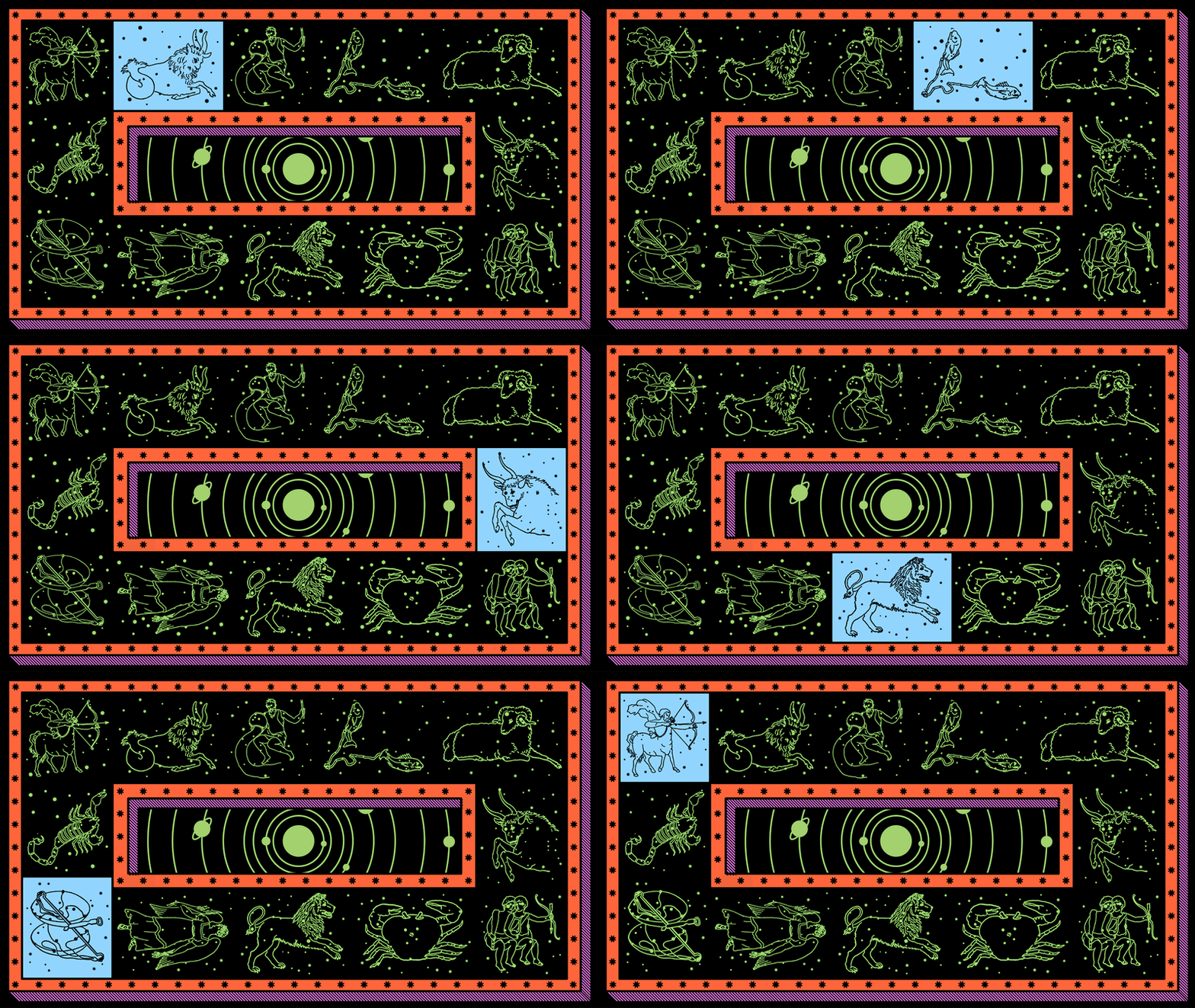
Over the past decade, the ancient divinatory practice of astrology has made a comeback. Windswept by a perfect storm of economic collapse, digital transformation, social upheaval, and political regression, the millennial generation washed up in adulthood and soon revealed themselves to be a lot more interested in astral prophecy (and communism) than their parents. This curiosity was fed by a new league of star astrologers on social media and eventually streamlined into billion-dollar astro-tech startups like CoStar and The Pattern. By now, the enthusiasm for astrology has been thoroughly institutionalized. The cult has become a church. But what does this AI-driven form of astrology still have in common with the star-based divination system formalized thousands of years ago by polytheistic priests? Long before humans formed anything resembling a civilization, our ancestors relied on the Moon and stars to mark time. Hunter-gatherers studied lunar movements to align their hunting seasons with the mating seasons of their prey. Early farmers mapped the sky to know when to plant their crops. It’s hard to say when exactly this practical relationship took an enchanted, or paranoid, turn. As far as we know, the thing we now call astrology was formalized in ancient Babylon, but that may be an accident of preservation. Their priests happened to write on clay, one of the only ancient materials that survives both fire and burial. Tablets from 4,000 years ago warn, "if an eclipse occurs in the evening watch, it signifies pestilence." It took only a few centuries for prescriptions of this sort to become a powerful tool in the hands of autocrats.Any Assyrian ruler worth his salt kept an astrologer on staff, alongside advisors who drew omens from the guts of dead animals or pools of water. (This made for a confusing chorus of more-or-less knowledgeable authorities, an IRL version of what many of us encounter online.) The rush of prophecy drove some of these rulers to crash out in epic fashion. One unfortunate tradition evolved where Mesopotamian kings, warned by the stars that their lives were in danger, installed a temporary replacement only to execute him.Over time, star-based divination became systematized, towards greater data collection and more conservative interpretations. Augustus regularly published his own horoscope to reassure Rome he wasn't dying. In 762 CE, the caliph al-Mansur had astrologers pick the date to lay the foundation for the city we now know as Baghdad. By the Renaissance, astrology was an ordinary subject at European courts and universities; popes held personal astrologers, and Catherine de Medici kept Nostradamus on retainer. For over two millennia, it was considered cutting-edge science and dictated policy all around the world. But then a German guy came along and, as usual, spoiled all the fun.Astrology’s golden age would be snuffed out by a scientist who practiced it himself. Swabian polymath Johannes Kepler moonlighted as a court astrologer, while dismissing the work of some of his colleagues as “mad ravings.” His attempts to reform the field—discarding the zodiac and houses—led him to discover the actual laws of planetary motion, and found modern astronomy. Building on Copernicus, he deduced that planets moved in imperfect ellipses around the Sun, not in perfect circles around the Earth, upending the prevailing cosmology of the time. A huge vibe killer: Astrology's authority had long rested on the heavens being perfect and geocentric. Kepler's math proved neither was true. Newton’s theory of gravity did the rest. By the mid-eighteenth century, astrology had been evicted from European courts and universities for the first time since Babylon.In response, Western astrology went into private practice. Liberated from court responsibilities, it became a free-floating system, available to any person or group disillusioned with the current marketplace of religion and science. This adaptability granted astrology numerous resurgences, boosted by new technologies, reaching new adherents across the political spectrum. It preoccupied occult fascists in the 1920s; jaded housewives in the 1950s; and hippies in the 1960s, who embraced the Age of Aquarius as part of a potluck of naturalist and non-Western thought.This collection is about astrology's latest constituency. What does the new new age say about us and about the staying power of this ancient form? Astrology today is strikingly absent from the halls of power. Meanwhile, other fallible predictive tools, such as economic forecasts and large language models continue to prevail. Today, astrology is for the commoners, and its appeal is intuitive. In an era narrowed by digital technology, the stars offer a rare opportunity to transcend the constant present and contemplate something like a future. When everything seems random, destiny becomes a seductive alternative to chance. Astrology connects us, sometimes to one another, but more often with a sense of everlasting self.But at what cost? Skeptics see astro's renewed popularity as part of a general resurgence of anti-science thinking—the kind of brain-worm that returns when the liberal order melts away—or a particularly useless form of navel-gazing while the planet burns around us.Beyond the reach of binary attitudes, a unique culture has evolved around the contemporary reinterpretation of this ancient practice. To get a sense of its contours, we asked a group of writers, artists, scientists, and astrologers to reckon with the ways they navigate superstition in our disenchanted world. The pieces here run the gamut from true belief and ironic consumption to total rejection, but all get at the question: Can the zodiac still offer us transcendence, or is it merely another way to ignore reality by looking for our own reflections in the stars?How millennials became the astrology generation.By Grace ByronThe summer before my senior year of college, I often found myself at picnics where lithe women wove flower crowns, and tarot cards were standard fare. The left-leaning outcasts of Bloomington, Indiana proudly pulled up their Cafe Astrology charts at every chance. The stars, it seemed, could explain just about everything: why they were crushing on a particular person, why we were friends with each other, why everyone was 'going through it right now.' This, if nothing else, was an easy shortcut to intimacy. We could learn each other’s Venus placements and skip straight to trauma bonding. Astrology spared us the difficult work of actually getting to know each other, or ourselves.One of my best friends at the time gave me a bag of runes hand-carved on beans that I was to sleep with under my pillow. Such esoterica felt like a rebellion against the stringent conservatism around us, the hallowed Christianity of many of our childhoods. We had grown distrustful of institutions, religious or otherwise, and had just begun to learn the art of protest. The feigned individuality of astrology offered another form of elevated community, a way to at once fit in and stand out.By the end of summer, this burst of counterculture dissipated as friends who had graduated moved away and others went overseas to study. The picnic table was empty. I started wandering the grocery store at night and drinking overpriced cosmopolitans at dive bars. Now that the bandwagon had moved on, I began to realize that I had enjoyed the community it brought more than their arcana. I made new friends—conceptual artists, the entire women’s rugby team—who rejected the nihilistic determinism of astrology, and instead processed the world through a combination of feminism and talk therapy. This seemed practical, by comparison.By the time I left the co-ops and communes of the sleepy college town behind, I had all but recanted my foray into magical thinking. I traded in my Virgo neuroses for turtlenecks and an OCD diagnosis. I stopped paying attention to Mercury retrogrades and Saturn returns. But when I arrived in New York, I realized the astro craze had taken hold there, too. In the years after Trump’s first victory, CoStar was founded, AstroPoets took off, and evidence piled up that the skyward orientation was a generational phenomenon.*My aversion to astrology puts me squarely in the minority among my cohort. According to a 2024 Harris Poll, 83 percent of millennials at least “somewhat believe” in astrology. (A staggering 56 percent of us report having paid for an astrology subscription, rising well above the 32 percent average of all American adults.) By comparison, only 62 percent of Gen Z report a casual adherence to astrology. How on earth did we become so esoteric?Speeding through the political chronology that accompanied our coming of age, you see a cascade of systemic collapse—9/11, the war on terror, the financial crisis, the rise of Trump—institutional crises that left deserts of meaning. Millennials emerged from this vacuum as the least religious and most left-wing generation of Americans in measured history. Our departure from organized religion didn’t lead us to its opposite—militant atheism, also compromised by the War on Terror—but to agnostic ambivalence. This relativist turn partially accounts for our peculiar attitude to star-based analysis. The number of millennials who say they strongly believe in astrology is only slightly higher than it was among previous generations (a historical constant hovering between 25–30 percent), but the number of us who are willing to indulge it is at a record high.The passive entertainment of this ancient craft only became possible in this peculiar age. Astrology apps driven by multi-billion dollar tech platforms like CoStar, not to mention the army of cosmic influencers on social media, appear as a hopeful distraction among our endless doom scroll. Previous outbursts of esoteric interest have followed a similar pattern. In the late 1920s and early 1930s, the Great Depression left many reeling and astrology columns took off in newspapers. During the civilizational rupture of the Vietnam war, the rise of alternative small presses flooded the market with occult books that fed the esoteric turn of the Hippie generation. Between such heydays, the reliable 25–30 percent of devoted adherents keep the culture alive, until history and technology conspire to produce another revival.The malleability of esoterica allows it to migrate across the political spectrum, always finding the newly disenchanted. In the twentieth century, astrology drew the interest of a new generation of occult fascists, who developed an opportunistic interest in the relation between stars and soil. Today’s new converts are overwhelmingly on the liberal-leaning side of the political spectrum. Chani Nicholas, for instance, is a popular leftist who reads the stars for her devoted following. But even a platform as popular as CoStar skews left, with its preference for a style that combines poetic prose and therapy speak.The aesthetic of a lot of astrological content has emphatic Eastern touches, suggesting either Gnosticism or a Vedic influence. This offers another hint at why a portion of the left has turned to the stars. Unlike religion and science, astrology appears untainted by Western hegemony. It couches individualistic self-importance in communal terms—what is more social than the universe?—and cloaks our navel-gazing impulses in ancient dignity. As Lauren Oyler observed in The Baffler: “Astrology lovers today feel less need to mask their self-obsession; they relish it, brag about it on social media, even claim it as political.”Unburdened by colonial baggage, astrology has special purchase in the communities that have been most harmed by organized religion and patriarchy. Among millennials, queer people have emerged as a reliable base for astrological speculation. The Harris Poll found that 61 percent of LGBTQ Americans said that astrology gave them more confidence. “This false empowerment of the excluded is the seductive appeal of astrology for leftists and the LGBTQ+ community,” Lucian Staiano-Daniels observes in Foreign Policy. This line of argument has a long history on the left going back to Adorno: astrology, particularly in its modern manifestation as horoscopes, mimics the cruel determinism of the market, and offers a consumerist approach to identity and community. At its best, it’s pointless fun; at its worst, it’s an extremely roundabout way to mask our self-righteous excesses.But does astrology really stand out as a toxic pursuit in our capitalist hellscape? Many other popular opiates have similar problems. Self-righteousness is, after all, a common side effect of talk therapy. Organized religion and politics can be an equally myopic and dusty prism through which to perceive one’s destiny. Sports fandom (arguably the straight man’s astrology) can also be an easy way to astroturf community, and attach one’s wellbeing to a rotation of stars beyond anyone’s control. What’s the harm in a little bit of esotericism?*I have so far resisted the temptation to join a few of my crunchier friends on their regular pilgrimages to their eerily accurate trans psychic in South Brooklyn. If anything I’ve found going to synagogue, Quaker meetings, or Buddhist sanghas more fulfilling. Organized religion seems more communal and charitable to me. Churches at least feed people—and, for better or worse, have a history of driving political engagement. But these are merely different strategies for suffering. Like my own desire for control, they’re a fantasy, a balm for the breaking apart of communal life under late capitalism.Many of us are searching for methods to simplify the overwhelming chaos of the postmodern world. Talk therapy. Religion. Literature. Astrology. Nevertheless, it would be foolish to assume that all these systems have equal clarifying power. No matter how much logical information we run through it, an ancient system derived from a two-dimensional misreading of our galaxy can only illuminate so much. Astrology is a vast projection space for wishful thinking with all the beauty, comfort, and folly that comes with it.In retrospect, the astro craze says more about us than the enduring power of the form itself. It is a reflection of millennial malaise—a popular coping strategy for a generation of digital semi-natives, born early enough to mourn the disappearance of the old world and too late to feel fully at home in the new one. Gen Z, based on all surveys, are already a lot less enthused. The astrology revival, popular as it may be, seems destined to get old with us.And she has bad news for you.By Theresia EnzensbergerMy mother is an astrologer. She has boundless knowledge of the stars, their constellations, the ephemerides, and ancient Mesopotamia. She can read anyone’s birth chart, but you can’t hire her to do it. She finds being paid to talk about astrology unserious, even frivolous. But if you come over to her house, and find her in the right mood, she’ll turn on her ancient, rumbling computer after dinner and stare at the lines of your birth chart, only to arrive at a verdict that will likely upset you.There might be some fun stuff in there, too. She’ll guess the professions of your parents correctly. She’ll make some vague but poignant observations about your character or choice of partner. But in the end, your prospects will be gloomy. I’ve heard her tell people that they are in the wrong profession, that they should get a divorce, that they are on the wrong path entirely. She is not trying to be a dick. She's just being honest. The universe is chaotic. Human existence is full of pain and folly. Astrology must account for that.My mother takes her field—one that is either maligned as nutty and unscientific or dressed up in a sparkly, ironic guise—extremely seriously. And she is holding onto that in a milieu that is at best bemused by such things.My father was a writer, and sometimes, against his will, a kind of public intellectual. My parents’ world was populated by cranky poets, argumentative linguists, decayed but erudite gentry, polyglot radicals, glamorous seniors, and the occasional millionaire. I remember my mother at these dinner parties, chatting unselfconsciously about the alignment of the stars. Often, it made people open up to her. The most unlikely candidates would tell her about pending divorces, secret girlfriends, or financial problems. More often, she got side-eyes and snide comments. On one occasion, I remember her getting into a full-on sparring match with a Nobel laureate in Physiology. These people fancied themselves the ultimate eccentrics, but my mother’s interest in astrology brought out their conventional sides, the limits of their narrow definition of respectability.For a while, I wasn’t much better. During my early teenage years, I became a humorless ambassador of scientific veracity. In many ways, the tamest rebellion imaginable: I’d prance around eye-rolling while she explained everyday occurrences with the position of Saturn and Uranus. I didn’t get this patriarchal attitude from my father. He kept the same ironic distance to astrology as he did to all overarching systems, though he fully accepted that part of my mother. Whenever asked about his belief system, he’d say something about “calmly revering the unfathomable,” quoting Goethe, I found out later. They both had a thing for the Romantics, so the contempt I had for the unexplainable was definitely not homegrown.My own stance on astrology softened when I started dating. Nothing will make you turn to the stars quite like a string of terrible boyfriends. My mother was happy to help.Why is he so brilliant at parties, but so boring at home?He’s a Gemini, he needs the audience!Why is he always trying to split the bill?Capricorns are just careful with their money.And the classic: Why is he not texting back?Neptune is in his third house, so naturally, he’s a bad communicator!Astrology gives you the tools to both overanalyze and justify the shitty behavior of your crushes. It breeds a strange kind of tolerance that reinforces the worst instincts of the lovesick and horny. In that way, it is the unholy opposite of the boundary talk that was the essence of millennial therapy babble.My new interest in astrology happened to coincide with its pop-cultural renaissance. Suddenly, astrology was cool. It was queer, it was woke, it was SJW- and girlboss-compatible. All the knowledge I had soaked up against my will, contemptuously listening to my mother, now amounted to social currency. My friends were thrilled that I was astro-literate, and I was thrilled to have this specialized avenue to learn more about them.In a way, I was more at home in this new era of astrology than my mother. This became clear when she had a short stint writing monthly horoscopes for Vogue Germany. The editors didn’t like her gloomy snark, and she didn’t like to be steered in a light-hearted direction.She felt much more at home in the pages of the cranky national daily she wrote for years earlier. In her weekly column, penned under the outrageous pseudonym “Trevira Buddensieck,” she tracked the geopolitical fortunes of world leaders like Putin, Merkel, and Obama based on their birth charts, and analyzed the “birth dates” of events like the soccer world championship or the German national election.I admire her confidence, her ability to remain undeterred by the demands of habitus and high brows. Sometimes, her taste naturally coincides with the expectations of her milieu: She will read 1,000 pages of Luhmann in one sitting, wrote her master’s thesis on Djuna Barnes, and loves to talk at length about Jean Genet. But there is no amount of patronizing disapproval that will make her conform to the expectations of others and disavow astrology. Instead, she integrates the two worlds. If challenged, she doubles down—like one instance in 1989.After enduring a painfully self-aggrandizing birthday party that my father’s publisher threw himself in Venice, she summarized the scene in a short story. It’s a story à clef, a deliciously sardonic satire of the German publishing world. Her protagonist is the astrology-obsessed wife of a German poet, who finds herself adrift in a universe of “greying elderly gentlemen, each his own planet, united only by a duty to orbit the publisher—their sun.” Peter Handke makes an appearance (“an Austrian writer . . . who cultivated the aura of the perpetual youngster, just without the enthusiasm”), as does Max Frisch (“an extroverted newt [who] almost managed to climb to the position of cheerful patriarch”).The story produced a minor scandal. The elderly gentlemen were not amused by her portrayal of them. The publisher declared her persona non grata. A win on all fronts. My mother’s academic background in literature and decades of astrological inquiry had conspired to make her a cuttingly good reader of people.Of all the spiritual pursuits, astrology is the most literary. You have to suspend your disbelief, but once you’re inside the story, the world building has its own, stringent logic. Analyzing a chart is not unlike analyzing a poem: the building blocks—the stanzas, if you will—are houses, constellations are meters, and the planets, being named after Roman gods, provide symbolism and metaphor. Maybe it’s because of my mother’s literary bent that she expects astrology to account for the dark sides of our lives.While I learned a lot about astrology from my mother, the more important lesson, I think, came from her stubborn refusal to bow to the pressure of polite society. Even today, it is considered a provocation in Germany to venture too far outside the bounds of “serious” literature. I credit my mother with mostly feeling free from this arbitrary dictum.My interest in astrology has waned a little in the past years, maybe due to a lack of shitty boyfriends. But when I call my mother, I still ask her about people’s rising signs, about the current constellation and their impact on current events. The older we get, the harder it becomes to communicate with our parents. References are lost, politics diverge, and emotional baggage piles up. It feels ever more important, then, to still have a shared language. Astrology has become a way for me to connect with my mother, to use a common vocabulary for gossip, feelings, and big life decisions. The milky way, it turns out, offers common ground that would put the best family therapist to shame.Was the grumpy German philosopher right about astrology?By Jamieson WebsterIt's funny and a bit sad to picture Theodor Adorno, titan of critical theory, spending his winter sojourn in sunny Brentwood seething over the LA Times’ horoscope section. But there he was in 1952, fresh off the boat—a severe exile, back in the U.S. to preserve his citizenship—clipping out astrologer Carroll Righter's daily aphorisms about what the stars had in store for Virgos and Leos. He spent three months parsing sentences like "follow up that intuition" and, far from harmless esoterica, found the same root credulity that had given rise to fascism. In the generic horoscopes of a second-rate conservative newspaper, Adorno saw millions of Americans learning to cheerfully accept their own powerlessness.The title of Adorno’s study, The Stars Down to Earth, has always spoken to me. Maybe I held off on reading it because I indulge in my own horoscope, and was hesitant to let a grumpy Freudo-Marxist spoil the fun for me. Eventually circumstances forced my hand. Among a resurgence of astrology and far-right governance, Adorno’s thesis that esoteric belief is a symptom of impending authoritarianism suddenly seemed too urgent to ignore.Adorno's diagnosis stings. In his view, occultism must be seen as part of the Enlightenment, not its failure. “The enlightenment overreaches itself,” he writes memorably, by which he meant that it produced a mentality so brittlely rationalistic that it was unable to resist mythology. The ultra-rational modern subject might not be open to magic or witchcraft, but per Adorno is unusually open to secondary forms of superstition. These folk beliefs mimic the structure of rational inquiry, but are much more totalizing. This theory might help explain why so many tech CEOs believe in race science; or why so many intellectuals I know read their horoscopes religiously.Adorno’s primary critique of astrology is that it robs people of their agency. “While the astrological way of thinking is indicative of a ‘disillusioned’ world, it enhances disillusion by surrendering the idea of the human even more completely to blind nature than it actually is.” The rotation of planets in one’s chart is an overdetermined system, where destiny is decided from the time we draw our first breath. In that way, it mirrors capitalism. Mars in the seventh house, born with a trust fund—what's the difference?According to the theorist’s logic, astrology offers a fateful but false sense of comfort. While its scholarly cousin, modern astronomy, reveals the cosmic insignificance of Earth amidst billions of galaxies, astro recasts the same universe in pleasingly anthropocentric terms. It thus fills an epistemic gap that has become progressively wider in recent decades, and produced ever-deeper reserves of alienation. Significance and insignificance have become harder to distinguish from one another. Adorno would have had a field day in our current media environment—with astrology social media apps that link to your stock trading accounts and dating profiles—if he’d been able to function at all.In the 1950s, Adorno envisioned modernity as a barely tolerable reality, built by barbaric social, political, and historical forces, upon which its subjects were nevertheless entirely dependent. We may not be more dependent on these forces than ever, he speculates, but we are more aware of our dependence, and as a result feel more helpless. This feeling is exacerbated by our civilization’s obvious suicidal tendencies, which persist despite all our knowledge. Adorno, at the time of writing, is obviously thinking about nuclear war; we might think of the climate crisis and backsliding democracies.He notes that while the Los Angeles Times column is fairly genial, many astrological outlets are quite apocalyptic, filled with prophecies of doom and gloom. Astrology, then, offers us a mirror of a society careening towards disaster.The good Marxist wants us to take responsibility for our dependence on regressive social and political forces, so we can take matters more fully into our own hands. Denial makes us disposed to both occultism and authoritarianism, two sides of the same coin. We entrust our destinies to omnipotent forces that—at least at first—seem “very far away.” This has soothing effects, even when we don’t take the matter entirely seriously. We are dreaming and we cannot wake up.To me, this assessment is both right and excessively mean. My colleague Aris Komporozos-Athanasiou argues that this disparagement of the masses is beside the point. He sees in the return of astrology a new form of imaginative community linked to societal shifts towards speculation over stability. Yes, a bit like cryptocurrency, but nevertheless, a community that is decentralizing structures—from banks to more accepted forms of religion—and trying to embrace volatility and the unknown. Trying may be the operative word. The question remains: How can such an embrace of volatility lead to anything but a return to retrograde politics? Importantly, people are responding to real epistemic and societal shifts. We are all looking for something new to orient us together.I was reminded of an aside by the psychoanalyst Jacques Lacan, who warned that the attempt to find orientation in a “constellated sky,” against reference points in culture, will eventually pulverize us. The stars, so very far away, can only lead to a magnification of the self because there is no fixed point of orientation. We want to claim the heavens, but they only take us further from ourselves and each other.If we are becoming more and more “narcissistic,” as many claim, it is because we are incredibly disoriented in a world that places the responsibility for creating meaning on the individual. The ideals that used to ground culture feel ultra-abstract in a system that commodifies everything. This recognition, when the old solutions no longer hold, is often the moment that one seeks a psychoanalyst. The question of what one wants is the beginning of responsibility. This is the very agency Adorno demanded. The return of occult practices and the rise of authoritarianism, then, are mere symptoms of a world unable to contain its contradictions. We’ve lived through a period of great prosperity, but the equality, peace, and freedom that were promised now seem like an exclusive privilege, if not an ever-more distant mirage. We are at the end of a line of thinking. What’s next? What can we better take account of?At the risk of sounding naïve, what if we are finally waking up? When I fell in love with Adorno’s title so many years ago, I thought of those wishes you make when you look up at the stars. All that longing projected onto other worlds—so painfully far away. I heard Judy Garland singing, a very different tune from Adorno’s and yet with a similar understanding of what we seek: “Someday I’ll wish upon a star, and wake up where the clouds are far behind me.” If little bluebirds fly, “why then, oh, why can’t I?” This is the note of maximal pain. The one that makes us want to leave and join some other “out there,” far away from here.We want to go home, but ironically, we imagine flying up into the sky, into the unknown. This isn’t a mistake: the unknown is the right direction. More than ever, we need the stars down to earth. What I hear from my patients who tarry with occult spirituality is a desire for an unknown that is always right here. The radical task, then, is not to look away but to look closer—to remain alert to the quotidian mystery of everyday life on this planet.Best taken with a grain of salt and a group of friends.By Alice Sparkly KatAll horoscopes are satirical. Sometimes, the astrologer will say something like “You’ll meet a very sexy stranger tomorrow” or “Next week might suck a little.” This is best understood as a little cosmic joke, designed to help us hold half-truths.Horoscope reading is speculative reading. The reason why we read horoscopes is not to figure out when we need to turn in a project or who to date, but in order to bring myth back into our lives. If you are a Sagittarius, never forget that you are part centaur.Don’t treat your life as fantasy. Divination is an act of perception and you must commit to perceiving reality. If you are a Pisces and you identify with the ocean, then you must never forget that the Atlantic is haunted or that the Pacific is militarized. You can read all twelve signs, just one sign, or just the overview. The word or phrase that helps you imagine possibility might not be in the horoscope for your personal Sun sign, but in the horoscope for the zodiac sign that reminds you of a friend who matters to you.Never read horoscopes with regular consistency. Read them when you run into them, when you pick up a discarded newspaper on a bench. Forget about astrology for a few months and then come back to it.Horoscopes are friendship prompts. Do not read them on your own. Read them with people at the dinner table. Call up a friend who asks you good questions on the phone and read their horoscope to them. Ask them to read yours to you. The astrologer who is writing the horoscope does not know you, but your friends do.The classic book of astro-personology that spooked college students across America.By Claire L. EvansEvery college house has a copy of The Secret Language of Birthdays somewhere. At the Compound, the two-bedroom I shared from 2003 to 2006 with five people around the corner from a muffler shop in Highland Park, it was usually found near the threadbare porch sofa where we lingered day and night over coffee and Parliament Lights. Like the Hammond Organ, the glass-topped coffee table set on a cream ceramic panther, the pleather dinette chairs, and a series of orange tabbies that shepherded the house’s tenants like Charon on the short walk to campus, it belonged to nobody.My space at the Compound was a converted mudroom with linoleum floors, by far the draftiest room in the house. It was filled with furniture and art that predated me by several generations. The house had been handed down by graduating upperclassmen so many times that nobody knew whose name was on the lease, and in the three years I lived there I never met a landlord, not even after the plumbing started seeping into the side yard, killing what remained of the lawn.The Secret Language of Birthdays is an astrology book, or at least that’s what we believed it to be as we ceremoniously read each other’s entries out loud on the porch. But this 800-odd page doorstop of marginalia and compatibility charts is the product of its own idiosyncratic art—a “personology” reverse-engineered from the outstanding personality traits of some 14,000 famous individuals. “If one considers astrology to be heaven-oriented,” explains the book’s author, Gary Goldschneider, “personology is earth-oriented.”Goldschneider was a former child savant; a scholar trained in psychiatry and medicine at Yale; a pianist known for his marathon concerts. In Amsterdam, 1984, he played all of Beethoven’s 32 sonatas in one sitting for an audience of 10,000 people. A year later he did Mozart’s. His parents were both born on New Year’s Eve, 1913—and, accounting for the time difference between Russia and the U.S., at the exact same stroke of midnight. Thus began a lifelong obsession with birthdays. His book has sold 1.5 million copies and counting.His system doesn’t preclude the zodiac; it grounds it. The Sun and the Moon and the stars run their clockwork in the sky, but on Earth, it’s the seasons that turn—which Goldschneider presumed may have a more immediate effect on a person’s temperament than remote celestial bodies. A Scorpio is an autumnal personality, for example. Everything living traces its cycles of life and renewal along the procession of equinoxes and solstices, a terrestrial timeline yoked to the stars. For Goldschneider, personology was a multi-scalar, cyclical theory of nature, a worldview summarized by the maxim: A day is a year is a lifetime is an age.In The Secret Language of Birthdays, every birthday corresponds to a phase of life; the Scorpio-Sagittarius-cusp, my affliction, is linked to the period around 56 years of age, to the onset of the winter cold, the last actionable moment to set things right in life. Goldschneider substantiates this interpretation of astrology by citing Jung, Hegel, the Hindu wheel of time, Yeats’s widening gyre, medieval alchemy, George Gurdjieff, Maslow, Freud, and the Rosicrucians.Not that we ever absorbed any of this on the front porch at the Compound. If a birthday can be imbued with meaning based on the people who share it, why can’t a house? Some of the younger cohort, myself included, unsuccessfully lobbied to rename our abode the Batcave. The bathroom walls were painted an oddly flattering lime green. Bicycles and drum sets evaporated from the unlocked, cluttered garage. An ancient avocado tree dropped fruit on the roof; we gathered them in paper bags and left them, hard as stones, in a kitchen cupboard until they all ripened at once, setting off orgies of guacamole. In a square of dirt in the front garden we grew a single radish the size of a tennis ball. The rent was $200 a person and 20 years later, what we still talk about is the radish. I had three good birthdays there. My birthday, according to Goldschneider’s personology, is the “Day of Elegance.”The Elegant—myself, Charlie Johnson, Voltaire, René Magritte, Goldie Hawn, and a stunt pilot named Phoebe Omlie, to name a few—are an “emotionally labile” bunch: aloof, tasteful, and prone to self-destructive rebellion in their first 28 years. There are many things that happened in the Compound that I regret—impulsive romances with older men who regarded my dirty ears with amusement and one particularly thunder-licked decision to leap into a car with broken tail lights and go joyriding up a mountain pass in a torrential rainstorm with four of the most reckless people I’ve ever known. I also regret giving my email password to my first boyfriend, who wielded it with malice. In middle age we Elegant lose our flair for danger and grow cold, sleek, and so emotionally impenetrable, even to ourselves, that we risk calcifying into stone.The only antidote for the Elegant, Goldschneider advises, is to reveal ourselves before it’s too late: “There are few lasting virtues in being cool,” he writes. At the Compound we were all extremely preoccupied with being cool, everyone save for my roommate Annie, who in a paroxysm of self-consciousness renounced being a scenester to devote herself to Latin (I remember genuinely struggling with the ratty sweater coat she chose to signal this disavowal). In her retirement, she looked—god forbid—comfortable, which is all she wanted to be. Annie was right, of course, but it didn’t really matter; none of us were cool to begin with. Myspace had just launched. The digital cameras traced wormlike light trails across our party shots. I collected pictures of whales and narwhals and hid typewritten May ’68 slogans in returned library books.The Compound is only a few miles from where I live now, as I approach, to my great befuddlement, the preordained autumn of my life. The last time I walked by, trying not to look too closely, there were two college kids on the porch, both breathtakingly beautiful, soigné in Y2K vintage. I thought, “A day is a year is a lifetime is an age,” but that’s not how we dressed in 2005. Our coolness was never so studied, so referential. The seasons are still turning, although these days it feels more and more as though they’re turning inwards, each cycle rewriting the last. The Compound kids were reading together on our couch. I couldn’t tell what the book was. But it was January 15, the Day of Heroic Inevitability, so I can guess.We should study it anyway.By Philip BallFor most of human history, astrology seemed a perfectly reasonable way of predicting earthly events. The Moon pulled the tides, the Sun warmed the soil and drew water into the sky. Why shouldn't other celestial bodies co-determine our health and fortune just as much?This logic was state-of-the-art, until a greater one supplanted it. By the nineteenth century, scientists had developed theories of nature’s invisible forces and ways to measure them accurately. The astrological reasoning that once seemed so sound fell apart. The stars were too distant, their influence too weak, the predictions drawn from them performing no better than chance guesses. Scientifically speaking, astrology turned out to be bunk.That isn’t to say that we shouldn’t study it historically. On the contrary: understanding why our ancestors found astrology plausible—and why scientists eventually abandoned it—can teach us something crucial about the past, prediction, free will, and the new speculative technologies we're building today.*Like astrology, science is all about making predictions. No theory is worth much if it can’t predict what we might see in the real world. Ancient astrologers believed that celestial bodies radiated “emanations” which dictated matters on earth. Physicians from the time of ancient Greece through the Middle Ages believed that our disposition was governed by vital fluids called humors, and the stars and planets were thought to exert a sort of tidal pull or a warming effect on these fluids, determining the state of our health. The close coincidence of the lunar cycle and the menstrual cycle was one of the most obvious of these occult (that is, invisible) connections. (It is indeed just a coincidence, albeit one still widely imbued with significance.) Astrology reflected a belief in sympathetic magic, the idea that things that look similar are linked together by an invisible web of influences.Invisible influences? Occult forces? Despite these mystical labels, such things really do exist. Gravity is one of them: a tug that anchors us to the ground. But by the seventeenth century, a new class of natural philosophers, such as René Descartes, insisted that all processes in the physical world were mediated by direct physical contact between objects or particles.Subsequent breakthroughs in physics have revealed new flaws in astrology’s conceptual framework. The steady and predictable motions of the stars themselves have shifted the constellations over many centuries, rendering the old astrological zodiac out of date now. Given the intrinsic evolution of gravitational systems, the claim that the precise configuration of planets at a person’s birth can reliably determine personality or destiny is scientifically untenable.In the seventeenth century, gravity alone seemed to undermine that idea, apparently acting “at a distance” and instantaneously across empty space. When Isaac Newton first developed a theory of gravity, he was content to accept it as an invisible and inexplicable force akin to magnetism, leading a rival to accuse him of invoking a “scholastic occult quality.”Gravity's occult reputation is a reminder that today's fringe idea can be tomorrow's established science—which is one reason why astrology remains, for historians, a genuine waymark in the evolution of ideas. It’s short-sighted to dismiss it as a ridiculous superstition left over from a pre-scientific age. Instead, it’s best understood as an early example of the kind of speculative conceptual framework that is often needed to bridge a gap in scientific understanding before something better comes along.The modern cosmological idea of dark matter—another necessary but literally “occult” influence in the cosmos—arguably serves a similar function today. Astrophysicists invoke it to account for some invisible source of gravity, but no one has the slightest idea what it is, or if it is really a new form of matter at all. In short, we still need to speculate about things unseen and unexplained, and shouldn’t be afraid to do so. In that way, astrology might also be a useful north star: understanding why it seemed plausible and why it ultimately failed may help us track our latest leaps of judgement.*While dark matter earned its place by explaining phenomena we already see, astrology always promised more than that. Its alleged ability to predict the future—say, to forecast outbreaks of war or disease, or the fortunes of individuals—was controversial even in its day. Some of this controversy was about whether astrologers could really know those things in advance, but some was driven by an acute fear that they could. Did anyone truly want to know what disasters awaited them? The question would recur in a new guise when science seemed to promise its own form of prophecy.For if, as Newton implied, the natural world runs according to laws that govern the motion and interactions of objects, shouldn’t everything be as predictable as clockwork? In this view, the limitations of our predictions stem simply from limits on how much we know about all the objects in the universe.If there were some kind of all-seeing creature—say, a God or a demon—that knows the current position of everything down to the last atom, and the exact mechanical laws that dictate their motion, this being should be able to plot out the entire future. That idea was formalized in 1814 by the French mathematician Pierre-Simon Laplace. The thought experiment (now dubbed “Laplace’s demon”) seemed to spell doom for free will. We might regard this as a kind of extrapolated astrology, a predictive capacity generalized beyond the stars to include everything that exists. But modern physics has complicated matters for Laplace’s demon. For one, we now know that there are systems of interacting objects whose trajectories are exquisitely sensitive to their starting positions. Move the objects just the slightest fraction, and eventually they will end up taking very different paths. This means that we could never gather precise enough information to predict where, for example, all the planets will be with certainty over very long timescales.The discovery of quantum physics in the early twentieth century introduced an element of unpredictability and randomness to the finest grain of the physical world. This is not because we don’t know enough about the particle in question; it’s a fundamental limit on what is knowable. According to some scientists and philosophers, the unpredictability introduced by chaos and by quantum physics doesn’t rescue free will because we can’t do anything about it. Others think that, far from making the universe nearly deterministic, modern physics blows determinism apart and makes many futures possible.*But even if the future is open, how do we get to choose? After all, only one thing ever actually happens; the question is why it happened and not another thing. Even if we genuinely have free will, that doesn’t mean we can do anything we like. We can’t will ourselves to fly or to grow a hundred feet tall. What we can do—and more generally, what can happen—is highly constrained, by the laws of physics and chemistry and biology but also by the laws of the land, social conventions, and by what has happened before.And yet the appetite for prediction has only grown. The more data we have, the better our predictions are likely to be, even if they will never be perfect. Today's equivalent of ancient celestial charts are algorithms such as large language models. Embedded in chatbots, they anticipate the most likely next word from the statistics of word order in all the texts they have been trained on. And we’re using them to predict real futures, too. Financial analysts are using AI to forecast the markets, while biotech companies are increasingly interested in using AI to predict a baby’s future health and personality from their genes.Some of this prediction will work well, because AI is very good at spotting past patterns that can be expected to recur. But much of it is no more scientifically valid than ancient astrology. Both endeavors mistake correlation for causation. At their worst, LLMs are hardly more reliable than the fictitious “correspondences” that astrologers thought they saw in nature. The future, alas, is not written in the stars, encoded in our genes, or computable by algorithm, though our desire for it to be otherwise seems perfectly hardwired.Face-to-face with Joan Quigley, the astrologer who stage-managed the White House.By Joey FrankOn July 2, 1776, representatives from the 13 colonies gathered to ratify the Declaration of Independence when the Moon was full in Capricorn. They chose to celebrate the nation’s birthday on July 4th, once the Moon had moved into Aquarius. At the time, the most popular non-bible books in the colonies were almanacs. All of them featured a table of moon phases for farmers, and virtually all contained a woodcut of the Zodiac Man. Did the men in Philadelphia set America's Sun in Cancer to align their experiment with the crab, fortified in its shell, scurrying along the Atlantic’s edge? I’ve long suspected they preferred an Aquarius moon because they wanted the dream life of the nation to be rooted in intellectual independence. In astrology, scheduling is everything, and we Americans are nothing if not star-spangled.In the spring of 1988, Donald Regan, Ronald Reagan’s recently resigned chief of staff, published a book about why he had quit. Regan had found it impossible to do his job because the president was in the thrall of higher powers. Scheduling Ronnie’s day-to-day required Donald to first clear every major event with the president’s wife Nancy, who in turn had to run the date and location past her astrologer in San Francisco. Nothing moved—no speech, foreign trip, or summit—until a woman named Joan Quigley had checked the stars.Regan’s revenge arc sent the White House into crisis management mode. The president’s liberal critics, who had always detected something unserious in Ronnie, were having a field day. His evangelical base didn’t appreciate the contention that the president was under the influence of black magic.At first, the White House denied the story, then half-denied it, and finally admitted it in a way that seemed more palatable: Nancy had turned to astrology as a trauma response after John Hinkley’s 1981 attempt on her husband’s life. (Calling Joan from her husband’s bedside, Nancy reportedly asked if her astrologer could have seen it all coming. Yes, Joan said without hesitation, she would have prevented it.) The official narrative became that astrology had never guided the president, let alone his administration, but had simply served as an emotional crutch for his panicked wife. It was a forgivable story, even a sympathetic one. The only problem: It wasn't true.The Reagan couple had, in fact, entertained a rotation of astrologers since the early 1950s, first in a social and later in a professional capacity. Joan Quigley started consulting with Nancy Reagan in 1973, and was on the payroll of Reagan’s 1980 presidential campaign. In that year, according to Quigley, she helped schedule Reagan’s debate with Carter, all the way down to the timing of his most memorable punchline (“There you go again”). Her work only picked up after John Hinkley’s misguided 1981 attempt to impress Jodie Foster. From that moment until nearly the end of Reagan’s second term, Quigley said she effectively co-managed the presidential calendar: when Reagan should travel, when he should sign legislation, when the timing was right to shake Gorbachev’s hand in Reykjavík.If Quigley was even half as influential as she claimed in her memoir, What Does Joan Say?—a parallel history of the Reagan White House, where every decision prompted the titular question—astrology had helped shape a decisive period in American history. The arch-conservative president, who arguably did more than any other to create the country we now live in—destroying unions, taking our foreign policy underground, defunding libraries, and ending the evangelicals’ self-imposed exile from electoral politics—was informed by a system still widely associated with the counterculture. This was strikingly off-brand: Ronnie’s anti-hippie track record, well-established since his Bloody Thursday crackdown at Berkeley, had always been essential to his appeal.The Reagan White House did its best to suppress this alternative history, but they never managed to shut up the astrologer at the heart of it, Joan Quigley, who I’d meet in a Hong Kong hotel room 19 years later.*I was born and raised in Reagan’s D.C., a city built from scratch by stone masons who were students of celestial symbolism. They gave buildings birth dates—etched into cornerstones laid at astrologically significant moments. (If David Ovason is to be believed, they also planned the streets to align with the stars, and embedded a system of 13 circles into the city’s design, mapping both the original states and the lunar cycle.) Ronald Reagan was not introducing something alien into American political life when he based his schedule on planetary transits. The night of his inauguration, my parents hosted an anti-inaugural ball, and my mother went into labor while laughing at a sarcastic toast. Reagan’s first day as president, January 21, was also my birthday. The Sun was in the sign of Aquarius by one degree.My search for Joan Quigley began in 2007, a few years after my father—a medical doctor, psychotherapist, and psychoanalyst, Dr. Justin Frank—published a controversial book about another paradigm-shifting president, George W. Bush. In Bush on the Couch, my father argued that Bush's sobriety, achieved through evangelical Christianity rather than AA, functioned as a self-delusion mechanism. The 12 steps could have taught him humility, but a personal relationship with Jesus gave him something else: a sense of divine election, a feeling not of surrender but of superpower. I started to wonder if astrology had worked the same way for Ronald Reagan. A sort of Freudian primal scene appeared in my mind: Ronnie and Nancy in the 1960s, crouching around a natal chart, enthralled by an astrologer who concludes that Reagan should abandon acting and pursue politics.Nancy met Ronnie at a particularly vulnerable time in his life. His first wife Jane Wyman had just won an Oscar for her breakthrough role as a deaf-mute victim of sexual violence in Johnny Belinda. Married for nine years with two children, they divorced within a year of the award. Ronnie had mostly starred in B -movies and was likely experiencing the competitive jealousy that often plagues men married to leading ladies. Newly single and at sea, he met a bit player actress and astrology buff named Nancy Davis. It couldn’t have been long before she took him to one of her astrologers, who would surely have seen that Ronnie had the birth chart of a natural—even presidential—leader, sharing a Sun placement with Lincoln and FDR. Already the president of the Screen Actor’s Guild, with an all-American face and strong anti-communist bona fides, he seemed destined for higher office. That astrologer could very well have been the Hollywood power-stargazer Carroll Righter, who graced the cover of Time magazine in 1969, just months before the Moon landing. The Reagans attended Righter’s zodiac parties, for which he’d book entertainments specific to each sign—lion tamers for Leo, sets of identical twins for Gemini hired from central casting. The influence of Righter, who Reagan called “a good friend” in his first autobiography, could be felt at his gubernatorial inauguration, scheduled at 12:10 am—a time so bizarre that reporters asked about it immediately, compelling his executive secretary to issue a denial: He does not believe in astrology. He is not guided by the stars.Righter would die a week after Donald Regan’s scandalous book drop, just as the national press was busy digging into the president’s esoteric influences. The corporate-lawyer-turned-celebrity-astrologer never wrote a memoir about his time with the Reagans, and made sure all his files would be destroyed on the day of his death. Joan Quigley, by then, was the last Reagan astrologer standing.*To understand Joan, you have to understand the world she came from, which was not the world of crystals and incense and the Age of Aquarius. Born into an essentially aristocratic Texan family, she was drawn to hidden systems and occult knowledge, while her relatives went to the right schools and made the right investments and found the whole thing faintly embarrassing. This type appears reliably across a certain stratum of old money: the family member who turns toward astrology or tarot or tTheosophy not as a rebellion against their class but as an extension of its confidence—the assumption that the deep structures of the universe are, like everything else, available to those who know how to look.Joan was a young girl the one time her mother hosted an astrologer for a parlor reading. She was waiting outside when her mother emerged, her face contorted—looking, Joan said, like she had seen a ghost. She never told her daughter what the astrologer had revealed, but in a strange, hushed tone, she whispered, “That's not an afternoon's entertainment.”Joan Quigley moved to San Francisco and approached her career as an astrologer with the tech-savvy, self-starting ambition that would build Silicon Valley. In 1975, a 20-year-old Steve Jobs developed a horoscope software program called Astrochart for Atari written in 6502 assembly. Astrologers had long relied on books and ephemeris tables that tracked each planetary movement to manually calculate a chart, but a computer could do it in seconds. Joan helped develop a personal minicomputer, the Digicomp DR-70, which allowed her to have more information at her fingertips than any other astrologer. The back cover of her book shows her surrounded by printouts, reading glasses on, playing the role of analyst rather than mystic. For the Californian Republican money class, astrology was only plausible when it resembled a Bloomberg terminal more than a séance.Joan insisted on this distinction. She wanted nothing to do with hippies and shamans, and didn’t appreciate being lumped in with them during the scandal following Donald Regan’s revelations. “I am a serious, scientific astrologer,” she told the Associated Press at the time. "I am really not one of these clowns, and I really don't like this circus atmosphere.” Nancy Reagan, her client for over 15 years, didn’t come to her defense. Overnight, she stopped returning Quigley’s calls.*I tracked down Joan Quigley through her sister Ruth, who I found in the San Francisco Yellow Pages, and dutifully forwarded the inquiry. The documentary feature I produced, Manda Bala, had just won the Grand Jury Prize at Sundance, and I was ready to fly to the Bay Area to make something that started with Joan.She replied to my email with a handwritten note on hotel stationery, scanned and sent by the concierge at the Mandarin Oriental in Hong Kong. Speaking to Joan on the phone shortly after, her words were slow and a little slurred. She had suffered a stroke but insisted that I visit her in Hong Kong anyway, promising to put me up as her guest at her hotel and divulge everything she knew.Joan made only one request of me before my trip: to bring her a copy of Robert Browning's “The Pied Piper of Hamelin.” Since I couldn't find a copy of the poem before my flight, I printed out a 40-page PDF that she leafed through in the hotel room. In the German folktale on which the Victorian poet’s piece is based, the piper who relieves a town of its rats demands to be paid on pain of playing a song that will, if the townspeople don’t pay up, also relieve them of their children. It’s a cautionary tale, I couldn’t help but note, about not slighting a shamanic figure.Throughout the three days I spent interviewing Joan, she wore the same camel colored cashmere sweater. I was 26, she was 80, and we were alone in her hotel room together. She had natural poise and beauty, a product of her time and her practice. Her frailty did little to shrink her 5’10" stature. She maintained that sense of gravity even as I helped her move back and forth between her chair and bed. In all her years consulting with clients, most of her hours had been spent alone, fielding calls from powerful people. In her small beige dominion, she received me with that same spirit.Her thoughts zoomed in and out of focus, skipping decades in a sentence. She cycled quickly between bitter rage and high-minded astrological analysis. One moment, she ranted about her sister Ruth, who she believed wanted to extradite her back to San Francisco and have her killed. In another, she carefully broke down her most famous client’s birth chart. “Ronnie was an Aquarian, but he had a Scorpio planet. This is why he thought he would do something to please God. They always feel that God gives them the strength to carry out what He wants them to do, and they believe that. He did the peace thing with Gorbachev for God, which was good.”Despite her impairment and all the time that had passed, Joan still felt the Reagans’ betrayal acutely, though it was clear that she blamed Nancy most. Her hatred burned so pure that it almost seemed to lift her spirits. In her view, the first lady was little more than the “daughter of a travelling salesman who told men dirty jokes . . . She used to stare at [Ronnie] cow-eyed, so obviously obsequious . . . She was a woman who didn't tip her hairdresser. Can you believe that? That's a triumph of hope over experience.” But then her mood turned again. Coming down from her riff, she grumbled quietly about Nancy, the woman who had tried to “wipe her out of history . . .” whose money she only took “cause it proved how much she needed me.”I asked her to read my own birth chart. Joan held the papers I’d handed her tightly: “Can I keep this?”"You like affectionate people. Joey is a diminutive name. It's affectionate. Your father gave you that name." She set the chart down. "You are dramatic. You understand the drama of life. Drama is your thing."I said I liked that."I'm not so dramatic," she said. "I'm an intellectual."I finally asked her: Did Nancy ever refer to Ronnie’s birthchart? Did Joan and Nancy see in this chart an inevitable rise to world-historical power?Joan’s face tensed up. I worried that she was displeased by my question and its implication that I’d flown all this way to get the scoop on someone more important than her. “Listen,” she said, ominously. “A bonfire is going to cross over the border of Western Turkey. We must stop it. If we let it burn, all of Europe will go up in flames.”The oracle was glitching. I was taxing Joan too much. She seemed distressed, and it was my last day to film her. Her mind was still doing the work it had always done—reading the room, finding patterns, assigning meaning—but she had lost all sense of scale.She actually had only met Ronald Reagan once in person, when she finally visited D.C. in 1985. Prior to that encounter, she’d only met Nancy once before, in San Francisco in the ’70s. Yet the Reagans had become Joan Quigley’s defining clients. In turn, my meeting with Joan for those three days has become a foundational fact of my astrological bonafides, and a tale I repeat often––even though I was so defeated by the experience that I never bothered to transcribe the audio file.Deeming Joan’s voice too frail and slurred in her stroke recovery, I argued to myself that the content of our conversation was just an irrelevant appendage to the fact of our meeting. Her paranoia had become inseparable from her astrological know-how. They were the same condition at different intensities. The mind that could look at a chart and find information about a real person was the same mind that could look at a hotel dining room and find a coordinated conspiracy. Pattern recognition, taken far enough, becomes indistinguishable from madness.It didn't occur to me, until recounting our meeting now, that I had ventured into that hotel room to find out about Reagan’s inception into astrology, but instead found a primal scene of my own: our bodies briefly conjunct in that small hotel room overlooking the HSBC building, coasting on orbits that wouldn’t meet again. Joan and I are nine years short of our meeting’s Saturn Return and I can still feel the gravity of her camel-colored planet, out there in the cosmos.Did The Pattern doom my relationship? By Stella BeltTwo summers ago I fell in love, just as The Pattern said I would. As a fireball meteor streaked through the New York sky that July, the astrology app prophesied that I’d find ACTIVATION OF POWER, SELF-ACCEPTANCE, OPPORTUNITY, ABUNDANCE, and a PARTNER IN DESTINY. I met him at a barbeque days after reading my fortune, and we were a couple a few weeks later. Unfortunately, by then, I had already skipped ahead thanks to The Pattern’s Time Jump Feature—an add-on I paid extra for—which predicted a downswing the following summer, threatening RELATIONSHIP SHIFTS, GROWING PAINS, and LETTING GO OF IDENTITY.The app’s predictions loomed over the first winter of our relationship. I met his family in Canada before Christmas and returned to New York alone. At a party with college friends after New Year's, stubborn social formations reasserted themselves. The dance floor felt sparse, and our four shared years of school no longer seemed like such a remarkable commonality. We were all just two years out of the world where we’d met, but things were already getting lost—easy intimacies, some classmates’ names.I returned to The Pattern that night, hoping for assurance that my present infatuation wouldn’t wither like my older affections. My boyfriend was still in Canada, but his distance didn’t protect him from my cogitations. I texted him a wall of disclaimers before requesting his birth time. He was no stranger to the concept of the Astrology Girlfriend, though he hadn’t known, until then, that he was dating one.*I’ve always wanted to know what would happen next, but I hadn’t thought to solicit the stars until Snapchat enabled its Discover page in 2015. A high schooler at the time, I’d click my way through a row of circles, emblazoned with the logos of platforms like Daily Mail, Vice, CNN, Refinery 29, and Comedy Central—swiping past features on child sex abuse and ISIS to fabulous bikini bodies and “eye-popping displays,” before landing on Cosmopolitan, whose free weekly horoscopes were vague enough to confirm just about anything. I renegotiated my Virgo questions week by week until the prophecy provided seemed to answer them. With the advent of CoStar in 2017, my astral curiosity was streamlined into superstition. I took the app seriously when it warned of “Trouble with Sex and Love”—no matter that I lacked easy access to either. Too shy to hasten its arrival, I imagined romance would come for me at whichever high school house party aligned with friendlier stars.When college began, I texted my mom twice to confirm my birth time, and she replied, “8:24. Stop doing your Horoskop and do your homework.” I ignored her advice and memorized my chart instead, accepting predictions from any source I could find. By my second semester, it was time for an upgrade: I purchased The Pattern’s Go Deeper+ package for $29.99, which renewed quietly into a $59.99 annual charge. Armed with top-shelf astrological data, I reevaluated my bonds with old and new friends, which the app defined with vague, prescriptive adjectives (EPIC, MEANINGFUL, COMPLICATED, SOULMATE), and cycled through forecasts of our pasts, presents, and futuresIf it sounds like I had gamified my life, this was baked into the UX of The Pattern, which had recruited its founding Chief Growth Officer straight from the mind-numbingly addictive Candy Crush. In those early days, the app was described as “Facebook for the soul.” By 2019, Channing Tatum was taking to Twitter to rant about its eerie accuracy, convinced it had been listening to his therapy sessions. While it swore not to be serving people’s data back to them, The Pattern did advertise itself as “a mirror, helping to better understand yourself and others.” A year into the pandemic introspection boom, the platform had 15 million users, though I suspect few were as devoted as I was.Against its promise to help me “connect with people on a deeper level,” The Pattern primarily connected me to the most paranoid version of myself. After a “CHALLENGING” diagnosis, I feared new friends would write me off. Inevitably, the only thing that could soothe this discomfort was the app itself.*By the start of 2025, the oracle had deemed my new relationship MEANINGFUL. But, alongside affirmations like “Karmic Link: Past Life Lovers” and “Expansion Attraction,” I found a direct attack: “If there’s conflict between you, it might [be] because instead of being a free spirit, you may act insecure or even clingy.” I fixated on the app’s critique and confirmed it immediately by sending my boyfriend a screenshot. He was busy with his friends and stressed by my willingness to trust an AI sage that knew little about him or us. I felt embarrassed and full of dread, which added more desperation to my side of our exchange and only reinforced his new vision of me.My dread was mostly unrelated to our astral report card. The Pattern had confirmed the harmony we’d found in each other, but I’d wanted it to account for my reservations. I was unsure I wanted to be in a relationship, and my boyfriend started to suspect that I was seeking out negative omens. In response, I kept my fortunes to myself, though my inquiries only became more compulsive. I pulled tarot cards every night and held my tongue when a Canadian astrologer warned the masses not to make big decisions before 10 pm.For the time being, the stars gave me permission to remain coupled and rehearse my doubts in private. I thought this meant I wouldn’t hurt anyone, but that turned out to be far from true. I told him I might want to be alone and then took it back, a cruel sort of practice run for when I would mean it. Catching up with me, The Pattern declared that RELATIONSHIP SHIFTS would last between June 22, 2025 and May 1, 2026, and the transit’s description alluded to a breakup, encouraging me to “try to let go of controlling the outcome.” This frightened me, too. We were together and it was warm there, despite all my ambivalence.I didn’t know it at the time, but our breakup happened to coincide with a total eclipse in Virgo—what astrograph.com called “A Virgo Lunar Eclipse of Discernment and Compassion.” Looking back, I suppose “the emotional landscape” was, indeed, “illuminated with unusual clarity, revealing both the patterns ready to fall away and the deeper integrity asking to emerge.” My voice sounded strange that night, and I watched my body leave alone, as if compelled by an alien source.In the weeks that followed, I pulled more tarot cards and reread the same transits, but my tools had lost their luster. I didn’t need them as much, now that our old house was leveled. Still, the alien feeling lingered, and part of me wondered if The Pattern had possessed me. But this was just another attempt at deferring responsibility, proof I was still hoping for an astral authority to take the blame. The app had been honest in its advertising all along. The trouble is, when you look in any mirror long enough, a sort of blindness sets in. Maybe next time, I won’t need endless reflection to trust what I already know.The limits of critical astrology.By Sam ReynoldsI am, by the standards of my field, a skeptical astrologer. But I'm not skeptical of astrology. I'm skeptical of astrologers, myself included.This is probably the result of my background. I grew up in the church where I learned to believe everything, escaped to the academy where I learned to question everything, and stumbled into astrology with all that baggage, almost by chance. Before I became a skeptical astrologer, I was an astrology skeptic. The transition was prompted by an older woman I had a crush on. She believed in astrology and I wanted to prove her wrong. She challenged me to see an expert, and I agreed because I thought I’d catch a glimpse of the tricks happening under the hood.The astrologer I met was a jovial, older Black man. As a first order of business, he told me that I was not a Sagittarius as I'd hoped, but a Scorpio, on the other side of the cusp. This pissed me off to no end. I wanted to be a centaur, not some arachnid. Then he said I was smart, but I'd just told him I was in graduate school, so that didn't impress me much. When he said, "It seems like something happened to you in utero," this didn't seem like a deep insight—I'm 4'11”—but what he added stopped me cold: "some complication between your mother, a sibling, and your father." Two months before, my mother had revealed to me exactly what that complication was. "How do you know that?" I demanded. "It's right here," he said, pointing to a configuration between my Mercury and Moon. Things didn't work out with the older woman, but, after that, I started doing charts for some of my friends. I wasn't trying to legitimize astrology, let alone begin practicing it myself. I saw it more as a parlor trick that I expected to fall apart. But people would say, "That's spot on, how did you know that?"Astrologers split, roughly, into two camps on that question. One camp treats it as pure divination—an enigma, full stop, no further questions. The other insists there's a physical mechanism we simply haven't discovered yet, and that better instruments will eventually detect the forces we’ve spent our careers citing. I don't belong to either camp, exactly. If you forced a number out of me, I'd say 90 percent of what astrology does is happening right here on Earth—in culture, between us, across 5,000 years of stories we've built up around the sky. The other 10 percent I'll call mystery, but it's above our pay grade to explain how and why it works. I've stopped treating the not-knowing as a failure of research and started treating it as a feature of the thing itself.I've come to appreciate astrology as a palimpsest—one interpretation written over another, argued with, revised, for as long as the practice has existed. Go back to the Hellenistic astrologers and you'll find them disagreeing with each other in exactly the tone we use online today. That's closer to how theologians argue over scripture than how physicists read data: There's a history of who said what, and when, and why, and all of it becomes part of the meaning. Astrology, like literature, is one of the few systems today that gives people license to think about their lives, their fates, their futures. I've said as much to colleagues and watched grown adults get furious with me for putting astrology and literature in the same sentence. But both are built out of language people keep returning to, because it resonates in different ways each time you read it.My clients split along the same lines astrologers do. Some treat a reading like a verdict—asking when they will marry, as though life were just a collusion of time and fate rather than a string of choices. Those clients get less out of my consultations. The ones who treat astrology more like a game of chess, holding several moves at once, can do more with the information because they’re not just waiting on its fulfillment. An astrologer once told a client of mine that January 2008 would be a good time for her to find love. She didn't. That didn’t mean the astrologer was wrong, or that astrology was wrong—she might’ve spent the month on her couch watching House. Other than the UPS guy, how exactly did she expect to meet anyone?When I consider what I believe, I think the church and the academy are still arguing it out in me, all these years later. Astrology turned out to be the only room that’s big enough for me to hold both of those postures at once. Faith, I've decided, isn't the opposite of doubt—it's what's left standing after you stop needing certainty and keep going anyway.The word consider is, itself, an astrological word: considerare, Latin for "to think with the stars." That's all astrology offers, as far as I'm concerned: not a fixed answer, not only divine intervention, but a second language to think with, provided you have the discipline to use it honestly—which to me means skeptically.My 30 years spent considering have only deepened my certainty that astrology is worth studying. The skeptic isn't in-house during my sessions these days, but he's always waiting outside.International transit guided by the stars.By Phillip PyleIn 2024, the German Ausländerbehörde denied my residence permit for the second time. Forced to leave Berlin, reminding myself that I never really liked it anyway, I consulted a personalized map on the popular astrology website Astrodienst to see where I should go next.A new world emerged, veined with colorful lines—planetary meridians that marked where celestial energies converge with my birth chart. This was my first inquiry into astrocartography and the results were indifferent. Few of my lines went through major cities, let alone ones I had considered living in. In fact, the map seemed to be sending me straight home, with several crucial lines running through the same rural Kansas town where I grew up and happened to be heading anyway to save money.Deprived of spectral direction, I bounced between Kansas and Austin, staying with friends and family, still on Berlin time. If this seemed all wrong, I soon found out why. Rifling through my childhood home, I stumbled upon my “baby book” and in it discovered my exact birth time. It turned out to be 30 minutes later than the ballpark time my mom had pitched to me before. My first order of business was to generate a new birthchart, which, luckily, didn’t undo the vague identity I had constructed around the signs I’d known. The next was to generate a new astrocartography map, where 30 minutes turned out to make a whole world of difference.From the left side, colorful parabolic waves prophesied the “dawning of renewal,” obsessions with “exotica and extravagance,” and calls to “experience the transforming powers of sexual and emotional ecstasy.” A lone line passed through Detroit, Tampa, and Havana, marking areas suited for “successful gala nights.” To the east, a rural-bound vertical crossed the Americas to promise luck in “dealings with authorities, legal courts and state institutions as well as international businesses.” Across the globe, a pair of intersecting red and blue curves carved a niche in Shanghai, prompting me to travel there if I ever felt “monotonous and dull.” They also suggested I consider booking a massage to help vent the “stored anger” and “repressed emotions” that inevitably come with a trip to the region.Other lines traced the steps of my past, skirting the college town where I attended undergrad, and the commute I took during my master’s thesis. This was almost as auspicious as the realization that my new Sun conjunct Medium Coeli line cut through New York City, which promised “the truth and realism needed to bring all areas of [my] private life to light.” I had just signed a lease in Brooklyn a week prior, a prosaic choice for an editor that now seemed sanctioned by the universe.*I assumed this was a novel experience, but have since been swarmed by fellow travelers. Just recently, at a bar downtown, a friend told me that he planned to move to Paris—a decision supported by his Jupiter line, which is said to denote regions primed for career opportunities and luck. He works in fashion as a casting agent, so it’s hard to refute his conviction that he belongs in the French metropole. That same night, I met someone who cited her Venus line as proof that she would find love in Marseille, home to the hottest men, or “trade,” in Europe. I don’t share her opinion, but then again, I haven’t been to any of the major cities on my Venus line, let alone seen the men that call them home.As with YouTube pick-a-card tarot readings or TikTok astrology forecasts, astrocartography adds a sense of predestination to our personal mythologies. These kinds of celestial pointers are valuable in a world that creates ever more aimless people. Yet, the ability to act on these readings remains limited by the same forces that cause us to reach for astrocartography in the first place. Few people can afford to choose where they live, let alone move great distances to align with their charts. Astrocartography, a product of the 1980s, is best suited to digital nomads, who can afford a €220 reading from Soho House's resident astrologer and have enough Miles to turn their map into an itinerary, but don’t necessarily have the means to buy property.Luckily, astrocartography can help you understand more than your own journey. As a tool that computes the interactions between the stars, individual people, and particular places, it can help explain historical events, political biographies, and celebrity personalities. In the Astrodienst Forum Archive—which permanently closed on February 1, 2023, and now exists in a bunch of PDF screen captures—I read dozens of posts from one “Mike New,” who connects the influence of Karl Marx to the path of his Mars conjunct Imum Coeli (“Lower Midheaven”) over Moscow, his Pluto conjunct Medium Coeli over Beijing, and his Saturn conjunct Imum Coeli over Washington, D.C., attributing the hysterical reception of his ideas to the presence of the paternal Saturn. Even the stars, it seems, are not immune to daddy issues.In the same thread, Mike explains George W. Bush’s decision to invade Afghanistan via the country’s confluence with the ex-president’s Mars conjunct Medium Coeli, and defends Jackie Onassis as “no golddigger” for marrying Aristotle Onassis on the basis of her Jupiter line. Her late husband, President John F. Kennedy, would have known to avoid Houston had he consulted his own map, and according to New, “should have stayed at home.” This powerful advice comes only 60 years too late.*In his second-century CE Tetrabiblos, Claudius Ptolemy proposed that geographically mapping astrological patterns served two ends: understanding the fates of entire nations and cities on one hand, and of individual men on the other. This logic preordains actions as a matter of fate—absolving transgressions, whether imperial invasions or the denigration of the dead, by recasting them as destiny.The most influential recent inheritor of this tradition, the American astrologer Jim Lewis, hand-drew his first map in 1976, and patented his official Astro*Carto*Graphy [A*C*G] system in 1981. Lewis’ maps contain 40 total lines, aggregated from 10 planet lines—including those of the Sun and Moon, for which there are four axes (conjunct with Ascendant, Descendant, Medium coeli or “Midheaven”, and Imum Coeli—aka “Bottom of the sky” or “Lower Midheaven”).Lewis would eventually become his own case study. In the ’80s, years after patenting A*C*G, he was struck by a car while crossing Military Road in Sydney. The accident had occurred on Lewis’s Mars Ascendant line, the sine wave path that Mars follows, as plotted from where it first rose above the horizon at the astrologer’s time and place of birth (9:30 am on June 5, 1941, in New York, NY). That Lewis experienced such trauma on a road named for arms and armies, on a planetary line associated with the Roman god of war, conflict, and upheaval, seemed beyond coincidence. This was proof of concept. In his 1995 obituary, written by British astrologer and close friend Robert Currey, the fellow believer noted wryly that Lewis “was not immune to the negative potential on A*C*G’s ‘planetary power lines.’” He continues, “It was his greatest success and yet he was also a victim of the work. There is a cruel irony that someone so cerebral (Sun and Moon in Air) should have been affected by a brain tumour at the age of 54 years.”In The Psychology of Astro*Carto*Graphy, published posthumously in 1997, Lewis wrote that, “its most interesting use lies in its ability to help us understand how particular places can come to symbolize the accepted, suppressed or projected parts of the self.” This worked on a global scale as well. For example, Lewis attributed the fall of the Berlin Wall to the conjunction of Uranus, Neptune, and Saturn—an alignment marking a transformative schism between Eastern and Western politics and thought. In his chapter on Jim Jones, he locates the seeds of the 1978 Jonestown massacre in the cult leader’s birth chart. Though he cautions us not to think that star signs could diminish someone’s responsibility for mass murder, his analysis nevertheless speaks to a fatalistic sense of inevitability that runs immediately downstream, expressed by users on online forums and in the published works of professional astrologers. Written in the final months of his life, The Psychology of Astro*Carto*Graphy is permeated by both the specter of his own death and the morbid conclusions that tend to eventually emerge from all cradle-to-grave systems.*Someone I follow on Instagram recently went viral for a Reel that declared, “I’m moving to Portugal because my zodiac said it would be good for me.” Their Jupiter line passed through Lisbon, a confluence that would supposedly bring them “an aura of confidence, freedom, and loyalty.” They added, “And God knows with the state of the world right now I cannot risk missing out on some confidence and freedom.” In the comments, some asked how to generate their own map. Others dragged the poster for contributing to Portugal's housing shortage.I know that mix of revelation and humiliation well. Unlike Jim Lewis, whose own life only ever confirmed his patented system, my relationship to astrocartography has been shaped by skepticism from the start—and by the unglamorous fact that I knew exactly what would happen to my data the moment I generated a new map. In the present Age of Aquarius, where mysticism tangles easily with data collection, it's perhaps best to treat astrocartography as an addendum to intuition, not a substitute for it—otherwise we'll start mistaking the pop-up ads for our destinations as prophecy, rather than the result of a website where we agreed to “allow all cookies.”The material reality on the ground, in any case, has a way of overriding spectral destiny. Just before Christmas, I was unexpectedly offered the opportunity to buck my personalized map and return to Berlin to work in a different role at the same magazine. I quickly accepted. I was moving on the assumption that global capital streams held more sway over my happiness than a system designed long before we knew that the earth was round. Rookie mistake. I’m already back in New York and have no plans to turn my back on it—or astrocartography—ever again.Your destiny in one line. By Dorothea LaskyAriesLook for the field of dandelions at midnightTaurusYou will know which hands to holdGeminiYour visions of purple will never ceaseCancerBelieve in things and go about your dayLeoThere will be a pink horizon somewhereVirgoThrough the bluster of each noon, you will danceLibraYou will open each soft blue book carefully and write a poemScorpioYour dreams of love will involve biting and yellow costumesSagittariusEven when you can’t find it, the blazing sun will hold youCapricornYour gift is a portal, where you will create new timeAquariusYou will fall in love with yourself within a forestPiscesThe forest will find you, too ♦
Gen Astro | Broadcast
Dispatches from the <i>new</i> new age.
14,097 words~64 min read