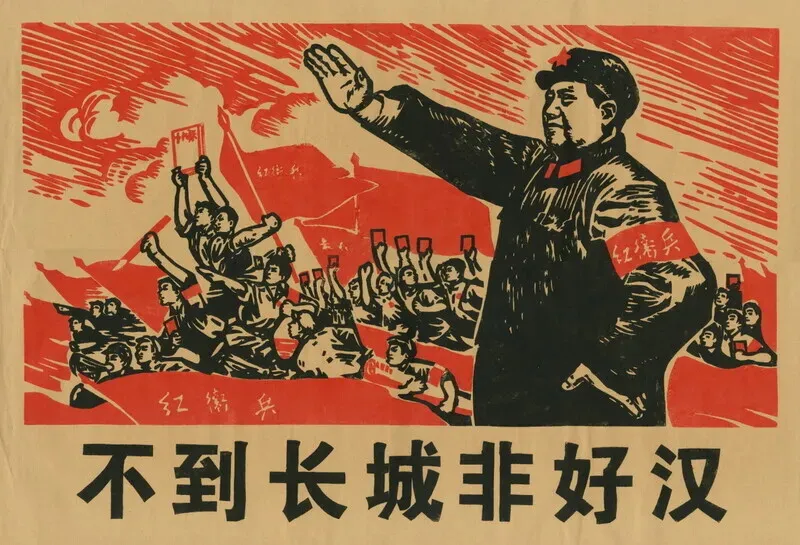
A poster from the Cultural Revolution in China depicting Mao Zedong, the text reading, “He who does not reach the Great Wall is not a great man.” The line comes from a poem written by Mao. (courtesy Incheon National University Academy of Chinese Studies archive)
By Yi Jong-sik, professor at KAIST Graduate School of Science and Technology PolicyKorea is said to be obsessed with medical school while lawyers are considered to rule the US. In China, however, engineers seem to be at the top of the totem pole. Chinese science and technology are seen through this framework in the KBS documentary series “Talent War” and Dan Wang’s bestselling book “Breakneck: China’s Quest to Engineer the Future.”For decades, almost without exception, the top positions of general secretary and premier in the Communist Party of China (CCP) have gone to science and engineering graduates. President Jiang Zemin majored in electrical engineering, Premier Wen Jiabao in geology, and incumbent leader Xi Jinping in chemical engineering. Korea envies this aspect of China.So why and how did China transform into a country of engineers? The country was once far from being engineering-centric and viewed engineers with the greatest distrust. In 1957, the CCP’s theoretical journal Xuexi (Study) translated “technocracy” as an “engineer dictatorship” and labeled it a reactionary ideology. That year, the scientist Qian Weichang was branded a “rightist” for saying non-experts could not lead experts, and Tsinghua University punished 403 students and 168 faculty and staff.Paradoxically, the seeds of this perception’s reversal were sown at the same time. In early 1958, Chinese leader Mao Zedong formalized the principle of “being both red and expert.” “Red” referred to loyalty to the revolution shown not only through inner conviction but also background, party membership and organizational activities, while “expert” meant professional competence as certified by exams and degrees.Mao’s true intent was clearly far from cultivating an elite class. He targeted two extremes — “white-collar experts” who ignored politics and the empty politics of cadres lacking technological know-how. He sought to have cadres learn technical skills to supervise experts.In addition, the Maoist ideal was that being red and an expert should not be a medal for glorifying a select few but should spread to the working masses to ultimately eliminate the monopoly of experts on knowledge and governing qualifications. The person behind this strategy was Tsinghua President Jiang Nanxiang, who twisted this slogan to forge a program for developing elite talent.Jiang set up a system of political counselors, choosing academically outstanding students (expert) to perform political tasks (red), and made it his life’s mission to “unify” both types of people by recruiting professors into the party and training CCP members to become scholars. In 1965, he told incoming freshmen at his university that engineers would rule the China of the future and that a Tsinghua graduate would eventually become premier.The Cultural Revolution, which erupted in 1966, dealt a heavy blow to this initiative. The logic of the radical (rebel) faction was that cadres who were both red and expert comprised the “new bourgeoisie” that caused the Soviet Union to degenerate into revisionism. Worker propaganda teams took over the Tsinghua campus, and its professors were exiled to the countryside, with Jiang also fired.Students were then required not to become “red experts” but “cultured workers with socialist consciousness.” University admission was no longer based on exams but recommendations. Only workers, farmers and soldiers who had performed manual labor for at least two years were eligible to attend. Xi Jinping was among the young men who entered Tsinghua’s chemical engineering department through this path.The Cultural Revolution targeted both old intellectuals and “red and expert” cadres newly trained by the CCP, seeking to block the path through which knowledge, degrees and party loyalty could turn into the privileges of an elite detached from the masses.Mao’s death in 1976 ended his reign. In 1980, Deng Xiaoping said, “Being an expert doesn’t automatically make one red, but being red means striving to be an expert.”Taken at face value, this statement appears no different from Mao’s call to cadres to gain expertise. But while Mao believed that the expert concept could get revolutionaries to avoid delegating governance to experts, Deng considered expertise a core qualification to govern.The red and expert principle transformed from an ideal shared by the masses into a means for weeding out elite technocrats, and “being red” shrank from a commitment to the revolution shown through one’s life into a formal requirement of toeing the party line. The social origin system, a hereditary caste classification for separating children of workers and poor peasants from those of landlords and counterrevolutionaries, was abolished.In the early 1980s, 1.37 million revolutionary elders resigned to make way for 470,000 university-educated cadres to join the leadership. The share of college graduates among members of the CCP’s Central Committee soared from 26% in 1977 to 99% in 2002. Jiang’s prophecy of engineers running China came true as eight of the nine members named to the Politburo Standing Committee in 2002 had majored in engineering.Zhu Rongji, a Tsinghua graduate in electrical engineering, became premier, and Hu Jintao, a former political counselor, ascended to the presidency. Thus, China was transformed from a country of workers, peasants and revolutionaries into one of engineers loyal to the CCP.In short, the consolidation of “red engineer” dominance following the era of reform and opening is less the result of a smoothly implemented plan and more a paradoxical consequence of the failed ideal of a classless society. Because the Cultural Revolution attacked both the intellectual and professional classes that had been around before the People’s Republic of China, as well as cadres who helped the CCP’s rise to power and their children, academic and political power grew more closely intertwined.The ruling class of the post-Mao era emerging from this shared the identity of victims of mass revolutionary politics; they were tempered by persecution but never tamed by checks and balances.With the dream of a classless utopia dismissed, the regime shifted toward the pursuit of unquestioning efficiency within the system. The technocratic transition in governance further accelerated after the hope of combining science and democracy was lost at Tiananmen Square in 1989. Any dissent was often labeled treason against the party and science.Throughout its history, China’s “red technocracy” has operated on two conditions. One is the rejection of Maoist revolutionary politics espousing radical intellectualism and social equality, and the other is lingering authoritarian politics that circumvents democratic debate and checks and balances.Given the Sino-US technological competition and its drive toward self-reliance in semiconductors and artificial intelligence, Beijing keeps putting engineers in key positions, with young engineers from the Chinese AI company DeepSeek praised as national heroes. China has thus renewed its status as a country of engineers, along with an implicit agreement not to ask political questions.In modern Chinese history, challenges to the authority of experts came from two sources. Maoism, which raised issues in the name of equality, imploded into uncontrolled violence during the Cultural Revolution, while voices demanding democracy at the 1989 Tiananmen Square protests were crushed by tanks.Once dissenting voices were eliminated, the lone option left was a technocracy prioritizing maximum efficiency in governance in a top-down manner. Korea envies this aspect of China, but why exactly? Is it that the country reveres engineers or that it makes decisions with no questions asked?By Yi Jong-sik, professor at KAIST Graduate School of Science and Technology PolicyPlease direct questions or comments to [english@hani.co.kr]