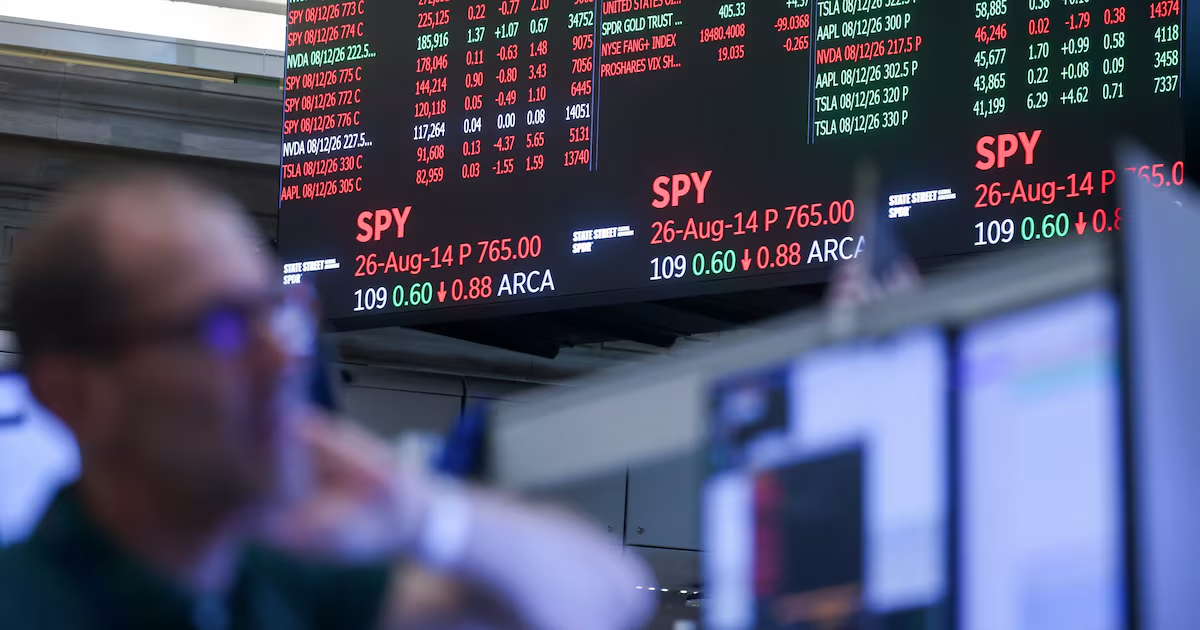
According to the ECB, a correction in stock market valuations, starting with AI stocks, is likely, whether today’s prices reflect a sensible and rational bet on the technology or are inflated by optimism. The warning is contained in a blog post by the Central Bank published earlier this week, which, right from the title, asks: is the enthusiasm for the AI boom justified, or is this the next dotcom-style bubble? After all, technological revolutions – from the railways of the nineteenth century to the internet in the 1990s – have always followed a pattern of boom and bust. “Why is the share price of chip giant Nvidia 20 times what it was in 2022?”, economists ask. To which they reply: because investors, rationally, thought it could become the new Google. Over the past four years, the AI gamble has expanded and become a reality (or rather, a race). The further share prices rise beyond what the companies are actually worth, the greater the fall caused by a correction in share values will be. And the Magnificent Seven (Alphabet, Amazon, Apple, Meta, Microsoft, Nvidia and Tesla), which are closely linked to AI, carry so much weight on the indices that a stumble could drag down part of the rest of the market with it.“Any observer can conclude that the possibility of a downward correction in the indices is very real,” Luigi Guiso, Professor of Economics at the Einaudi Institute for Economics and Finance, tells Il Foglio. “Over the last five years, the S&P 500 has risen by 73 per cent, exceeding the index’s average returns, which stand at around 7–8 per cent a year, and has climbed by over 12 per cent since the start of the year.” The comparison with the 2000s and the dotcom boom, however, does not convince him: “My impression is that this is a different kind of revolution. Back then, in many sectors there was room for only one winner: Google defeated all the other search engines. In AI, on the other hand, there is room for multiple players and for differentiated products: what GPT does, Claude does not necessarily do, so whoever fails will not cause a catastrophe. But as innovation affects all sectors, the ‘crash’ would be spread somewhat across the entire economy”. We’ve already seen some corrections, Guiso points out: “In March and April last year there was a significant downturn, then the market recovered quickly. It’s the same story this year. However, it’s difficult to gauge how much of this is down to doubts about AI and how much to political uncertainty.” But for the expert, even the concentration of market capitalisation on the Magnificent Seven does not in itself appear to be a danger: “Any index is heavily weighted by them given their size. But they are highly diversified conglomerates. Amazon, for example, is diversified both geographically and across product sectors.” He then adds: “Yes, they are investing heavily in AI, and if there is a crash, the fallout could spread to the rest of their business. But it remains to be seen whether that will actually happen or not.”For the ECB, the risk is very real and strikes at the heart of Frankfurt: the financial stability of the eurozone. In the third quarter of 2025, households in the eurozone had around €440 billion invested in US technology shares, almost all through mutual funds or ETFs (exchange-traded funds that track indices), “often without fully realising how concentrated the risk is”, the blog’s authors point out. “It would be a problem if a crash were to weigh on households’ spending decisions,” reflects Guiso. “But if you invest for the long term – for example, whilst saving for retirement – those fluctuations can be recouped.” The economist sees the risk for all those households that have entered the market not by conscious choice but driven by advisers riding the wave of enthusiasm: “We need to ascertain what sort of households they are – whether they belong to wealthier segments or not – and whether some have bought specialised ETFs heavily exposed to AI rather than a more diversified index such as the S&P 500.” The economist then concludes: “The problem exists and must not be overlooked. But that is how the market works: it has periods of strong growth, followed by corrections. The S&P 500 yields an average of 8 per cent with a standard deviation of 20, so any given year could see a return of +20 per cent or -20 per cent. The only way to manage risk is to keep your money invested over the long term.”
Why AI market can drop without it being a disaster
Guiso (Professor of Economics at the Einaudi Institute for Economics and Finance): “It would be a problem if a slump were to weigh on households’ spending decisions. But if you invest for the long term – for example, whilst saving for retirement – those fluctuations will be recouped.”
TL;DRAI
ECB warns AI valuation correction is likely: Nvidia +20x, Magnificent Seven concentrated risk, €440B eurozone households in US tech ETFs. Tech leaders should avoid panic-driven infrastructure decisions during market corrections—long-term horizons absorb typical volatility.
767 words~3 min read