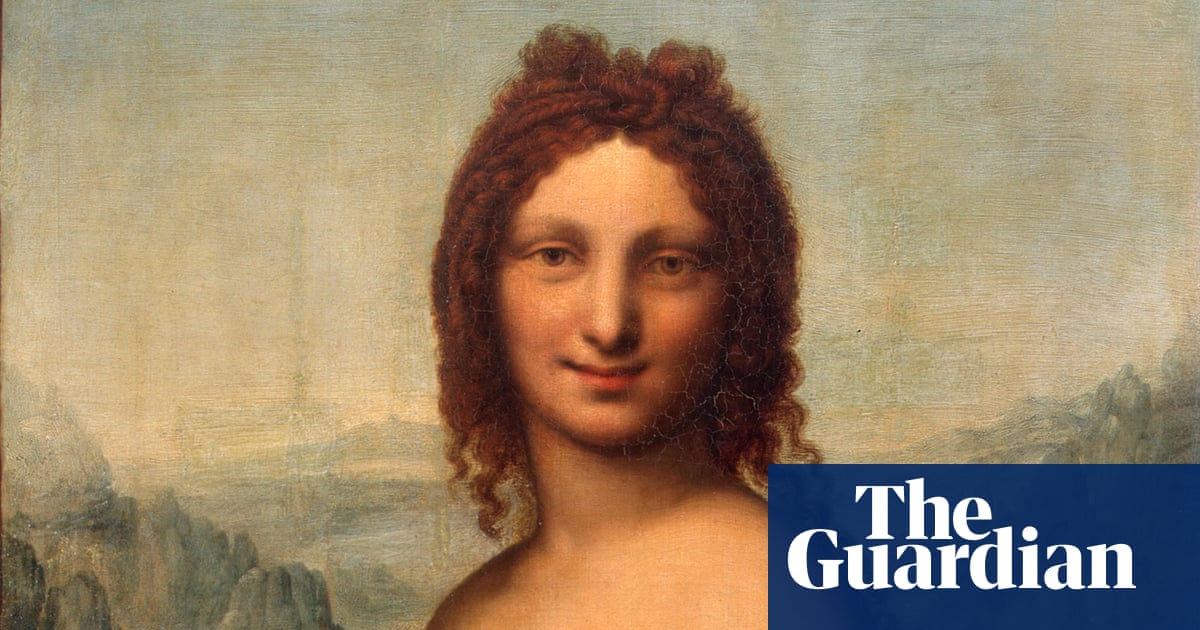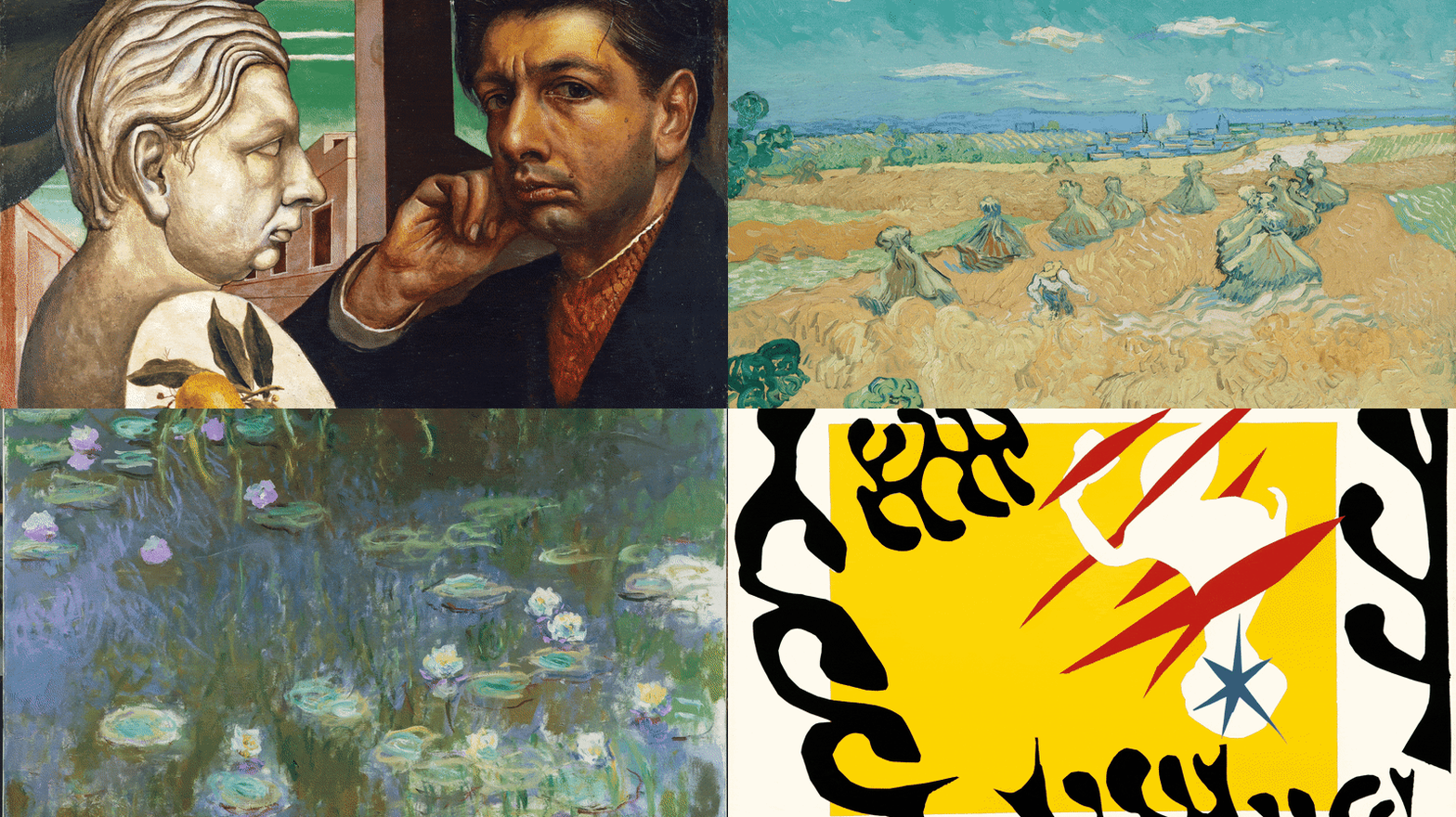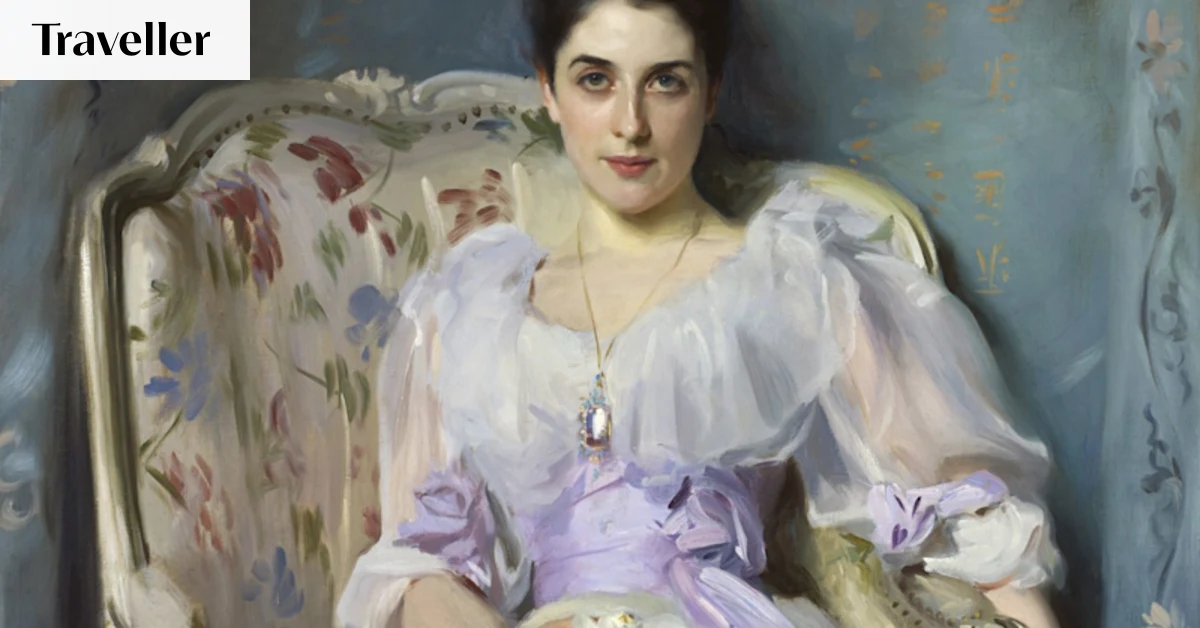
Imagine you’re in one of the world’s great galleries, trying to view every painting. Several hours later, your feet hurt and your brain is so over-stimulated that you crumble and stumble out, wondering what you’ve missed. You’re doing this art appreciation thing all wrong.Fiona Lowry, the 2014 Archibald Prize winner, says that when looking at a painting, you should allow time to feel your feelings. “Notice what you see first, what you initially miss, where your eye travels and what other images come into your mind – then come back to it,” she says.Traveller asked seven experts – curators, artists, gallery directors and more, including Lowry – for their most magical paintings, excluding Leonardo da Vinci’s Mona Lisa, viewed by millions of people each year. Pop them on your must-see list and go ahead and feel those feelings.THE PAINTINGSLady Agnew of Lochnaw, 1892, John Singer SargentJohn Singer Sargent, Lady Agnew of Lochnaw.National Galleries of Scotland, Edinburgh.Sign up for the Traveller Deals newsletterGet exclusive travel deals delivered straight to your inbox. Sign up now.Maria Stoljar, creator and host of Talking with Painters and self-confessed portraiture tragic, nominates this work as one of her all-time favourites. “Capturing a young woman’s face is difficult enough – a millimetre of misplaced paint can lose the likeness. But Sargent goes well beyond likeness here. It’s the enigmatic expression and pose that I find so compelling – is she languid, sultry or just bemused? The restrained palette, composition and seemingly effortless handling of paint make this one of his most brilliant portraits.”Where National Galleries of Scotland, National, The Mound, Edinburgh, Scotland, UK. See nationalgalleries.orgThe Death of Sardanapalus, 1844, Eugene DelacroixEugene Delacroix, The Death of Sardanapalus.The Louvre, ParisRaafat Ishak, the Victorian College of the Arts’ head of painting, says he’s had a postcard of this painting in his studio for years. “There’s something about the Baroque realism of it that’s quite fascinating with the swirling bodies – everything goes around in circles and comes back to the same point again. It’s very big and dominates the space and everything around it as well. It’s the reds and the flesh – it’s a full-on work.”Where The Louvre, Paris, France. See louvre.frCool White, 1959, Lee KrasnerLee Krasner, Cool White.National Gallery of Australia, Canberra © Lee Krasner, ARS/Copyright AgencyWhile many people visit the National Gallery of Australia to see its most famous – and infamous – painting, Jackson Pollock’s Blue Poles, for NGA curator Magda Keaney the painting that’s almost always hanging beside it, Cool White, is alone worth a trip to Canberra. “To stand before it is as much a physical experience as a visual one: its scale, energy and totemic presence is both disorienting and hypnotic. What first appears chaotic or unresolved, soon reveals a rigorous visual logic and structure. Krasner’s an extraordinary colourist yet this monochrome canvas belongs to her Umber Series. Suffering from insomnia, and still recovering from the deaths of Pollock – her partner in life and art – and her mother in 1959, she began working at night. This nocturnal process shaped the palette: she turned to natural and earthy pigments rather than her characteristic bright colours that required daylight.”Where National Gallery of Australia, Canberra. See nga.gov.auSaint Francis in the Desert, c.1475-80, Giovanni BelliniGiovanni Bellini, St. Francis in the Desert.Michael Bodycomb/Frick Collection, New York.Art Gallery of NSW chief curator Justin Paton recommends setting aside at least 30 minutes, “or maybe a day”, when visiting this painting. “From the rabbit poking its nose out in the foreground to the patchwork of fields on far hills, it’s a picture you can enter at any point and make your way through imaginatively,” he says. “Saint Francis, barefoot on the sun-warmed stone, is undergoing a mystical event. Bellini brings the rapture to us through his reverent, deeply felt details. We sense the spreading warmth of the morning sun, the way light shakes through the laurel tree. Surely, this is one of the most grateful and generous artworks ever made.”Where The Frick Collection, New York City, US. See frick.orgThe Return of Judith to Bethulia, c.1470-75, Sandro BotticelliSandro Botticelli, The Return of Judith to Bethulia.Uffizi Gallery, FlorenceAs Keaney explains, Judith is the warrior heroine who, with her attendant Abra, beheads the Assyrian general Holofernes to save her home of Bethulia. “The story was taken up by many Renaissance artists,” she says. “But Botticelli’s Judith is especially beguiling because we encounter her not at the violent climax but afterwards on the road home with Abra. I’m captivated by the quietness of this imagined journey – Judith is almost ethereal in her blue robes and, although she still carries her sword, her face is saintly and serene. While Botticelli’s The Birth of Venus is also at the Uffizi, this small-scale panel is unfamiliar, beautiful and strange all at the same time.”Where The Uffizi, Florence, Italy. See uffizi.itKrishna defeats the demon Bana, c.1585–90, artist unknownKrishna defeats the demon Bana.Art Gallery of NSWPaton says that sometimes looking at paintings is just a licence to wonder, “to marvel at what human hands have made. I’ve seldom seen more wonder per square centimetre than in this page from a late 16th-century folio on show in Avatar: Forms of Vishnu (on until October 5). Carnage and lyrical beauty mingle as blue-skinned Krishna does battle with Bana, whose fanned arms (several dozen of them) send the painting into imaginative overdrive. A tiny work that feels gigantic, a 400-year-old work that feels thrillingly alive – little wonder so many Sydney artists have loved spending time with this painting.”Where Art Gallery of NSW, Sydney. See artgallery.nsw.gov.auThe Crossing of the Red Sea, 1632, Nicolas PoussinNicolas Poussin, The Crossing of the Red Sea (detail).National Gallery of Victoria, MelbourneIshak says you can “read” this painting in a zigzag from the top to the bottom, or vice versa. “I often go to the NGV just to look at it – I sit there for five or 10 minutes, sometimes half an hour. It’s more about the construction of the painting and how it works that interests me – it really motivates me to paint.”Where NGV International, Melbourne, Vic. See ngv.vic.gov.auJimson Weed, 1936, Georgia O’KeeffeGeorgia O’Keeffe, Jimson Weed.
Forget the Mona Lisa: Experts name 30 lesser-known paintings you need to see
Seven art-world experts, 30 paintings from Australia and around the world. Pop them on your must-see list.
3,346 words~15 min read