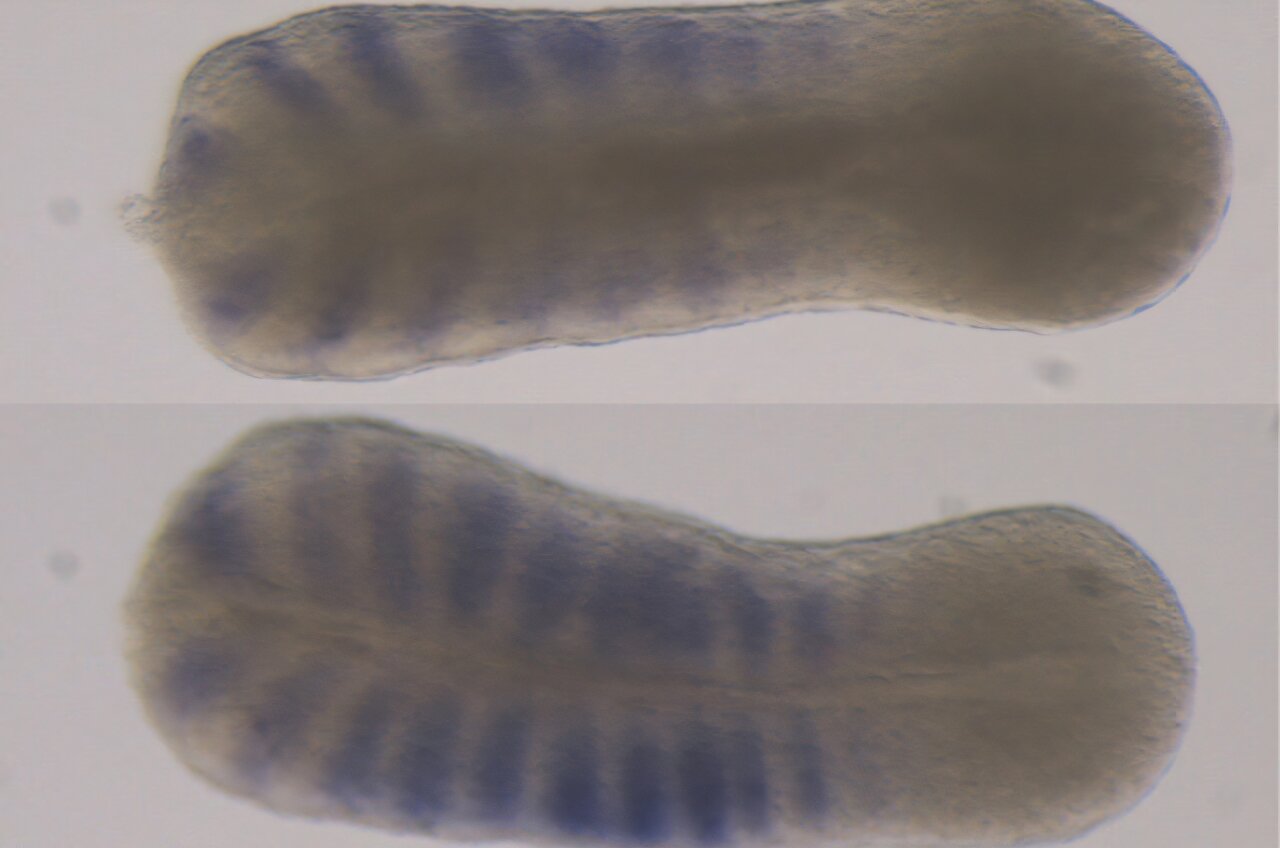
Compared with a control tail explant (bottom), a Rac1-inhibited explant (top) forms fewer, larger somites. Credits: Pappa & Tsiairis, Development (2026)
A molecular pathway known for controlling cell shape and movement also helps regulate the rhythm by which the vertebrate body is divided into repeated segments, FMI researchers report in the journal Development.
The work links cell behavior to the segmentation clock that guides the formation of vertebrae and other tissues, and may help explain developmental conditions involving congenital spinal malformations.
The clock behind body segments
During early development, waves of gene activity sweep through the presomitic mesoderm, a temporary strip of embryonic tissue that is progressively divided into somites—paired blocks of cells that later form vertebrae, skeletal muscle and part of the skin. Each wave helps trigger the formation of a new pair of somites. In mice, a new pair of somites forms roughly every two hours, paced by an internal molecular clock called the segmentation clock.