China's H1 humanoid robot shipments top 40,000 units: report
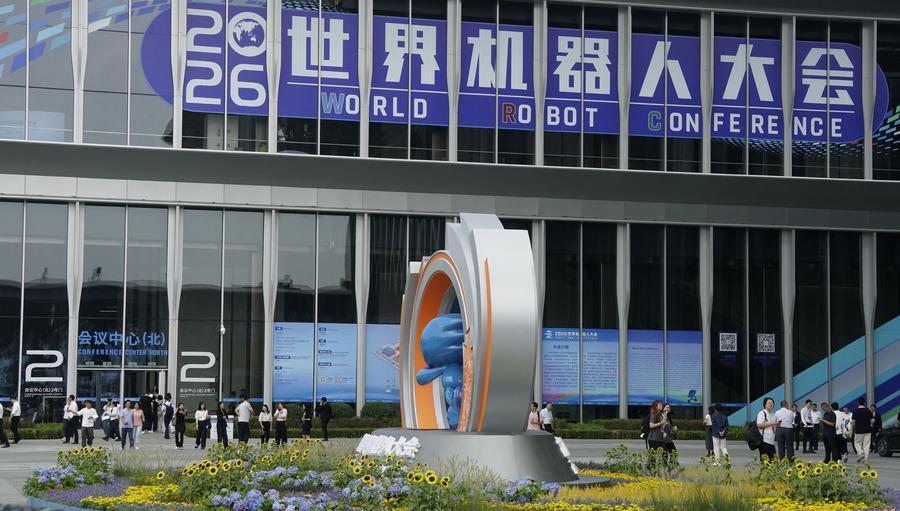
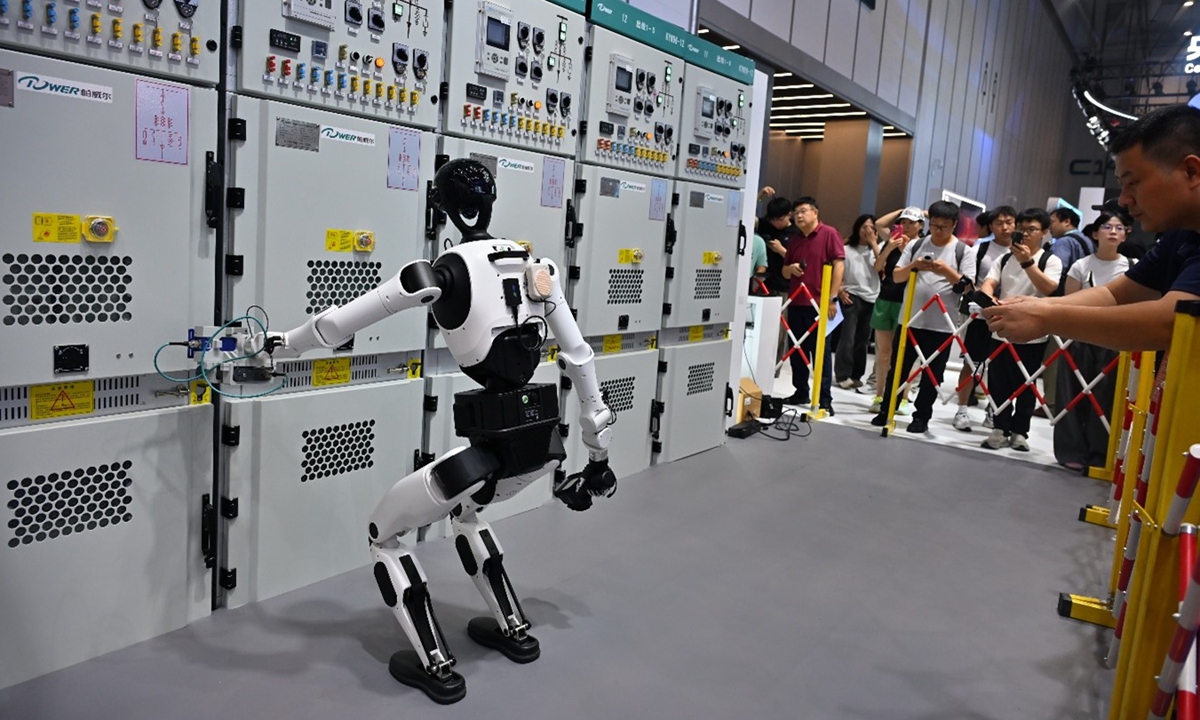
The Tien Kung 3.0 humanoid robot demonstrates aa power facility inspection task at the 2026 World Robot Conference on August 20, 2026. Photo: Tao Mingyang/GT China shipped more than 40,000 humanoid robots in the first half of this year, lifting its share of global shipments to 97 percent, according to an industry report released on Thursday at the 2026 World Robot Conference (WRC) in Beijing. The sector has moved past small-batch trials into routine deployment and real-world application at scale, the report said.The 2026 Humanoid Robot Industry Development Report, compiled by the China Humanoid Robotics and Embodied Intelligence Committee of 100, examines the industry across five dimensions - overall landscape, development trends, technology mapping, the industrial chain and applications - and compares progress in China, the US, Germany, South Korea and Japan.Technological innovation has entered a phase of "cluster emergence," the report said, with faster iteration and steady gains in environmental perception, planning and decision-making, and motion control, giving robots more adaptability and stability in the complex settings where they are being put to work. On the supply side, China has built full-chain manufacturing capability spanning key chips, components and complete machines.Applications have entered what the report called the deep-water zone of full rollout, with the first-half shipment figure cited as evidence. The report also pointed to a "four-in-one" ecosystem taking shape around standard-setting, talent training, international cooperation and innovation infrastructure.That shift was visible on the exhibition floor itself, where more than 2,000 exhibits from more than 300 companies were pitched at specific jobs rather than at audiences. The five-day conference - themed with "Human-Robot Symbiosis, Production-Demand Convergence" - runs through Sunday. At the X-Humanoid booth, its Tien Kung 3.0 humanoid demonstrated an energy inspection task, holding a testing device as it checked a bank of high-voltage cabinets for faults.By pairing its in-house HuiSi KaiWu embodied intelligence platform with State Grid's artificial intelligence large-language model, its robots can autonomously read operation tickets, interpret tasks, navigate complex environments and inspect electrical cabinets, with benchmark deployments already in place in several provinces, a representative of the company said.At the National and Local Co-built Humanoid Robotics Innovation Center's booth, a firefighting version of the LingLong L2.0 humanoid made its first public demonstration, shutting a gas valve, cutting power and aiming an extinguisher at a fire source without a remote control, while a WeiLong M2 handled casualty transfers and a XunLong quadruped searched simulated rubble. Zhejiang-based Robot++ brought wall-climbing robots that grip carbon-steel surfaces by permanent magnets, grinding coatings off weld seams before running magnetic particle and ultrasonic tests for surface and internal defects. Inspecting a spherical tank with a capacity of 3,000 cubic meters takes workers 15 days to a month and requires scaffolding; the robots finish grinding and inspection in four days without it, Zhao Dekui, a company engineer, told the Global Times. One unit covers curvature down to a 2.5-meter diameter, enough for most storage tanks, spherical tanks and wind turbine towers, Zhao said. One product mounts a humanoid upper body on a climbing chassis, swapping arm-end tools for inspection, welding, cleaning or grinding.