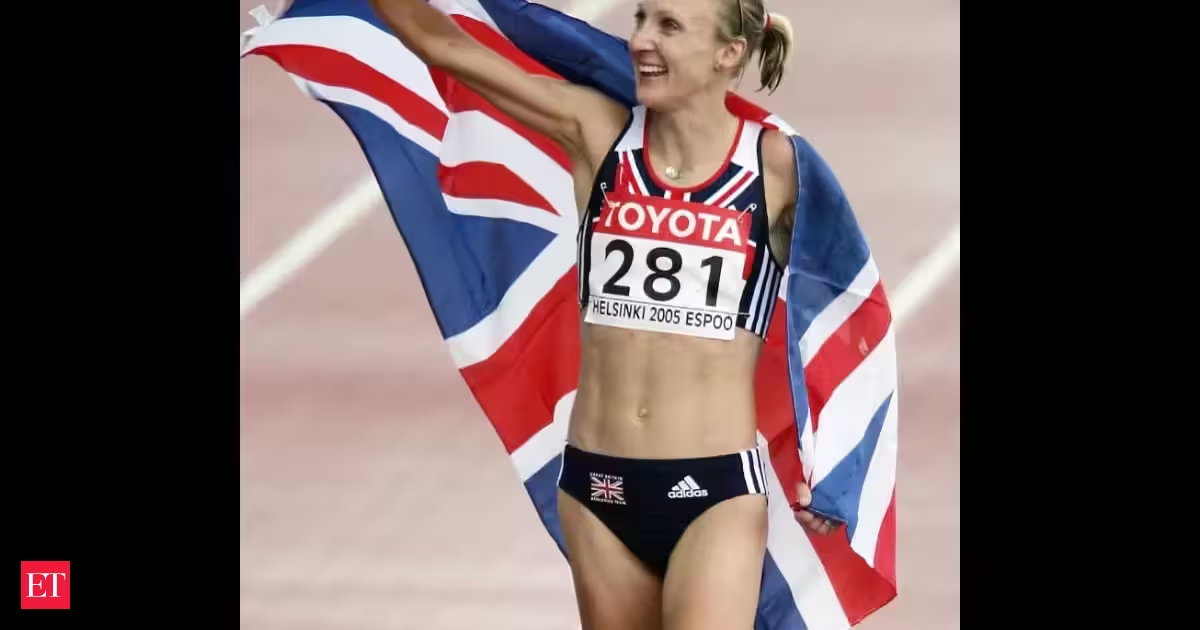
Imagine you are in an argument with someone who has hurt you. You know you are right about what happened, and you have every reason to be angry. The easiest thing might be to raise your voice, say something hurtful back, or make sure the other person feels the weight of your anger. But sometimes, you simply explain what you will and will not accept, and then stop arguing. You do not need to insult them to make your point. You do not need to shout to make your boundary real.That kind of moment reveals something we often miss about strength. It is not always the person who dominates the conversation, has the sharpest comeback or refuses to back down who is strongest. Sometimes, strength is staying composed when you have every reason to lose your temper.We see the same thing at work, in friendships and inside families. Someone can disagree firmly without humiliating another person. They can say no without being cruel. They can walk away from an unhealthy argument without feeling that they have surrendered. And they can remain true to themselves without constantly needing to prove that they are right.Nowadays, when being outspoken is often mistaken for confidence, that distinction matters. There is a difference between having a backbone and having something to prove.That is the idea behind a powerful observation from British marathon great Paula Radcliffe.Quote of the Day by Paula Radcliffe: “You can be strong and true to yourself without being rude or loud”Why Paula Radcliffe’s quote on strength and authenticity matters todayModern life often rewards volume. Social media arguments become competitions over who can deliver the sharpest response. At work, confidence can sometimes be mistaken for speaking the most. In relationships, standing up for yourself can gradually turn into trying to control the other person.That makes Radcliffe’s observation particularly relevant. Being strong does not require becoming harsh. Being authentic does not mean saying everything that comes to mind. And standing firm does not require making someone else feel small.There is a difference between having a backbone and having something to prove. A person can say “no” without insulting someone. They can walk away from an argument without being weak. They can defend their values without turning the conversation into a battle.What Paula Radcliffe’s quote means in real lifeImagine someone at work being repeatedly interrupted during meetings. They could respond by shouting, embarrassing the colleague or turning every future meeting into a confrontation. But there is another option: calmly finishing their point, addressing the behavior directly and making it clear that they expect to be heard. That is strength without unnecessary hostility.The same applies to personal relationships. Suppose someone crosses a boundary that matters to you. Being true to yourself may mean saying that the behavior is unacceptable and deciding what you will do next. It does not require insults, threats or public humiliation. Sometimes the strongest response is simply a clear boundary followed by consistent action.Radcliffe's quote also challenges the idea that confidence must always be visible. Some of the strongest people are not the loudest people in the room. They do not constantly announce their achievements or defend their character. They know themselves well enough that they do not need to win every argument.Who is Paula Radcliffe?Paula Radcliffe is one of Britain's greatest female marathon runners. Born on December 17, 1973, in Northwich, she competed at four consecutive Olympic Games between 1996 and 2008.Her international career began on the track and in cross country. She became World Junior Cross Country champion in 1992 and later won medals and titles at the World Cross Country Championships. At the 2000 Sydney Olympics, she set a British record in the 10,000 meters but finished fourth.Radcliffe's greatest achievements came after she moved into marathon running. She won the London Marathon in 2002 before setting a world record of 2:17:18 in Chicago later that year. In 2003, she lowered her own marathon world record to 2:15:25 at the London Marathon. That record remained unbeaten until 2019.Her career also included difficult moments. At the 2004 Athens Olympics, she withdrew midway through the marathon. She later returned to win marathon gold at the 2005 World Athletics Championships in Helsinki. After taking time away from competition following the birth of her daughter, Isla, she returned to win the New York Marathon in 2007.Radcliffe competed at the 2008 Beijing Olympics and later continued competing at the highest level. She qualified for the London 2012 Olympics but withdrew before the Games because of injury. Her final elite race came at the 2015 London Marathon.Team GB puts her achievement more precisely, terming her ‘the greatest British female marathon runner in history.’Paula Radcliffe's legacyRadcliffe's legacy is built not only around her records but also around the extraordinary demands of elite endurance sport. Marathon running requires physical strength, discipline and the ability to continue through periods when the body and mind are telling an athlete to stop.Her career also shows that strength is not the same as an uninterrupted journey. There were victories, records and world titles, but there were also Olympic disappointments, injuries and withdrawals. The ability to continue after setbacks became an important part of her story.In 2026, Radcliffe's achievements were recognized in the New Year Honors, when she was awarded an OBE. Her career remains closely associated with British distance running and the marathon, where she established herself as one of the sport's defining athletes.That makes her words about strength particularly fitting. Strength is not always about dominating a room or having the last word. Sometimes it is about knowing who you are, standing by what matters to you and still treating other people with dignity.You do not have to become louder to become stronger. Sometimes, the clearest sign of strength is being able to remain yourself without needing to overpower anyone else.
Quote of the Day by Paula Radcliffe, the ‘greatest British female marathon runner’: ‘You can be strong and true to yourself without being rude or loud’
Modern society frequently equates loudness with bravado, overlooking the understated strength of composure and clarity. Paula Radcliffe's wisdom sheds light on recognizing that true power comes from setting respectful boundaries and being authentically oneself. It suggests that confidence should not be about volume or confrontation but about integrity and self-awareness, applicable in friendships, professional interactions, and self-identity alike.
970 words~4 min read