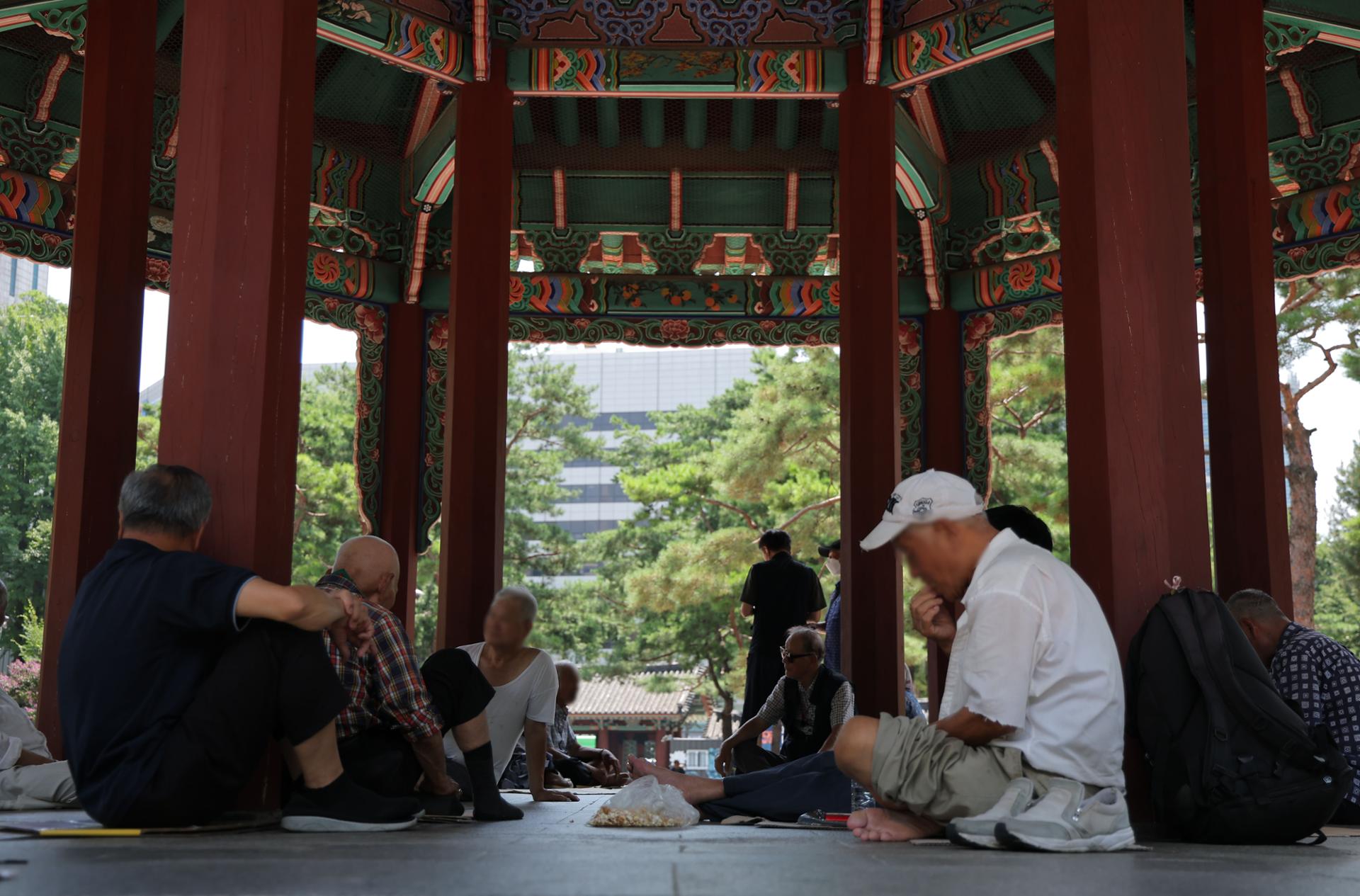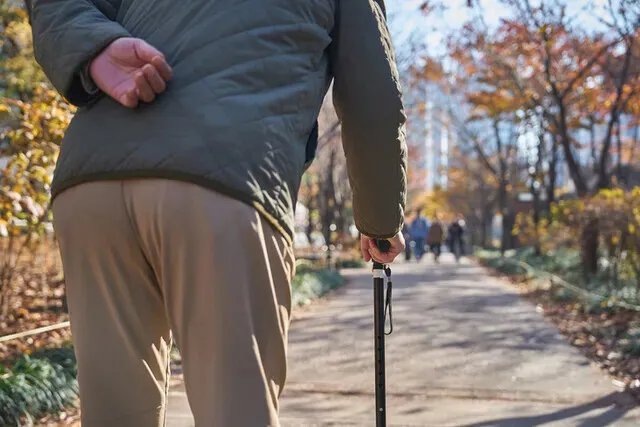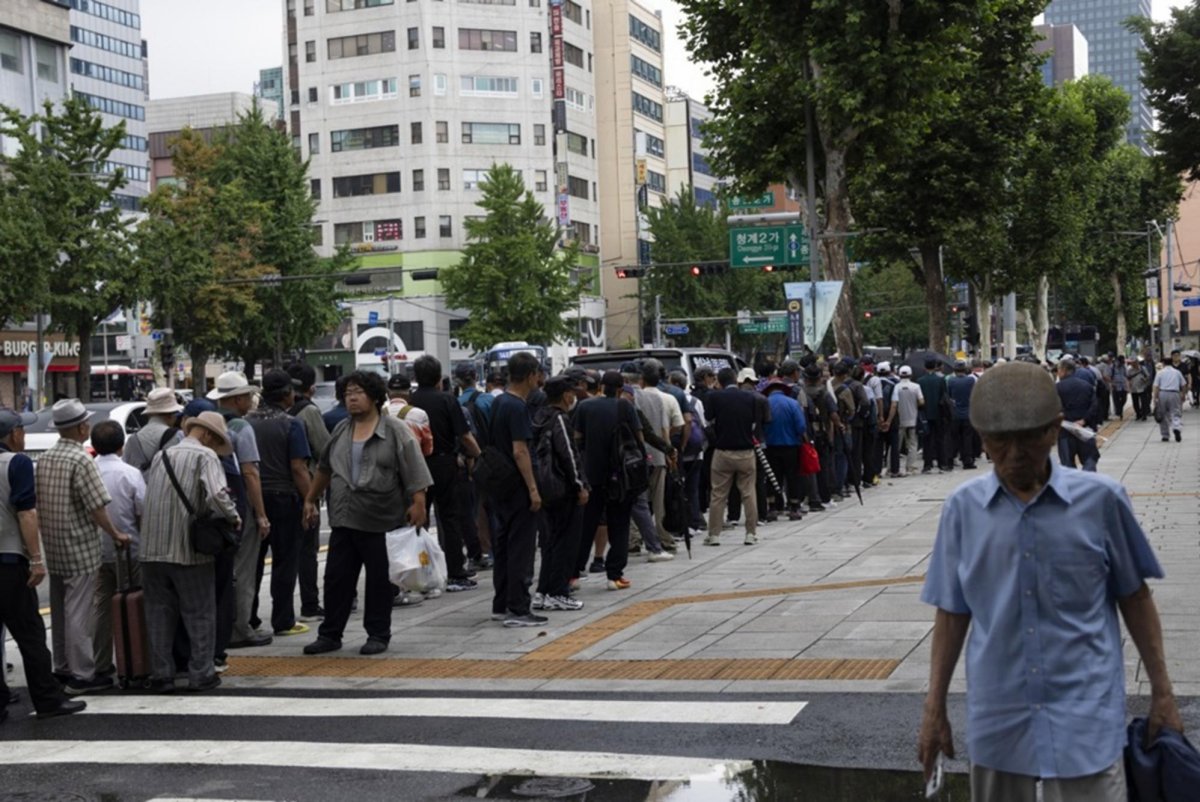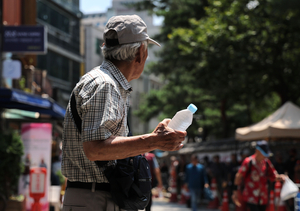
A senior citizen walks with a water bottle in his hands in Jongno-gu, central Seoul, on Aug. 3. (Yonhap) The number of South Koreans aged 100 or older nearly tripled over the past decade, with the increase particularly sharp among men, government data showed Thursday.As of Nov. 1, 2025, there were 8,604 centenarians in the country, up from 3,159 in 2015, according to data from the Ministry of Data and Statistics.The number increased by an annual average of 10.5 percent over the 10-year period, with 17.3 centenarians per 100,000 people in 2025.The ages were based on respondents' answers to a survey by the ministry rather than ages recorded in official resident registration data. In the past, births were sometimes registered late, which could result in discrepancies between a person's actual age and official records.The oldest respondent was 116 years old.Women, whose life expectancy is higher than men's at 86.3 years versus 80.3 years, accounted for 83.4 percent of all Koreans aged 100 or older.The number of male centenarians, however, grew at a much faster pace, increasing 3.3-fold over the past decade compared with 2.6-fold for women."With advances in medicine and changes in living conditions, the gender gap among people aged 100 or older appears to be narrowing," the ministry said, adding that the number of centenarians is expected to continue rising.Gyeonggi Province and Seoul, the country's two most populous regions, had the largest numbers of centenarians, at 2,052 and 1,268, respectively.South Jeolla Province, however, had the highest number relative to population, with 31.8 centenarians per 100,000 people, followed by Jeju at 30.4 and Gangwon Province at 28.6.The majority of Koreans aged 100 or older (59.8 percent) had received no formal education, and only 4.6 percent had attended higher education institutions.Officials attributed the figures partly to the fact that nearly all of today's centenarians were born during Japan's 1910-45 colonial rule of Korea, when access to education was limited for many Koreans.Some 92.8 percent had lost their spouses.The gender gap was particularly stark. Spouses were still alive for 30.2 percent of male centenarians, while only 0.7 percent of women had living husbands.Some 20.7 percent of centenarians lived alone, while 68.4 percent lived with their children or children-in-law and 5.6 percent lived with their spouses.Around 73.5 percent were cared for by their children or children-in-law, while others relied on paid caregivers.Among those receiving care from family members, sons were cited as caregivers in 52.4 percent of cases, followed by daughters at 34.9 percent and daughters-in-law at 34.5 percent. Spouses provided care in 4.9 percent of cases.When asked about their satisfaction with life, 43.7 percent described it as average, while 33.1 percent said they were satisfied.About 90 percent had chronic illnesses.The survey also pointed to healthy lifestyle habits as a possible factor in longevity. Some 70.6 percent said they had never consumed alcohol, while 86.9 percent said they had never smoked.About 75.8 percent said they had neither smoked nor consumed alcohol during their lifetime.
Centenarians in Korea near triples in 10-year period
The number of South Koreans aged 100 or older nearly tripled over the past decade, with the increase particularly sharp among men, government data showed Thursd
492 words~2 min read