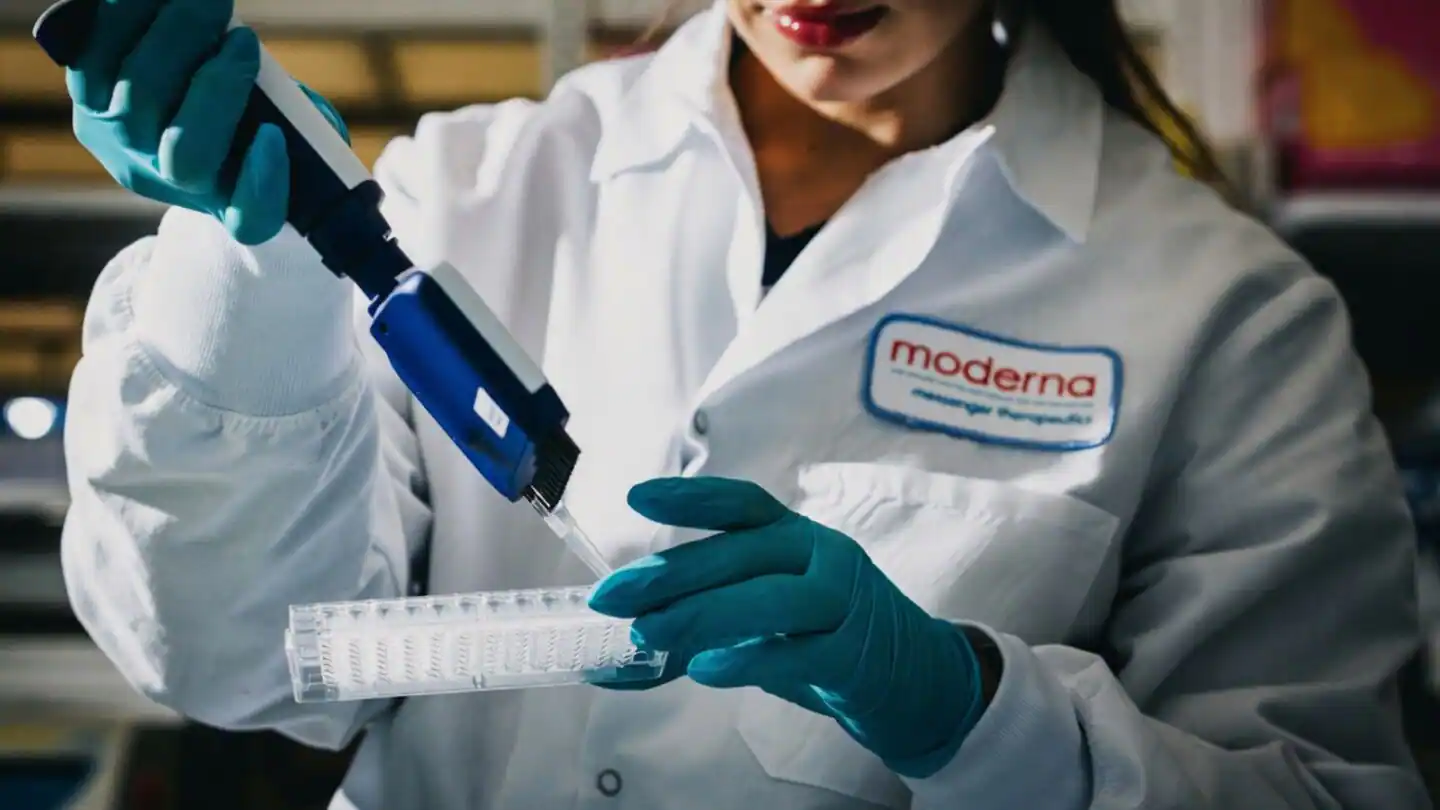
Merck and Moderna announced on Wednesday morning that a bespoke mRNA cancer vaccine, given alongside Merck’s blockbuster immunotherapy Keytruda after surgery, significantly reduced disease recurrence and metastasis in patients whose high-risk melanoma had just been surgically removed, compared to Keytruda alone. Moderna shares spiked by a record 177% on Wednesday and Merck's shares climbed nearly 13%. (Reuters)The Phase 3 INTerpath-001 trial enrolled 1,137 patients across stages IIB to IV — spanning thick tumours confined to the skin through to disease that had already reached distant organs before being surgically excised — and hit both its primary endpoint on recurrence-free survival and its main secondary milestone on distant metastasis. Interim analyses are scheduled early looks at the trial data by an independent monitoring committee, which is empowered to halt a trial when the effect is unambiguously large.The companies have not yet released the hazard ratios — the statistical measure of how successful the vaccine has been — pending presentation at an international medical meeting. But the wording of the announcement and the decision to stop for efficacy at interim both suggest that this is a breakthrough. In plain terms, this is the sort of landmark that cancer research has been chasing for three decades in general, and mRNA platform since its blockbuster success in 2020.Three firstsThe readout from the companies makes for three noteworthy breakthroughs.One: It is the first Phase 3 win — Phase 3 being the largest and most rigorous stage of drug testing, in which a candidate goes head-to-head against the standard of care in a large patient population — for an individualised neoantigen therapy, a class of medicine in which each patient receives a treatment manufactured specifically for their own tumour. The concept has been argued about in immunology journals since the mid-1990s. The first serious small-scale demonstrations came from Catherine Wu’s laboratory at Dana-Farber and Ugur Sahin’s team at BioNTech in 2017. It has taken eight years to move from those single-arm proof-of-concept studies to a randomised trial that has beaten a standard of care.Two, it is also the first regimen to demonstrably improve on Keytruda alone in the adjuvant melanoma setting — adjuvant meaning treatment given after surgery to mop up any residual disease before it becomes clinically visible. Since 2019, when the KEYNOTE-054 trial established Keytruda as the standard of care after high-risk melanoma surgery, a queue of experimental combinations — LAG-3 inhibitors, TIGIT blockers, IDO inhibitors, oncolytic viruses, each targeting a different lever in the immune system — have tried to add benefit on top and either failed outright or fallen short of statistical significance.Three, most crucially, this is the proof the mRNA field had been waiting for.The Covid-19 vaccines that Pfizer-BioNTech and Moderna rolled out in December 2020 established that mRNA could be manufactured at planetary scale and safely instruct billions of human cells to produce a target protein on demand. What those vaccines did not settle was whether the platform could do anything therapeutically important beyond infectious disease. That question has hung over the sector for five years. Moderna’s revenues collapsed as pandemic demand receded; BioNTech, CureVac and Arcturus each pivoted parts of their pipelines toward oncology; the investor case for mRNA as a general-purpose medicine, rather than a vaccine platform that got lucky with a pandemic, weakened steadily.INTerpath-001 is the first controlled, randomised, adequately powered Phase 3 study to answer that question in the affirmative. It does not, by itself, guarantee that mRNA will succeed in every therapeutic area now being explored — from rare genetic disorders to autoimmune disease and cardiac repair — but it establishes that the platform can produce a clinically meaningful benefit in a cancer trial. That is the proof the field has been waiting for since the pandemic ended.Also read: Billions of doses later, a Lancet review confirms mRNA vaccine safetyWhat the vaccine is, why it took so long to buildCancer cells accumulate mutations that produce abnormal proteins. When those mutant proteins are chopped up and displayed on the cancer cell’s surface, the immune system can, in principle, recognise them as foreign. Immunologists call these mutant fragments neoantigens — think of them as molecular mugshots unique to the tumour, distinct from anything the body’s own healthy cells produce. Because they exist only inside the cancer, an immune response mounted against them should attack the tumour without hitting healthy tissue, which is the perfect target in theory.The theoretical case had been made repeatedly. What defeated the field was manufacturing and identification. Every patient’s tumour carries a different set of mutations. To make a neoantigen therapy work, doctors need to biopsy the tumour, sequence its DNA and RNA, computationally predict which mutant peptides are most likely to trigger a strong response from T-cells (the immune system’s targeted killers, which hunt down cells marked as abnormal), and then build a therapy that presents those specific peptides to the immune system — all within a few weeks of the patient’s surgery, because that is the window in which the micro-metastases seeded by the original tumour are most vulnerable.mRNA is the technology that made this scalable. Intismeran autogene is a strand of synthetic messenger RNA that codes for up to 34 of a patient’s own tumour neoantigens. Once injected, the mRNA functions as a set of instructions the body’s own cells read and translate into the neoantigen proteins, which are then displayed to the immune system, which learns to recognise them. The Keytruda given alongside is what oncologists call a checkpoint inhibitor: it blocks a molecular handshake that cancer cells use to signal “friend, not foe” to attacking T-cells and switch them off. Keytruda’s arrival in clinical practice a decade ago — most publicly demonstrated when it drove former US president Jimmy Carter’s metastatic melanoma, which had spread to his brain and liver, into full remission in December 2015 — established the checkpoint-inhibitor class as one of the two great transformations of modern oncology, alongside CAR-T cell therapy for blood cancers.The two mechanisms are complementary. The vaccine teaches the immune system what a tumour looks like; the checkpoint inhibitor stops the tumour from silencing the T-cells that have learned to recognise it.The five-year data from the earlier Phase 2b trial, KEYNOTE-942, presented at the American Society of Clinical Oncology meeting in June, showed the combination reducing the risk of recurrence by 49% and distant metastasis by 59% against Keytruda alone. Wednesday’s Phase 3 confirmation, in a trial roughly seven times larger, converts an intriguing signal into an emerging standard of care.Also read: Weight loss, muscle mass, heart risk: Study decodes strengths & weaknesses of 19 GLP-1 drugsWhy cancer vaccines had been a graveyardThe reason this announcement carries such weight is that almost every previous cancer vaccine has failed. Melacine, GVAX, Stimuvax, rindopepimut, tergenpumatucel — each generation of the 1990s, 2000s and 2010s attempted to teach the immune system to attack tumours, and each hit the same wall at Phase 3. The vaccines were made off the shelf, targeting proteins that were over-expressed on cancer cells but also present on healthy tissue. Either the immune system refused to attack because it recognised the target as self, or it attacked and caused autoimmune disease. A handful of products limped through to approval — Provenge for prostate cancer in 2010, the herpes-derived oncolytic virus T-VEC in 2015 — but none delivered the transformative effect the field had promised.The individualised neoantigen approach negates that trade-off. Because the target mutations exist only in the tumour, there is no healthy tissue analogue for the immune system to react against; and because the therapy is manufactured after that specific tumour has been sequenced, it targets the patient’s own mutational fingerprint rather than a generic marker shared with normal cells. What was aspirational in immunology laboratories thirty years ago is now, on the evidence of INTerpath-001, clinically real.The patent cliff that explains the urgencyKeytruda’s US patent protection expires in 2028 , opening the largest revenue cliff in pharmaceutical history, roughly $30 billion in annual sales for Merck to competition from biosimilar manufacturers, which are firms that produce near-copies of complex biological drugs once patent protection lapses. Keytruda is the biggest-selling prescription drug in history, and its patent expiry has shaped Merck’s entire post-2028 strategy: build combinations with Keytruda that are structurally difficult for biosimilar makers to replicate. Subcutaneous injectable formulations, fixed-dose partners with other Merck molecules, and now personalised additions built patient by patient are all part of the same defensive architecture.That is why the Merck stock reaction on Wednesday, at around 13% climb, was much smaller than Moderna’s record 177% jump. For Merck, the readout was largely expected and priced in. For Moderna, it re-rates the entire premise of the company.Also read: Train the cell, then deploy: Science behind the new HIV study, and why it's a foothold, not a finish lineThe Indian angleMelanoma is not as common in India. It is largely a disease of fair-skinned populations with high UV vulnerability, and Indian incidence sits in the low thousands of cases a year against the 112,000 projected in the US for 2026 alone. The direct benefit to Indian patients from this specific approval, when it arrives, will be modest.The broader significance is the platform. The nine-trial INTerpath programme is testing individualised mRNA neoantigen therapies in non-small cell lung cancer (with two Phase 3s already enrolling), bladder, renal cell, pancreatic and gastric cancers — several of which are among the largest disease burdens in Indian oncology. If those readouts follow the melanoma trajectory, it could benefit hundreds of thousands of cancer patients in India. Of course, there will be sticky regulatory questions along the way.There is also the question of manufacturing access. A therapy that requires tumour sequencing, computational neoantigen prediction, mRNA synthesis and cold-chain distribution — all inside a six-to-eight week window per patient — carries a cost structure that, by every industry estimate, sits well into six figures in US dollars per course of treatment. Whether Indian mRNA capacity, which grew during the pandemic through Gennova’s platform and Bharat Biotech’s collaborations, can eventually localise this class of therapy will determine whether personalised cancer treatment reaches Indian oncology as an imported premium product or, eventually, as a domestic one.Wednesday’s readout is the starting gun for personalised oncology at scale. What it delivers to patients in the US and Europe first, and to everyone else after, will shape the next decade of cancer treatment.
mRNA’s second act: A bespoke cancer vaccine & what Merck-Moderna’s melanoma trial could mean for oncology
The Phase 3 INTerpath-001 trial delivered oncology's first personalised cancer vaccine win, and mRNA a therapeutic breakthrough since the pandemic.
1,726 words~8 min read