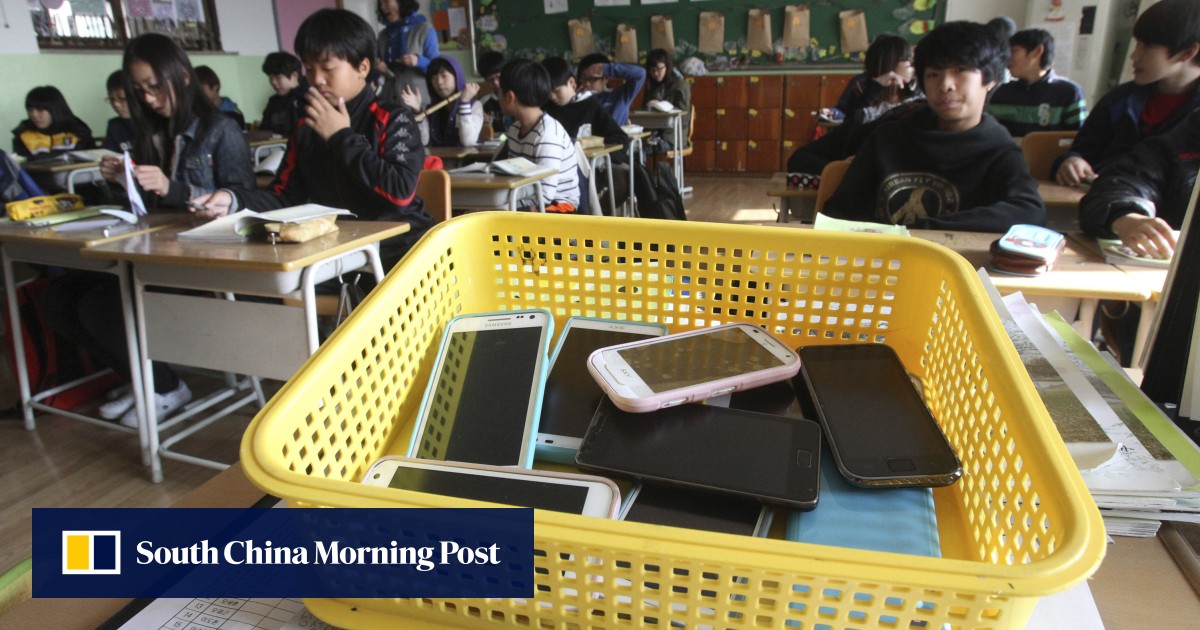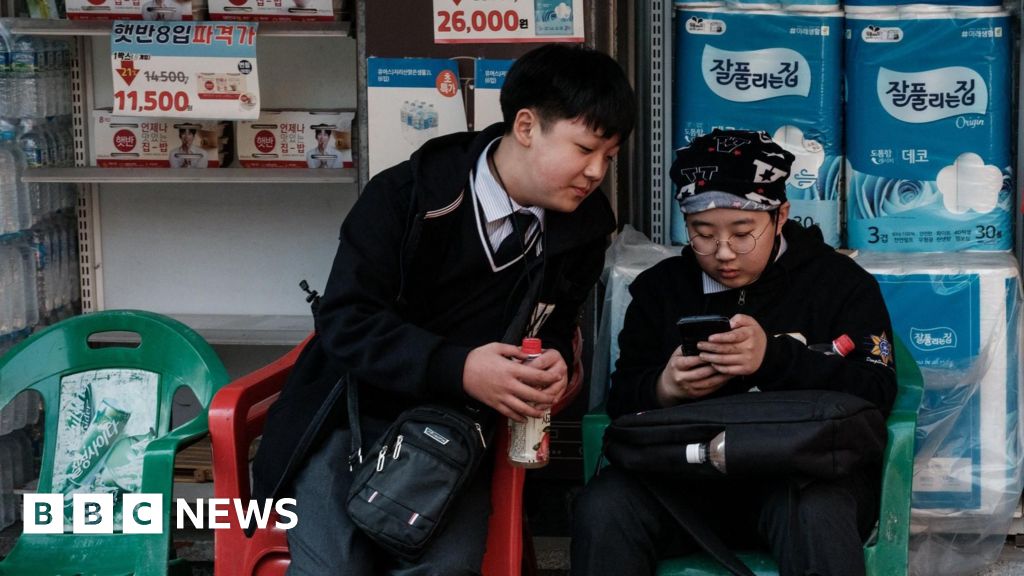
Lee Jae-min A new global trend is taking hold. An increasing number of countries are adopting or considering measures to ban or restrict student smartphone use. The driving force is clear: Smart devices negatively affect the mental development and health of the younger generation. According to data from the UNESCO Global Education Monitoring Report, updated in March 2026, 114 out of 197 education systems (58 percent) have now instituted national restrictions on mobile phones in schools.Korea recently joined this bandwagon. Effective March 2026, a revision to the Elementary and Secondary Education Act banned the use of mobile phones and smart devices during instructional hours. The law also allows each school to adopt its own regulations to expand the ban to cover the entire school day, including recess and lunch breaks. In fact, many schools have amended their internal regulations to opt for full-day bans. Given that 94 percent of South Koreans under 19 own smartphones and 63 percent own tablet PCs — according to a report by a government-funded research institute — this latest legislative shift is having a significant impact on classrooms nationwide.Picture a typical morning. Teachers collect powered-down phones at the start of the day, storing them away until school ends.Predictably, this law is a direct response to the concerns of lawmakers, parents and educators, who argue that smartphone use hinders academic performance by distracting students and eating into study time. Not to mention cyberbullying, online harassment, and other forms of digital abuse. According to a study by the Ministry of Science and ICT, the percentage of adolescents classified as "at risk" for smartphone overdependence reached a historic high of 42.6 percent last year. By comparison, the figure for the general population was just 22.9 percent. This stark contrast explains why Korea has become serious about mobile phone regulation in schools.The reaction in other countries is largely similar. For instance, a 2026 survey by the Pew Research Center found that nearly 8 out of 10 adults (77 percent) support a phone ban during class time for middle and high schools. Opinion is much more divided on a full-day restriction, with 48 percent in favor and 43 percent opposed.In a similar vein, several countries have adopted restrictions on youth social media usage. Australia pioneered this movement last December by enforcing a total social media ban for children under 16. Indonesia and France followed suit recently. Meanwhile, the UK, Canada, Spain, New Zealand, Greece and Japan are actively considering or investigating similar actions. Once again, the underlying driver is the constant digital overstimulation powered by hyper-optimized, addictive algorithms, infinite scrolling and tailored notification feeds.As for Korea, eight bills are currently pending in the National Assembly as of this August, all aiming to restrict social media usage for young students based on these very concerns. Given the current momentum, I believe the country is likely to adopt similar social media restrictions soon.True, this remains uncharted territory in Korea, and the debates are far from over. Skeptics have raised valid counter-concerns. Would the ban really improve academic performance and youth mental health? So many factors are involved in these matters that it is impossible to blame a single culprit. Would the ban even be effective? A pupil could easily offer up a decoy phone in the morning to circumvent the ban, and minors might attempt to compensate for their daytime deprivation with heavier usage after school. Ultimately, only time will tell whether and how this new endeavor can help address a uniquely modern social dilemma.Despite these valid concerns and question marks, I believe the new policy is arguably a step in the right direction. Phone-free and social media-free environments, once carefully designed, can — at least to some extent — protect minors by creating a daily "digital detox" window during school hours. Far from a cure-all, of course. But it will certainly help tame the problem.Furthermore, positive ripple effects should not be ignored. Legislation-driven action, like this one, carries profound institutional weight, bringing this critical matter to the fore and forcing wider public awareness. Parents and guardians are now more strongly alerted to the digital dangers confronting youth, prodding them to supervise their children’s device habits more actively. Ultimately, this reminds me that despite the challenges, this national policy is on the right track.The critical homework lies in the details, though. The right policy direction does not guarantee that specific actions taken are also appropriate — they are two entirely different questions. Moving forward, Korean schools will have to fine-tune their approach to tricky exceptions. For instance, how do schools accommodate students with special needs, preserve emergency communication and protect basic human rights?The stakes are real: Just last Friday, France’s Constitutional Council struck down an under-15 social media ban law, ruling that its overly broad terms unconstitutionally infringed on minors’ rights to freedom and communication. Similar legal challenges will inevitably arise here. The true test for Korean schools and the government will be navigating this continuous adjustment process properly.Fortunately, flexibility is built into the new Korean law, giving local education authorities and schools the discretion to adapt rules to their specific needs. Within a few years, best practices will naturally emerge from these localized experiments and spread nationwide. This allows us to pivot until we discover what truly works.Despite the inevitable headwinds, this new policy offers a hopeful path forward to protect our youth and cultivate healthier school environments.- — -Lee Jae-minLee Jae-min is a professor of law at Seoul National University. The views expressed here are the writer’s own. — Ed.
[Lee Jae-min] Smartphone bans in schools
A new global trend is taking hold. An increasing number of countries are adopting or considering measures to ban or restrict student smartphone use. The driving
921 words~4 min read