Story audio is generated using AI
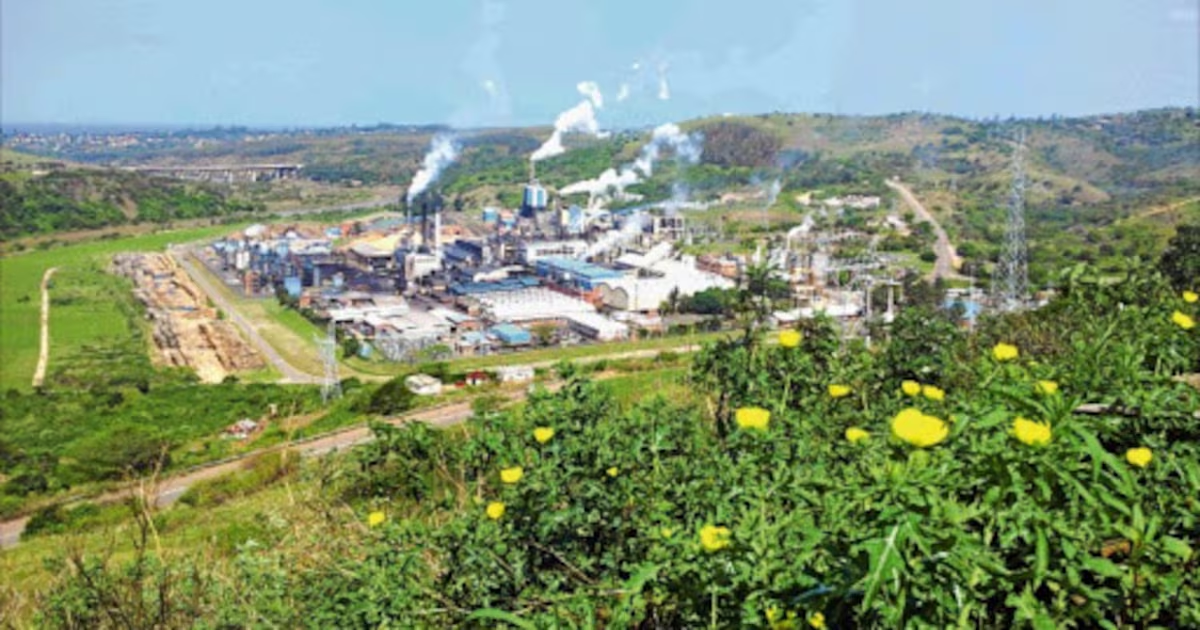
Every day, my role requires me to look at our business through two very different lenses. On one hand, I sit in boardrooms and speak with global investors who analyse our performance through balance sheets, ESG targets and the hard numbers of the circular bioeconomy. On the other hand, I have never lost sight of what is happening on the ground, because that is where my own journey began.More than two decades ago, I walked into Sappi’s Saiccor mill as a young graduate with a PhD in organic chemistry. Working in research & development and customer technical services, I spent years in laboratories and manufacturing plants learning the intricate science of woodfibre. I discovered how a tree could be transformed into everything from dissolving pulp for sustainable textiles to renewable packaging that helps reduce reliance on fossil-based materials. I learnt that sustainability is not simply a corporate buzzword or another reporting requirement. It is a living value chain that begins with a seedling in rural South Africa and extends into global markets.South Africa’s bioeconomy represents one of the country’s greatest yet often overlooked opportunities for the economic empowerment of women.The bridge between global markets and rural communitiesIn investor circles, we often discuss the growing demand for renewable, plant-based materials. Yet the true engine of the bioeconomy is not found in laboratories or stock exchanges. It is found on the land. Across South Africa’s rural communities, women are proving themselves to be entrepreneurs, employers and stewards of sustainable growth.Corporate forestry has an important role to play in connecting these women to the global economy. The sophisticated demands of international customers must translate into meaningful opportunities through enterprise development, skills transfer, market access and long-term business ownership.That is exactly what Sappi’s Khulisa programme was designed to achieve.The numbers are significant, but the real measure of success lies with the women whose businesses are transforming families and communitiesToday Khulisa supports 4,434 growers and 1,033 contractors, with women accounting for almost half of all independent growers. Since 1995, the programme has delivered more than 5.5Mt of timber valued at R3.57bn, while providing technical training, subsidised seedlings and support that enables entrepreneurs to build resilient businesses rather than depend on assistance.The numbers are significant, but the real measure of success lies with the women whose businesses are transforming families and communities.Growing businesses, not just treesWhen Dumisile Caroline Vumase joined the programme in 2005, she began with just 4ha of planted forestry. Today, she manages more than 105ha. She diversified into macadamias and has established a thriving orchard alongside her timber operations. Her success extends beyond her own business. She shares her knowledge with younger members of her community, helping develop the next generation of agricultural entrepreneurs.Dumisile perfectly reflects the mindset Khulisa seeks to cultivate. She continually learns, reinvests, diversifies and creates opportunities for others rather than seeing obstacles.Pinky Mooko, director of Baleti Estate in Mpumalanga, has demonstrated how sustainable farming can create resilient rural enterprises. Her business combines forestry with avocado, macadamia, pecan and honey production, while creating permanent and seasonal employment opportunities within the local community.Through Sappi’s enterprise & supplier development programme (ESDP), Baleti Estate received business development support together with 30 beehives and honey processing equipment, allowing the business to establish an entirely new income stream while developing additional skills among employees.The bioeconomy creates opportunities throughout the value chain, including transport, logistics, processing and manufacturing. Such entrepreneurs as Thulisile “Cannie” Ntombela demonstrate another side of the industry’s potential.After years spent building her entrepreneurial journey, Cannie established Lisile Logistics to focus on timber transportation. Through the ESDP, her business has grown to include three logging trucks, three trailers and dedicated office premises and has created 14 direct jobs alongside opportunities for consultants, technical specialists and administrative staff.Building the next generation of women entrepreneursThese women remind me why I fell in love with science and forestry in the first place.Whether you are a scientist developing the next generation of biomaterials, an investor evaluating sustainable businesses, a grower managing commercial forestry or an entrepreneur transporting timber across the country, the bioeconomy has a place for you.When women succeed, the impact reaches far beyond individual businesses. We see women investing in education, creating employment, supporting extended families and becoming respected leaders within their communities. Strong businesses become stronger households, stronger communities and ultimately a stronger economy.The transition to a more sustainable future is already under way. If we are serious about building a resilient, low-carbon economy, we must continue creating opportunities for women at every stage of the value chain, from the laboratory and the mill to the farm, the boardroom and beyond.• Wessels is group head of sustainability and investor relations at Sappi.