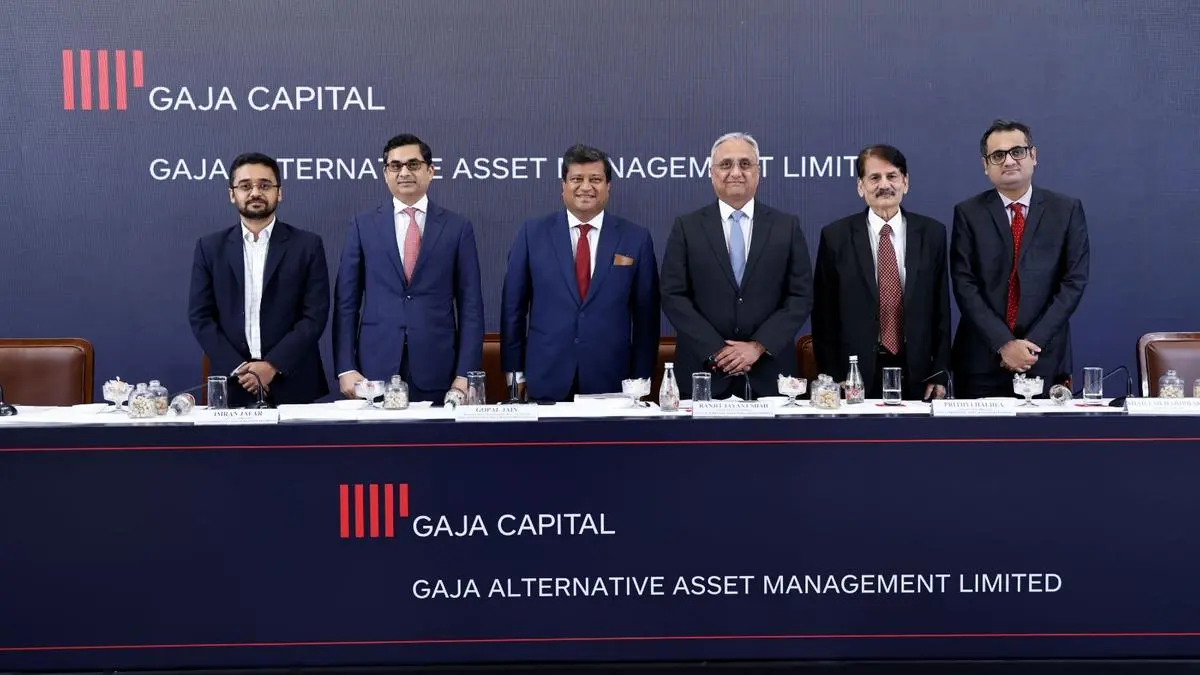
Gaja Alternative Asset Management’s ₹550-crore IPO, the first by a pure-play home-grown alternatives asset manager, opens August 19-21. The ₹152-160/share issue comprises a 2.81-crore-share fresh issue worth ₹450 crore and a 0.63-crore-share OFS worth ₹100 crore. Promoter-group stake falls from 71 per cent to 54 per cent post issue.At ₹160/share, the alternatives asset manager’s market cap will be about ₹2,256 crore (small-cap). Of the fresh proceeds, ₹372 crore will go towards sponsor commitments across Fund IV, Fund V and the Secondaries Fund, including repayment of a bridge loan.Gaja offers investors exposure to a two-decade-old alternative asset manager with a credible investment record, especially in mid-market segment, sizeable carried-interest economics and substantial sponsor investments in its own funds.While the business has attractive long-term optionality, the composition of current earnings (explained later) makes the headline valuation of around 28 times FY26 profit less attractive than it first appears. Its 52 per cent FY26 PAT margin appears robust, but top traditional AMCs (selling mutual funds) on a sustained basis clock 55-60 per cent margins.Thus, investors can wait and watch for now, and revisit it once there is greater visibility on fundraising and growth in recurring management-fee income.BusinessAlternatives are not entirely new to public market investors in India, with listed firms such as 360 ONE, Nuvama and Motilal Oswal, as well as AMCs including HDFC AMC, Nippon India AMC, UTI AMC and ICICI Prudential AMC, already offering some exposure to the segment.Gaja acts as investment manager to India-focussed funds, including Category I and Category II alternative investment funds (AIFs), and also advises offshore funds, which provide capital to companies in India.The AMC concentrates on four themes: education, employment and employability; financial services; consumer brands; and digital technology platforms.A typical private-equity fund has a lifecycle of eight to 10 years. The funds managed and advised by Gaja raise capital from investors and invest it in portfolio companies. Gaja oversees these investments and eventually seeks exits through IPOs, strategic sales or secondary transactions.Its revenue comes principally from three sources. First is management fee, charged on capital committed or invested by external investors. This is the most predictable component of earnings.Second is carried interest, or Gaja’s performance-linked share of profits generated by funds.Third is income from sponsor commitments, arising because Gaja itself commits capital to the funds it manages and participates in the investment returns generated by those funds.Sponsor income reflects fair-value gains, while carried interest is recognised once Gaja’s right to payment is established, though cash receipt can lag.Gaja’s funds have invested in companies including People Home Finance, Fractal Analytics, Eggoz Nutrition, Signzy, Amber, Leadsquared, Xpressbees, RBL Bank, Educational Initiatives, Avendus, Kinara, Suryoday, SportzVillage, Bakers Circle, EuroKids, Carnation, John Distilleries, TeamLease and CL Educate.Gaja’s investment record, across market cycles, is one of the stronger parts of the proposition. Early investments realised 5.61x multiple on invested capital (MOIC); Fund II 3.81x/18.61 per cent IRR (internal rate of return); Fund III 1.88x/9.4 per cent; Fund IV 1.74x/27.91 per cent. Returns are gross. Fund III is partially realised and Fund IV is still under deployment.Earnings growthThe key consideration lies not in Gaja’s reported growth, but in the composition of that growth.Total income rose from ₹103.96 crore in FY24 to ₹157.80 crore in FY26, while PAT increased from ₹44.74 crore to ₹81.96 crore. Yet management fees, the recurring component, fell from ₹75.85 crore to ₹60.08 crore, reducing their income share from 73 per cent to 38 per cent. Carried interest rose from ₹18.40 crore to ₹75.41 crore, or 48 per cent of FY26 income; income from sponsor commitments added ₹16.74 crore, or 11 per cent.In other words, close to three-fifths of FY26 income came from carried interest and sponsor investments rather than recurring management fees. This makes the reported ₹81.96-crore PAT a less reliable base on which to apply a conventional AMC-type valuation multiple.Sponsor-investment gains are volatile: ₹16.74 crore in FY26 came from fair-value gains, while income was nil in FY25.Note, effective tax rates stayed low — 19 per cent in FY24, a tax credit in FY25 and 6 per cent in FY26 — making reported PAT less representative.On a simple stress test, excluding carry and sponsor gains, FY26 income of ₹65.6 crore was below expenses of ₹70.4 crore, indicating that the recurring revenue base is yet to cover the cost base.Gaja’s cost-to-income ratio fell from 52 per cent in FY25 to 45 per cent in FY26, but is still much higher than top traditional AMCs (20-33 per cent).Cash flows also warrant some attention. Despite reporting PAT of ₹61.95 crore in FY25 and ₹81.96 crore in FY26, Gaja reported negative operating cash flow of ₹8.75 crore and ₹14.98 crore, respectively.Trade receivables, which stood at ₹62.89 crore in FY24, more than doubled to ₹131.88 crore in FY25 and remained elevated at ₹131.47 crore in FY26.Two consecutive years in which substantial accounting profits have not translated into operating cash flows are worth monitoring.Gaja’s investment-management operations are inherently scalable and require limited physical capital. But it cannot be regarded in quite the same manner as a conventional capital-light AMC.Gaja has committed about ₹274 crore as sponsor capital across its funds, or 6.41 per cent of their aggregate size; Fund IV’s sponsor commitment is higher at 8.45 per cent. This aligns Gaja with its limited partners and gives earnings exposure to fund performance, but also locks up capital and exposes shareholders to illiquid private-market assets.Successful fundraising could expand Gaja’s management-fee pool and operating leverage, making it the key growth trigger.ValuationAt ₹160 a share, Gaja is valued at around ₹2,256 crore (m-cap), or roughly 28 times FY26 PAT. At first glance, this appears reasonable. Listed Indian wealth managers (trailing 30-46x multiple), mutual fund companies (30-49x) and global alternative managers (32-40x) can appear a tad more expensive. That comparison, however, requires caution.Traditional AMCs derive the overwhelming share of their earnings from recurring management fees. For instance, management fees accounted for 85 per cent of FY26 total income for recently-listed SBI Funds.Gaja’s FY26 profitability is far more dependent on carried interest and gains on sponsor investments, which can vary significantly depending on fund performance and the timing of exits.Also, due to its sizeable capital base and sponsor investments, Gaja’s FY26 Return on Net Worth (RoNW) of 13.13 per cent trails most listed peers, which range from 24.13 per cent to 79.07 per cent; only UTI AMC and 360 ONE rank lower in the peer set.Given all of the above, applying similar headline P/E multiples risks overstating Gaja’s cheapness.Successful fundraising can improve the investment case by expanding recurring fees without proportionate cost increases. But at the IPO price, investors are paying ahead of that execution, leaving limited valuation comfort.Published on August 15, 2026
Gaja Alternative Asset Management IPO Review: Should You Invest?
Gaja Alternative Asset Management IPO is priced at ₹152-160 a share. We assess its earnings mix, carried interest, sponsor investments, valuation, risks and investment case.
TL;DRAI
Gaja AMC launches India's first pure-play alternatives fund manager IPO (₹550 crore, Aug 19-21) in midmarket PE with tech/fintech focus. Yet 59% of FY26 earnings from volatile carried interest, not recurring fees—raising valuation risk vs traditional AMCs.
1,105 words~5 min read