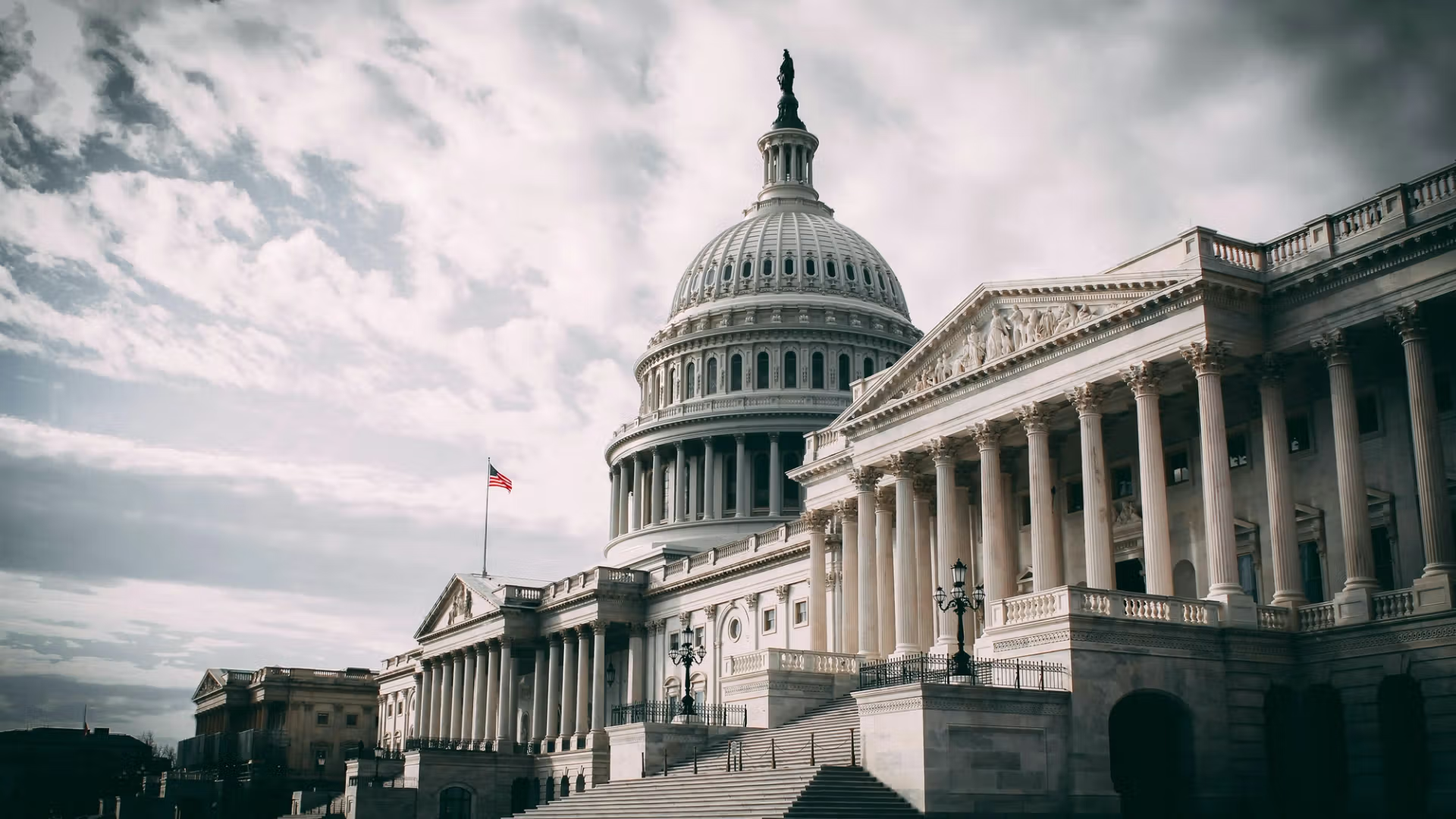
51 min ago6 min readCapitol in Washington, D.C. (Harold Mendoza on Unsplash/Modified by CoinDesk)SummaryCrypto is entering a more regulated, institutionalized phase as U.S. lawmakers debate the Digital Asset Market Clarity Act and regulators refine their own rulemaking.Bitcoin markets flashed mixed signals as major corporate holders and miners sold while large wallets and hedge funds increased bullish positions.Wall Street is deepening its involvement in select crypto products and infrastructure even as a shakeout forces weaker projects, exchanges and tokenization plays to fold or reset.Last week, Strategy sold bitcoin, Wall Street bought deeper into crypto, Washington kept Clarity alive, and Bitcoin itself split over how the network should change.Add in a major hardware-wallet security scare and a $1.5 billion hack that landed North Korea in U.S. court, and a theme emerged: Crypto is being tested as it enters its grown-up era.Here are five stories that defined the week.1. Policy: Clarity survives (for now)The Digital Asset Market Clarity Act missed the Senate’s August window, but the crypto market structure legislation will get another shot after lawmakers return in September.The industry had been hoping for a procedural vote before the congressional recess and reacted angrily when one didn’t materialize. CoinDesk’s State of Crypto analysis made the case that waiting may have been preferable to forcing a vote without enough support and watching the bill fail.The stakes extend beyond this Congress. If the legislation collapses and lawmakers have to start over next year, Democrats are likely to have a more prominent role in writing the next version of the bill. There are three Democratic women who could gain greater influence over the next round of crypto legislation. All have generally approached digital assets with considerable skepticism.Meanwhile, the regulatory train trundles on, leaving U.S. crypto policy moving on two tracks. While Congress is still trying to write the broad market structure, the Securities and Exchange Commission (and its sister agency, the Commodity Futures Trading Commission) is beginning to work on rules within its own ranks. But even that process is proving messy. The SEC said it’s delaying a planned “innovation exemption” for tokenized securities after concerns from both the White House and Wall Street, including fears that moving too aggressively could complicate Clarity Act negotiations and reshape market structure without a full rulemaking process.For an industry that spent years complaining that nobody would tell it what the rules were, that is progress. September will show whether Congress can actually agree on them.2. Markets: Strategy sold bitcoin — just as some of bitcoin’s biggest holders were accumulatingBitcoin spent the week sending contradictory signals: Strategy (MSTR) sold, miners unloaded coins, and corporate treasury losses piled up. At the same time, whales accumulated and hedge funds became more bullish.Strategy sold 1,690 bitcoin and raised $653 million from sales of its common stock. Strategy has now sold five times this year, totaling around 7,000 BTC — a sharp reversal for a company whose founders spent years insisting they would never sell a single coin. The company helped create the modern bitcoin treasury trade — raise capital, buy bitcoin, repeat — inspiring companies worldwide to turn their balance sheets into leveraged bets on the cryptocurrency.That explains why routine bitcoin movements are suddenly in focus. When roughly $320 million of bitcoin moved from wallets associated with Metaplanet (3350), speculation quickly followed that the Tokyo-based company was selling. CEO Simon Gerovich denied that it was the case.Trump Media (DJT) showed the downside of a bitcoin-holding strategy. The Truth Social parent reported $360.6 million in first-half losses tied to digital assets and digital assets pledged, much of them unrealized. It held 9,477 bitcoin worth about $557 million at the end of June, down from 9,542 at the end of March. Trump Media, Crypto.com and Yorkville Acquisition also scrapped a proposed publicly traded CRO treasury company and abandoned a separate ETF-servicing partnership, citing market conditions and shifting priorities.Meanwhile, public bitcoin miners, an easily overlooked source of coins hitting the market at the margin, added about $1.78 billion of selling pressure.That may happen. But last week showed that right now, institutions are choosing selectively.Grayscale dropped plans for ETFs tied to Cardano, Polkadot and Hedera. None of the proposed products became effective, and no securities were sold.Tokenization also got a reality check. Securitize shares fell 20% after its first earnings report as a public company missed expectations. Tokenized assets hit a record, and trading activity jumped. Revenue, however, fell short.That is a useful snapshot of institutional crypto in 2026: Enthusiasm can be genuine without every product, token or business model being a winner. Wall Street isn’t simply “adopting crypto.” It is paying for stablecoin infrastructure, expanding certain ETF strategies and demanding that the businesses behind blockchain’s biggest narratives eventually produce revenue.4. Tech and security: Coldcard shook self-custody. Bitcoin’s rebellion lasted two blocks.The most consequential bitcoin flows of the week, however, may not have been selling at all.About 210,000 bitcoin moved out of long-term holder wallets, according to Glassnode data, the most since December 2024. Normally, that kind of action might look bearish. This time, the transfers were the result of an unauthorized attack on Coldcard's offline wallets.Some affected users moved bitcoin into newly generated wallets, while others may have shifted toward regulated custodians or exchange-traded funds; U.S. spot ETFs attracted roughly $754 million during the period.The original blockchain also faced an entirely different kind of test.A controversial fork tied to Bitcoin Improvement Proposal 110, or BIP-110, mined just two blocks before stalling. The breakaway chain inherited Bitcoin’s mining difficulty while attracting only a tiny share of its computing power, resulting in blocks forming hours apart.Then the technical dispute overflowed into governance. Longtime developer Luke Dashjr was removed as a Bitcoin Improvement Proposal editor after controversy surrounding the proposal. Dashjr said he would take a sabbatical from his roles as chair and chief technology officer of mining pool Ocean.The week also brought another security story, this time involving a state actor and the courts. Bybit sued North Korea, its Reconnaissance General Bureau and the Lazarus Group over last year’s $1.5 billion hack and secured a preliminary U.S. court order freezing identified assets tied to the theft.5. Business: The shakeout is happening at the same time as the land grabHere is the contradiction tying much of the week together. Traditional finance wants more crypto, but many crypto projects may not survive long enough to benefit.More than 100 projects have folded in 2026, according to CoinDesk’s examination of a dot-com-style shakeout sweeping through the industry. While it's hard to find in advance the “real” businesses that will survive this cycle, what is clear is that the environment has become less forgiving of businesses betting that "numbers go up."Shutdown announcements from exchanges that survived some of the prior cycles, particularly BitMEX, showed how tough the market has become. The firm's attempted sale collapsed after prospective buyers balked at founder ownership and a shrinking business.Crypto spent years arguing that regulation would legitimize it, institutional money would transform it, and decentralized technology would offer an alternative to the traditional financial system.Now pieces of all three things are happening at once, just not the way crypto bulls thought they would.AI Disclaimer: Parts of this article were generated with the assistance from AI tools and reviewed by our editorial team to ensure accuracy and adherence to our standards. For more information, see CoinDesk's full AI Policy.12345678910Building the Zcash Machine: Tachyon and Quantum ReadinessBuilding the Zcash Machine: Tachyon and Quantum ReadinessZcash’s Tachyon upgrade aims to scale shielded payments, improve quantum readiness, and test whether its funding, security, and governance can hold.Jun 30, 2026Zcash’s Tachyon upgrade aims to scale shielded payments, improve quantum readiness, and test whether its funding, security, and governance can hold.Why it matters:Zcash’s Tachyon upgrade aims to scale shielded payments, improve quantum readiness, and test whether its funding, security, and governance can hold.View Full Report
Clarity survives (barely), Strategy sells and the untold story of Mastercard's $1.8 billion deal: Crypto's week in 5 stories
Washington kept crypto’s biggest legislative hope alive, Wall Street pushed deeper into digital assets, and a security scare sent billions of dollars of bitcoin moving between wallets.
TL;DRAI
Digital Asset Market Clarity Act deferred; Strategy liquidated $653M BTC amid miner exits, weakening corporate treasury trades. Wall Street adoption narrows to stablecoin infrastructure and select ETFs; Coldcard breach reinforces self-custody risks, limiting mainstream adoption.
1,301 words~6 min read