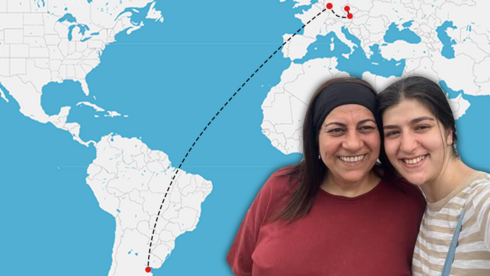
After the mother and daughter were found safe in Argentina, their case raises questions about police powers, adult privacy, debt and when a disappearance becomes a criminal matterLiran Tamari|Mali and Liel Yahalomi identified on a bus in Buenos Aires, Argentina (Video: Israel Police)That raises a broader question: What happens now? Do police have authority to act against someone who simply decides to disappear? What if the disappearance is connected to financial problems? And where is the line between an adult’s right to vanish from public view and a situation in which an entire law enforcement system is mobilized to find someone based on potentially misleading circumstances?ynet explains.Israel Police is responsible for investigating reports of missing people throughout Israel. Once a missing-person report is filed, investigators assess the level of risk and determine what steps should be taken.Police regulations define a missing person considered at risk as a child under 12, a person over 70, someone with an illness or disability who requires hospitalization or medication without which their life would be endangered, a person with a psychiatric condition who is hospitalized in a psychiatric facility, a member of the security forces or anyone else believed to be in danger.When the missing person is an adult, an investigation can be opened after the family reports the disappearance.Mali and Liel YahalomiFinding Liel and Mali Yahalomi in Argentina involved cooperation among Israel Police, Interpol and Argentine authorities. Information gathered during the investigation in Israel that indicated the two were in Argentina was passed through international law enforcement channels to Interpol in Buenos Aires. The information was then transferred to local authorities, who worked to locate them.Every Interpol member country has a National Central Bureau that connects domestic police with law enforcement authorities in other countries. In Argentina, that office operates within the Argentine Federal Police. Any law enforcement powers exercised on Argentine territory therefore belong to Argentine authorities and are governed by Argentine law.After Liel and Mali were located, they spoke with a local Interpol representative and an Israel Police representative. But the Israeli officer does not have the same powers in Argentina that a police officer has in Israel. An Israeli police representative cannot, solely by virtue of that position, detain or arrest someone in Argentina or compel that person to submit to questioning. Such actions, when legally justified, are the responsibility of local authorities.In Liel and Mali’s case, they were not suspected of a crime and were not subject to an international arrest warrant that could provide grounds for restricting their freedom. The Israeli police representative could speak with them, ask questions voluntarily and try to understand what had happened since they disappeared, but could not force them to answer.The conversation allowed police to address questions that arose during the search, confirm that the two were not in danger and relay the information to investigators in Israel.If evidence establishes grounds for criminal suspicion, the investigating unit must open a criminal case, which would be transferred to Lahav 433, Israel Police’s national unit that handles major organized crime, corruption and other complex investigations.Austrian police, however, reportedly ruled out indications of criminal activity almost from the beginning. An initial Israel Police inquiry also found that the two women had voluntarily left the apartment where they had been staying in Vienna, easing concerns that they had been abducted.Police regulations also require that when an Israeli citizen goes missing abroad, the investigating unit ensure that all required domestic investigative steps have been taken before turning to Interpol.If the two women are adults, have been located in Argentina, are healthy and capable of making their own decisions, and are not suspected of a crime or subject to an arrest warrant, there is no legal basis to detain them simply because they were reported missing in Israel or because they chose to disappear from their family.Authorities can search for an adult when there are concerns for that person’s safety. But once authorities establish that the person is safe and simply chose to disappear, the state cannot force that person to return to their family.The situation can change if evidence of criminal conduct connected to the disappearance emerges.Interpol uses what is known as a Yellow Notice to help locate missing people internationally. A Yellow Notice is a tool for locating a person, not an arrest warrant.A person who travels abroad in an attempt to avoid creditors will not necessarily be arrested. Debt alone generally does not provide grounds for arrest, and creditors have other legal avenues available to them.If enforcement proceedings are underway in Israel, for example, creditors can pursue collection procedures or seek court orders, including an order barring the debtor from leaving Israel. According to Israel’s government services portal, such a request can be filed in certain cases involving debts exceeding 50,000 shekels, or roughly $17,000.An order preventing someone from leaving Israel means exactly that: It prevents the person from departing Israel. It is not an international arrest warrant and does not give foreign police authority to arrest an Israeli citizen merely because that person owes money in Israel.The situation changes if authorities develop evidence of possible crimes such as fraud, theft, forgery, defrauding creditors or other criminal offenses.Even then, suspicion alone does not automatically give Israel Police the authority to arrest someone in another country. Israeli police jurisdiction is territorially limited.Under Israel’s International Legal Assistance Law, police can ask another country for assistance with a criminal investigation, including taking testimony, conducting searches and carrying out other investigative measures.That is different from arrest or extradition, however, and it does not grant an Israeli police representative the authority to independently detain or arrest someone on foreign soil.As far as the missing-person case is concerned, the mission is essentially over.Police have no authority to arrest Mali and Liel merely because they disappeared. Because both are adults, they can also refuse permission for police to tell their family where they are.Police cannot force the women to return to Israel or even require them to contact their family if they choose not to do so.Different rules can apply when a missing person is believed to be in danger. But once competent adults are found safe and no criminal grounds exist to detain them, choosing to remain out of contact is, in itself, not a crime.
Can Mali and Liel simply disappear? The legal questions behind the right to vanish
After the mother and daughter were found safe in Argentina, their case raises questions about police powers, adult privacy, debt and when a disappearance becomes a criminal matter
1,045 words~5 min read