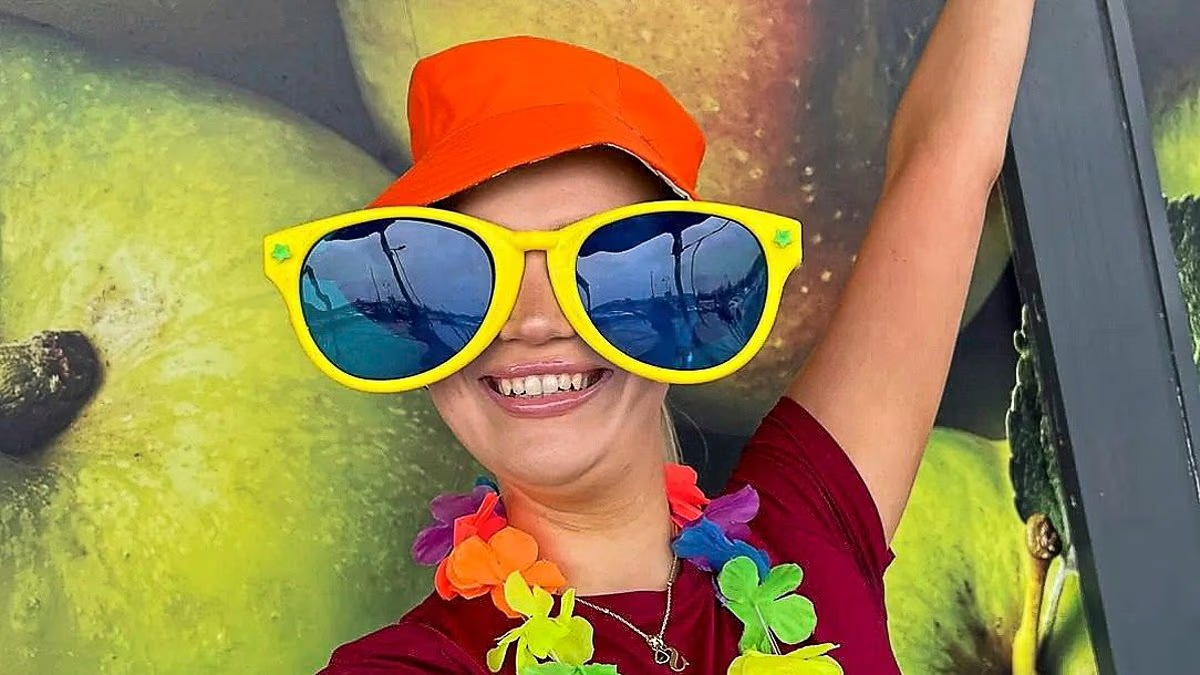
Sophie Jones is standing in the middle of London Bridge station singing Dancing Queen by Abba. She’s not a busker, nobody has requested she perform and her voice is, truthfully, fine. Two men walk past and look at her in a funny sort of way. A woman wheeling a suitcase smiles. No one actually says anything. Near the end of the chorus, Jones increases in courage. Her voice gets louder. To finish, she does a little leap.Afterwards, I ask how she feels. ‘I don’t feel awful. My heart rate’s a little bit raised, but I’ll ground myself, take a few deep breaths, look around and say, “Is anyone staring at me?”’ We skim the station. ‘No, they aren’t!’Jones, 24 and from Warrington, is practising ‘rejection therapy’ – in her words, a ‘self-help challenge where you purposefully, in a slow and controlled way, expose yourself to rejection. And, that way, your brain becomes desensitised to it. You learn that rejection can’t hurt you unless you give it permission to.’ Basically, you put yourself in embarrassing situations and hope that, in surviving them, you boost your confidence.It’s not an official therapy exercise – although plenty of therapists support the idea – but it is massive on TikTok. And, online, Jones is kind of a rejection-therapy celeb. For two years she has posted videos to social media of her performing tasks. Today, she has 600,000 followers on TikTok, 306,000 on Instagram, and her videos have received more than 48 million likes. In 2024, she left her job as a social media manager for a gym group and now makes all her money through online videos. She has appeared on This Morning, BBC and ITV news, and, this month, she is publishing her first book: The Rejection Cure.Jones found out about the concept through a TikTok video herself, in May 2024. She was ‘into the idea of self development’, but had always been ‘quite an inwards’ person. She ‘struggled with friendships’ at school and, when she got her first ‘big girl job’ at the gym firm, was scared to share any of her ideas. ‘It was really holding me back.’She wanted help, rejection therapy ‘terrified’ her and so, she concluded, that was a sign to do it. Her first task was minuscule: she asked her sister if she wanted to borrow her hairbrush. Jones’s sibling – confused and also in possession of her own hairbrush – said no, obviously. The rejection didn’t upset Jones. She felt chuffed.The tasks became bigger and more embarrassing: Jones danced, alone, in a public park (a few funny looks); she stood up on a busy Ryanair plane and wished everyone a happy flight (a lot of funny looks); she asked a train carriage if they wouldn’t mind her singing a song to them (some mumbled ‘sure’); she asked a random builder if she could try on his hat (‘as long as I can have it back afterwards’); she did her Tesco shop while wearing a wedding dress.After weeks of doing these tasks, in true Gen Z style, Jones began filming herself and uploading the content to social media. (She generally keeps strangers’ faces out of shot.) Within a month, she had 26,000 followers; a few months later that number was 100,000. Today, she does rejection therapy three times a week. ‘I had done it every day for two years and was getting slightly fatigued.’ She doesn’t film all of her tasks because she wants to prove to herself that she is not just doing it for online attention.Jones knows the concept sounds bonkers, but, she says, it works. ‘The thing I want to get across is that, for example, when I asked to try on a builder’s hat, you might think: “That’s silly.” But the point is, if you can ask to try on a builder’s hat [whatever they reply] you’ll prove to your brain that [doing something nerve-wracking] is not as bad as you thought. And then you can take that into your daily life and do something like ask for a pay rise.’ In her own daily life, rejection therapy has emboldened Jones to: make friends more easily; stick up for herself better in romantic relationships; and, last year, move – on her own – from Warrington to Brighton. ‘Younger me dreamed of having this confidence.’Paradoxically, ‘The thing I’ve also learnt is that people don’t like to reject you.’ Last year, a farmer let Jones sit in his tractor (he took the keys out first), and a month ago a stranger at a bus stop – who was already humming to herself – agreed to sing a duet with her while they waited for the bus to arrive. Once, Jones asked a restaurant if she could have a tour of their kitchen and she ended up doing a trial shift.I wonder why people are so willing to agree to her mad requests. ‘A comment I get quite often is about pretty privilege,’ she says. ‘People say, “Oh well, of course they’re going to say yes to you. You’re young and pretty.” But I truly believe it comes down to vibes. Maybe there is an aspect of pretty privilege, but I’ve seen other videos of people of all different ages and backgrounds doing rejection therapy. You know, if you approach it with a friendly vibe [it works].’ Later I watch a video where Jones asks two builders if they can please move their lorry. They say ‘No’, she says, ‘I’m just joking’, and they all laugh.Still, the practice has given her problems. ‘I’m not stupid. I know a lot of people will find rejection therapy inspiring, but I also realise that some people who knew me in high school have probably said some not-nice things about it behind my back.’ That doesn’t bother her too much, but Jones is single and dating ‘has been a minefield’.‘I’m on Hinge and, not to toot my own trumpet, people recognise me. I don’t know how I’d feel about going on a date with someone who knows my work. Much as I so strongly believe in my work, from a relationship point of view, a part of me is a bit embarrassed.’ She appreciates the irony. ‘I preach all this rejection therapy, yet going on a date and saying “this is what I do”, I’d be nervous!’ However, Jones thinks she’s getting better at ignoring those fears. Also, when she does find a boyfriend, ‘the right person isn’t going to care’.One criticism of rejection therapy is that it could also be embarrassing to strangers around you. Is it just another form of pranking? ‘It’s definitely different,’ says Jones. ‘I’m not encouraging people to go out and be a nuisance. I wouldn’t go up to anyone who’s in a rush, or seems vulnerable. I like to approach groups, so they don’t feel uncomfortable because they’ve got each other.’At London Bridge, Jones performs two more rejection therapy exercises. The first is to ask strangers if she can tell them a joke. We stand by the station entrance while she googles ‘bad jokes’. She finds one about a scarecrow. I watch as Jones approaches three women in their 30s. She does her gag and they laugh so much that she asks if she can do another. The women laugh again, she says thank you, and walks back to me, beaming.She tries another task: giving a stranger a compliment. Jones walks through the station, scanning people. ‘It’s important to do one that’s genuine, because I’d never want anyone to think I was taking the p**s.’A nicely dressed woman in her 60s walks past. Jones scuttles towards her and says, ‘You look gorgeous.’ The woman replies, ‘Oh, you’ve made my whole day.’Jones walks back, smiling again, and we discuss what she’s just done. It seems that if rejection therapy started as a way of boosting Jones’s confidence, it has turned into her doing small things to bemuse strangers.Her generation is, she thinks, often too scared to chat to people they don’t know. ‘Maybe it’s because we’re on social media so much, or because there’s more fear mongering that terrible things go on in the world and that strangers are scary. But, in fact, we’re all just people, and I think we’re craving connection now more than ever.’Rejection therapy has made her more confident. ‘But, also, it’s restored my faith in humanity.’The Rejection Cure by Sophie Jones will be published on 27 August by Bloomsbury, £16.99. To order a copy for £14.44 until 30 August, go to mailshop.co.uk/books or call 020 3176 2937. Free UK delivery on orders over £25.
SOPHIE JONES on the surprising benefits of 'rejection therapy'
Rejection therapy - doing embarrassing things to build resilience - is the latest self-help craze.
1,432 words~7 min read