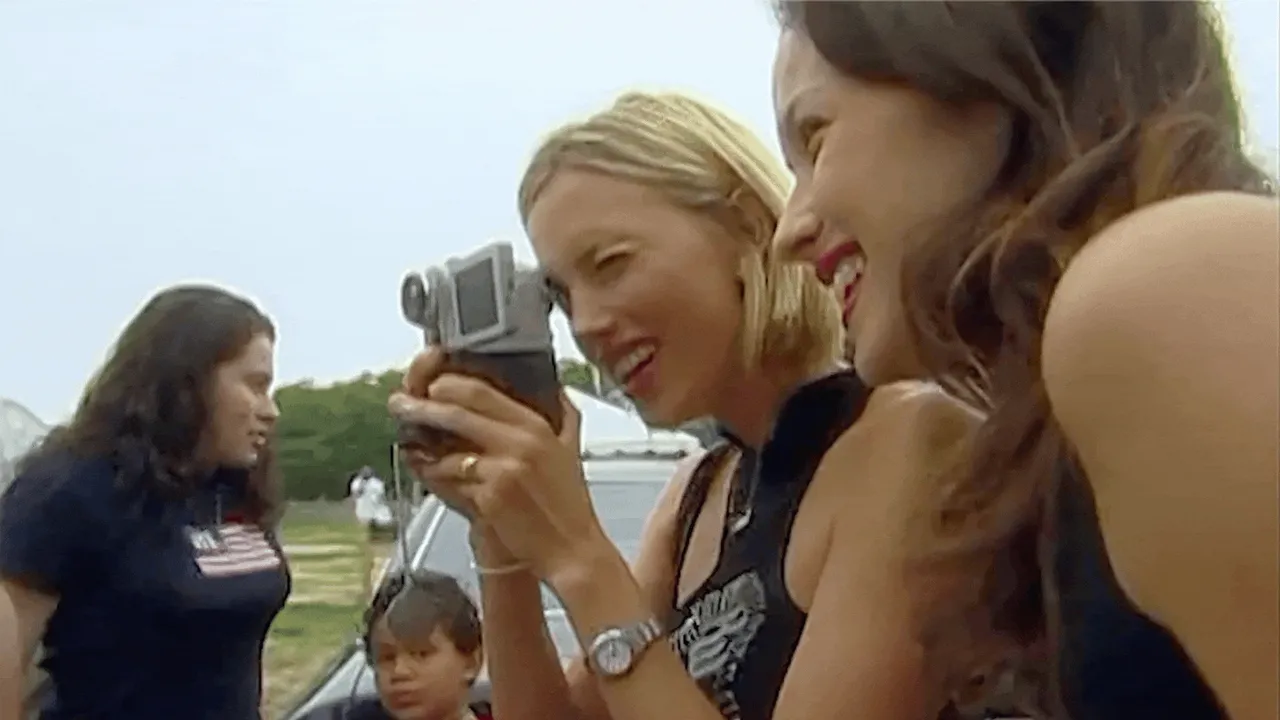
Marilee Foster is a farmer. In the eighteen-hundreds, her great-great-great-grandfather, a whaling captain, decided to leave the ocean behind him and buy about forty acres of land in Sagaponack, on Long Island, which have remained in Foster’s family ever since, and which she continues to tend, growing fruit and vegetables. Foster is also a writer, who publishes a column in the Southampton Press. “She writes about simple things: she writes about the first crop, she writes about sunsets, she writes about birds,” the author Steven Gaines, a resident of East Hampton, tells the documentarian Barbara Kopple. “It’s really . . . it’s the Hamptons that everybody misses.” According to Foster, her writing is done from a perspective only available to those who, like her, “spend most of their time in the field.” This gives her readers “a certain amount of texture.”Foster is one of the many characters who populate “The Hamptons,” Kopple’s fascinating nearly three-hour-long documentary, which first aired in two parts on ABC, in the summer of 2002, and which is now streaming, for a limited time, on the website Le Cinéma Club. Like Foster, Kopple provides a certain amount of texture in her work, though the field she spends time in and reports on is broader than that of the farmer’s: her subject matter isn’t just the so-called real agricultural communities whose hastening loss Gaines laments but much else besides. For “The Hamptons,” she spent the period between Memorial Day and Labor Day of 2001 roving the cluster of interlocking villages and hamlets on the South Fork of Long Island that have long served as a resort destination for moneyed New Yorkers in the summer months. The result was an intimate human mosaic, set in a highly distinct moment in time.Kopple’s film is a balm to anyone who’s grown inured to the characteristic beats of most current documentaries, which so often feel as if they came off a Netflix assembly line. Instead of talking-head interviews, or reënactments, or illustrative, quasi-humorous animated sequences, Kopple’s observational approach allows for meaning to emerge slowly. As a two-time winner of the Academy Award for Best Documentary, for “Harlan County U.S.A.” (1976) and “American Dream” (1990), which both focussed on labor disputes (one in a Kentucky coal mine, the other in a Minnesota meatpacking plant), Kopple is naturally attuned to the class tensions simmering underneath the Hamptons’ placid surface. And yet, her film isn’t politically didactic. Instead of a David and Goliath story, with working-class locals unidirectionally raging against wealthy out-of-towners, she presents an Altmanesque ensemble of diverse subjects, making “The Hamptons” a multivocal affair that has the grain of real life.The documentary consists of a collection of short vignettes, arranged according to summer’s chronological unfolding, and features a cast of recurring characters. There’s the longtime police lieutenant, and the local career fishermen, and the seafood caterers, and the waitresses at a local restaurant—a couple of party-happy Irish girls, and a beleaguered Australian. There’s the slick, glad-handing publisher of Hamptons magazine, and the feisty Citarella market scion who would love to have her picture featured in its pages. Then there are the young city professionals shacking up in summer rentals, as many as eight to a room, eight to a hot tub: Jacqueline, a flirty lawyer looking to find a husband; Angela, a shy investment banker who isn’t sure if the share-house experiment is for her; and Josh, a fun-loving guy who calls himself an entrepreneur but mostly seems to occupy himself with picking up girls. Then, there’s Marilee the farmer, and the gimlet-eyed Gaines, a classic insider-outsider figure who wrote the Hamptons history “Philistines at the Hedgerow,” and who explains to Kopple and, by extension, to us, Who’s Who in the Hamptons cosmology.Among those denizens are, of course, the famous or at least notable: the supermodel Christie Brinkley and her ex-husband, the musician Billy Joel; the polo-playing businessman and art collector Adam Lindemann; the hoteliers Rick and Kathy Hilton and their still teen-age daughters, Paris and Nicky; the “Sex and the City” author Candace Bushnell; the hip-hop moguls Russell Simmons and Sean (Diddy) Combs; and the celebrity publicist Lizzie Grubman, whom the camera begins to follow mere days before a dispute with a bouncer led her to back up her father’s Mercedes S.U.V. into a crowd outside the Conscience Point Inn night club, and injure sixteen people, resulting in a summer-long tabloid furor. (Grubman subsequently pleaded guilty to felony and misdemeanor charges and served a thirty-eight-day jail sentence.)Kopple’s documentary is a time capsule, offering a concentrated taste of an earlier moment in American culture, now resolutely over. To watch the proud father of the Hamptons publisher leafing through the magazine’s June issue, bragging that “this is a pretty thick book, four-hundred-plus pages,” or party-animal Josh asking a woman he meets whether she has a cellphone so that he can give her his number, or girls dancing at the club—their hair flat-ironed, their tight-fitting going-out tops just kissing the waists of their low-rise designer denims, their tiny shoulder bags tucked securely under their arms—is to feel oneself being tossed back on the waves of time. As a friend I was discussing “The Hamptons” with noted, too, “the most startling part about this documentary is how normal everyone’s face looks.” Botox hadn’t even been F.D.A.-approved yet. Were we ever so young?This peek into the relatively recent past is delightful fun, except when it starts to feel distinctly melancholic. So many mostly unfortunate things have happened since Kopple shot her documentary. This is true, for starters, in the celebrity realm: at a Fourth of July baseball tournament between the Roc-A-Fella and Bad Boy record labels which Kopple shows, players include the riding-high, since-disgraced and jailed Diddy; the starlet Tara Reid, who’d come to spend much of the next twenty-five years in seeming party-girl decline; and the singer Aaliyah, who’d die in a tragic plane crash the following month, at only twenty-two. Grubman, too, is front and center, less than seventy-two hours before the brutal events at Conscious Point would take place.The Grubman scandal, especially, serves as a harbinger of darkness to come. The apparent class disparity and aggression on display—the wealthy and well-connected Grubman allegedly told the club’s bouncer, “Fuck you, white trash,” before she accelerated into the crowd—have only become more pronounced in American life over the past generation. The media circus that erupted in the wake of the accident, too (the New York Post, in particular, was like a dog with a bone with l’affaire Grubman), practically seems like child’s play when we consider the near-psychosis-inducing coverage of every single moment of every single person’s life that we’re now exposed to 24/7, not only via the tabloids but via smartphones and social media. Kopple’s Hamptons—even with its endless velvet ropes and parties and Jacuzzis—is positively quaint in comparison. (A party thrown by Christie Brinkley even has paper plates.)As I watched, I kept thinking about Michael Rubin, the Fanatics billionaire, whose chief claim to fame is the annual Fourth of July White Party he hosts at his beachfront Bridgehampton estate. Taking a page from Diddy, who hosted his own annual White Party until 2009—an event whose lustre has naturally since faded—Rubin’s ultra-lavish bashes, whose gaudily decked-out guests include the likes of Jay-Z and Beyoncé, Robert Kraft and Tom Brady, Kim Kardashian and Leonardo DiCaprio, seem custom-made for social-media flexing. The whole point of the event is not the event itself but the retrospective broadcasting of its participants’ staggering wealth and power.And then, of course, there’s 9/11. As the summer of 2001 wears on through the lens of Kopple’s camera, our knowledge of the coming catastrophe casts a shadow over the proceedings. Watching the heaving throng of tan youths, drunk and dancing at Neptune Beach Club, while Josh the entrepreneur, happy as a clam, whoops, “This is the Hamptons, one hundred per cent!” I almost felt the urge to scream “watch out!” at the screen. Toward the end of the documentary, on the eve of Labor Day weekend, we see Gaines muse on the state of the Hamptons, and his words nearly topple with the weight of dramatic irony. “We’re living in a really special time now,” he tells Kopple. “There’s tremendous prosperity; this is the resort that was closest to the financial center of the world. . . . This one second in time is gonna be looked back on as a really golden age.” And how. ♦
The Wealth and Glam of “The Hamptons” Looks Almost Quaint
Barbara Kopple’s documentary follows a generation of starlets, moguls, and other tanned partygoers who have no idea what tragedies and class anxieties lie in store.
1,404 words~6 min read