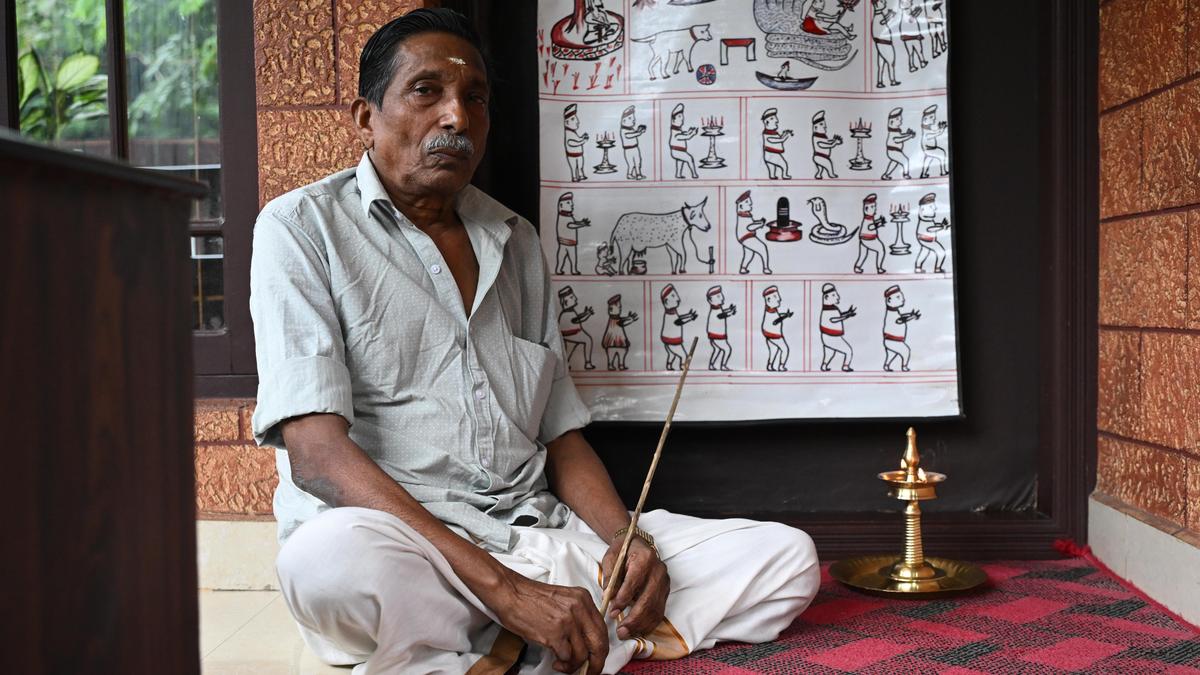
PK Narayanan sits crosslegged in front of a scroll filled with tiny illustrations. After a moment’s silent prayer, he points a thin wooden stick at it and begins to sing. A centuries-old story unspools, in a mix of prose and poetry, in ancient Malayalam. Narayanan from Vengola in Perumbavoor is one among the few artists who perform Raveli /Blaveli pattu (raveli vayana), a folk storytelling art performed during the month of Karkkadakam in the Ernakulam region. Over time, with urbanisation and shifts in socio-economic circumstances, spaces for such traditions shrank. Practised by the Veerasaiva community, known to have migrated from Andhra Pradesh and Tamil Nadu centuries ago, Raveli pattu evolved as an oral tradition, passed down generations. The artistes would go from door to door, with their scrolls and sing the same song, in praise of Lord Siva, during the month of Karkkadakam and the families would offer rice, coconut, and at times, a small cash offering. It was believed to bring in a dose of positivity to the otherwise “inauspicious” month. It is also performed during the Malayalam month of Kumbham, around Sivaratri.On the brink of fading awayToday, the number of people who practise the tradition has dwindled. Narayanan performs only on request. “At times, researchers and students, curious about this vanishing art form, reach out. Other than that, I rarely perform,” says Narayanan, who used to accompany his father Nanukuttan from the age of 15. “The song has no written script. I learnt it purely by ear,” he says. At 72, Narayanan says none of his three children is captivated enough by it to follow it.
How ‘Raveli pattu’, Kerala’s ancient story telling tradition, is struggling to survive
Explore the struggle of Kerala's ancient storytelling tradition, Raveli pattu, as PK Narayanan strives to preserve its legacy.
1,003 words~5 min read