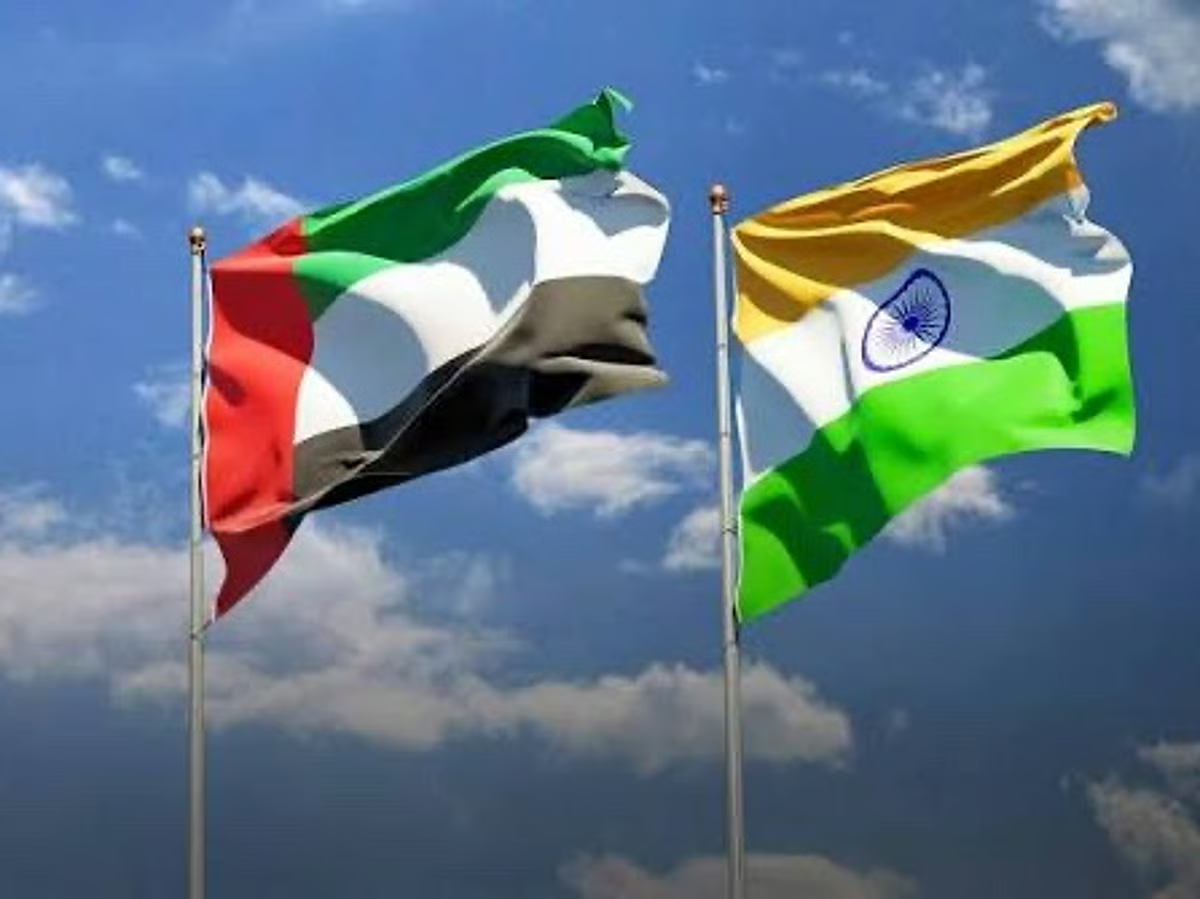
The UAE–India relationship has evolved far beyond a transactional trade route. It has become a strategic economic partnership built on trust, shared ambition, and a common vision for the future. As India celebrates its 80th Independence Day, this is a moment not only to honour our shared journey, but to define the next chapter of collaboration and global leadership.We can begin by recognising the changing identity of the Indian professional in the UAE. Far removed from yesteryear’s expatriates searching for gainful employment, they are stakeholders seeking permanence. This can be seen in the transition from survival and savings to genuine wealth creation and the transformation of the age of remittances into an era of equity. Corporate thinking must now catch up with this new reality. Indian businesses should see the UAE not as a host country, but as a home market - a global launchpad that leverages its strategic location, business-friendly ecosystem, and diplomatic reach to access markets across the Middle East, Africa, Europe, and beyond.This means transitioning from cross-border trading, investing in local talent, and creating joint ventures where intellectual property is co-owned, and not merely licensed. Talent mobility still needs practical solutions. While trade in goods continues to thrive, the full potential of trade in services remains constrained by talent barriers, including the lack of mutual recognition of professional qualifications, labour regulations and differences in professional standards. Addressing these challenges would unlock greater mobility of talent, deepen economic integration and create new opportunities for both nations.The evolving Indian professional mindsetThe next level of growth stems from a mindset change among Indian professionals – a transition from ‘doing business in the UAE’ to ‘doing business with the UAE.’ This includes integrating Indian human capital more deeply into the Emirati economic vision.Another challenge is the inter-generational transfer of knowledge. Many large Indian businesses in the UAE were established in the 1970s and 1980s. Today’s generation of leaders who are digital natives pursue the ‘what you can build’ paradigm in favour of the ‘who you know’, overlooking decades of hard-earned commercial wisdom and personal relationships. Access to business councils can be democratised. Mentorship programmes could connect veterans with younger tech entrepreneurs. Legacy institutions must become as adept at nurturing innovation as they have been at preserving trust. Our businesses must reflect the values of sustainability, transparency, and innovation that both nations hold in high regard.Institutional framework for growthAs active members of both the Institute of Directors (IoD), India, and the Indian Business and Professional Council (IBPC) Dubai, Tristar Group has experienced first-hand the value of structured dialogue, robust governance and trusted business networks.The IoD plays a pivotal role in promoting world-class corporate governance, ethical leadership, and responsible business practices, providing a strong framework for capital and investment flows between our two nations. Complementing this, the IBPC serves as an important bridge between policy and practice - translating strategic initiatives from New Delhi and Abu Dhabi into practical business opportunities, fostering collaboration and supporting enterprises, particularly SMEs, as they navigate an increasingly integrated economic landscape.New opportunities for growthInstitutional mechanisms, alone do not suffice. The next decade demands collaborative action in strategic areas – with professional and institutional input. The green transition is one instance, in the foreground of the UAE’s commitment to Net Zero by 2050 and India’s rapid scaling of renewables capacity. India’s engineering talent and the UAE’s capital can be leveraged to create a green corridor between the two shores, so that the movement of goods does not come at the cost of the environment. Likewise, industry can accelerate joint R&D projects in areas like green bunkering, sustainable fuels and renewable energy grid connectivity. The 80th anniversary is more than a celebration of longevity - it is a testament to resilience, foresight and the ability to adapt through decades of geopolitical uncertainty, energy crises, economic disruption, and a global pandemic. As we look to the future, the defining question will not be whether change comes, but how boldly we embrace the energy transition, harness digital innovation and strengthen the resilience of global supply chains.
UAE–India Partnership at 80: From historic ties to shared ambition
Green corridors, digital innovation and resilient supply chains to power the next decade
674 words~3 min read