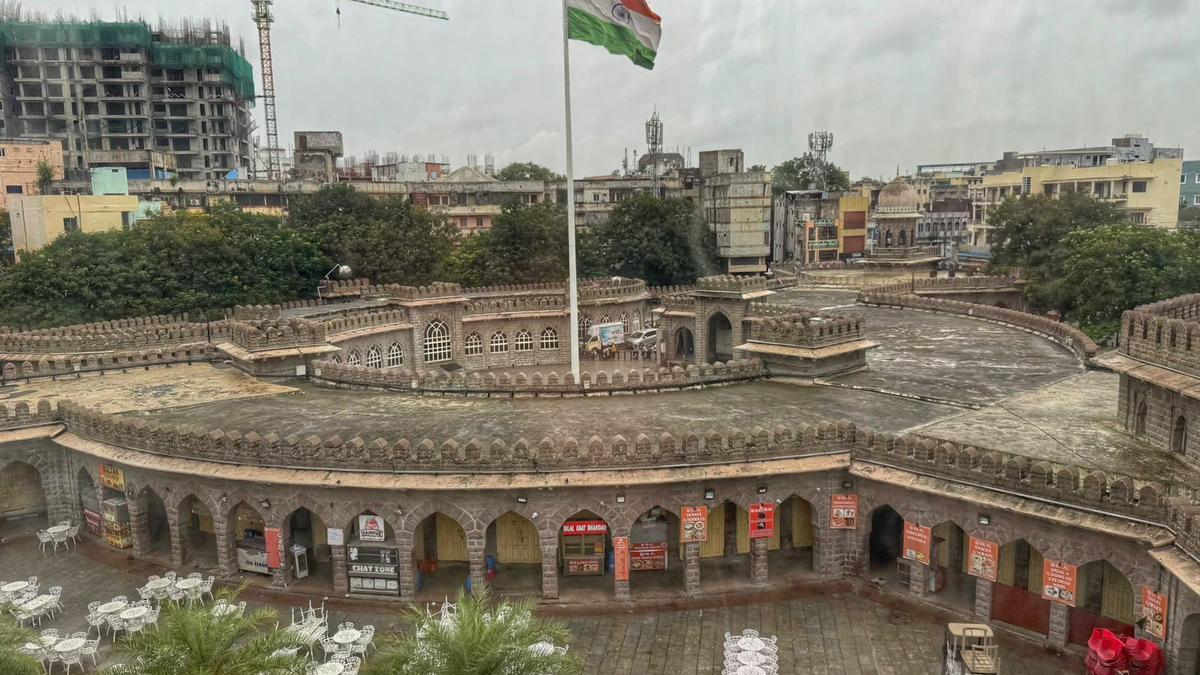
The MJ Market was one of the sites where ‘Independent Hyderabad Day’ was celebrated with flags and festoons in 1947, while another programme got underway at the Exhibition Pavilion. Serish Nanisetti
| Photo Credit: Serish Nanisetti
“Sheher khamosh tha. Sab jagah khamoshi thi (the city was silent. There was silence everywhere),” recalls Oudesh Rani Bawa, who remembers being a six-year-old and standing on the street in Gowlipura as residents gathered to hear the day’s developments on the GEC Radio. Hours earlier, in a pre-dawn swoop at 3 a.m. on August 15, 1947, Congress workers Krishnacharya Joshi, Dr G.S. Melkote and Ramananda Tirtha were picked up from Narayanguda and shifted to the Central Jail in Musheerabad.Also read | Independence Day 2026 updatesBetween the silence and the crackdown, the whiff of freedom and Independence was very much in the air on the day India became free, but Hyderabad did not. Hyderabad witnessed two different Independence Days that day. The calm also belied the unfolding reality, as an exodus of Hindus began amid growing fears over the Razakar menace spreading across rural areas.“The party’s [Communist Party] decision was to hoist the flag wherever there were party people. I raised the flag in Goshapet High School in Dhoolpet, and it was very tense at that time. Women went from place to place shouting slogans about Bharat and throwing flowers as if it was a festival. Young boys also joined, shouting jai, jai…” recounts Brij Rani Gour in her memoir. Gour, the sister-in-law of Oudesh Rani Bawa, was picked along with Yashoda Bai for hoisting the flag at the school.They were heeding a call by Congress leader Ramananda Tirtha, who had appealed to people to unfurl the flag wherever they could. “Observe Independence Day. We in Hyderabad cannot share the joy with the rest of our fellow countrymen who are our own citizens of Independent Democratic India… we refuse to be slaves,” he had said.The flag-hoisting programme was part of the ‘Join Indian Union’ campaign launched by the Congress. While the Nizam’s government maintained a firm grip over Hyderabad and sought to enforce its will, the same was not the case in many parts of the dominion. Workers skipped work, schoolchildren stayed home (it was a Friday), and cinema halls remained shut. Trains passing through the Nizam’s dominion were stripped of the Indian Union flags. As the Bombay-Madras Express steamed into the Gulbarga station at 2 p.m. on August 15, 1947, the Nizam’s Police got to work removing all the flags pasted on the train.The crackdown against the flag and those planning to hoist the tricolour had begun much earlier, when Arya Samaj leaders such as Narendraji, Dattatreya Prasad and Gangaram were arrested and sent to jail on July 30, 1947.However, on the day, a different kind of freedom was being celebrated elsewhere in the city. At Darussalam, Razakar leader Kasim Rizvi unfurled the yellow Asafia flag, calling it “the emblem of political power of Muslims”. A salvo of 110 guns was fired on the occasion.A more public celebration unfolded near Abids Shop, where ‘Independent Hyderabad Day’ was marked by decorating shops in the locality and installing a tall new flagpole for the Asafia flag. On the parallel road, however, there was silence, with traffic diverted and buses barred from plying on the route. Silence prevailed again in another part of the city, where the police enforced a curfew in Secunderabad that remained in force until August 20, 1947.At the Ordnance Depot in Secunderabad, then a British enclave because of the stationing of the Indian Army, the flags of both India and Pakistan were hoisted.At 3 p.m., a public meeting got underway at the Exhibition Pavilion, organised by Anjuman-e-Majlis-e-Azad. Raja Pratapgirji Bahadur delivered the main address, appealing to all communities living in the State to unite so that everyone could enjoy the fruits of freedom. The meeting also passed a resolution reaffirming the participants’ allegiance to the throne and the Nizam.But not everything was deadly serious. At the Paramount Cinema in Secunderabad, a new movie was in town — Wasiyat Nama. A newspaper described the reception to the film as one of “unprecedented enthusiasm” for the 3.30 p.m. matinee show on August 15. The movie was a two-year-old adaptation of Bankim Chandra Chatterjee’s Krishnakanter Will.The Nizam’s government had been preparing for the day, issuing a ruling that said: “In exercise of its power conferred by Rule 58 sub-rule (1) (b) of the Defence of Hyderabad Rules, the President of the Council is pleased to order that no flag of any foreign State shall be ceremoniously flown in any public meeting nor shall any salutation of such flag be made. Contravention of this order shall be punishable with imprisonment for a term that may extend to three years or with fine or both.”The ruling remained in force for 13 more months, until Hyderabad became part of India in September 1948. Published - August 15, 2026 08:09 am IST