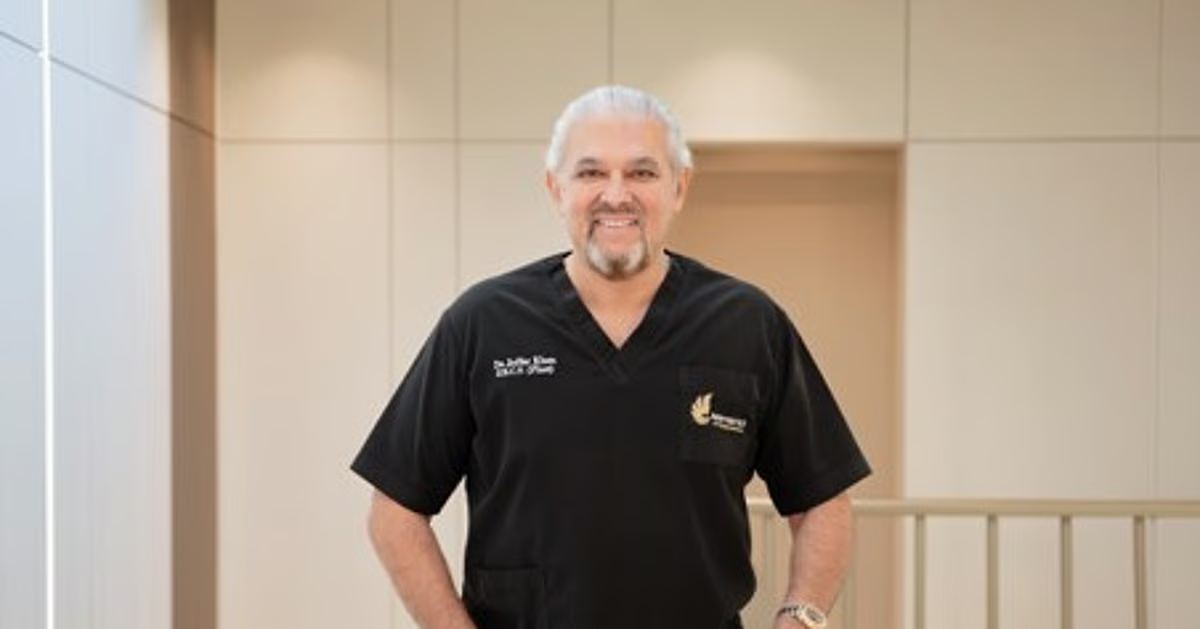
Dr. Gary Lawton Advocates for Dual-Plane over Subglandular Breast Augmentation
PR Newswire
SAN ANTONIO, Aug. 14, 2026
Yale-trained San Antonio plastic surgeon says corporate marketing does not overturn decades of anatomic and clinical evidence SAN ANTONIO, Aug. 14, 2026 /PRNewswire/ -- As national cosmetic surgery companies and new breast implant manufacturers promote above-the-muscle breast augmentation, Yale-trained, board-certified plastic surgeon Dr. Gary Lawton challenges the premise that a newly introduced implant and a forceful corporate marketing campaign transforms subglandular breast augmentation into a new or more advanced operation. Breast Augmentation in San Antonio
Subglandular breast augmentation is not new. It places the implant immediately behind the breast gland and dates to the earliest era of breast implant surgery. "A procedure does not become advanced because it has been repackaged with a new implant or corporate medical messaging," Dr. Lawton said. "The relevant question is whether the anatomy, biology, and long-term evidence justify moving the implant out from beneath muscle coverage." Breast Augmentation Frequently Asked QuestionsRapid Recovery Is Not an Implant PlaneNational cosmetic surgery organizations predominantly known for awake liposuction are now marketing awake, over-the-muscle breast augmentation. Similar national campaigns describe preservation of native breast tissue as an innovation, although preservation of healthy native tissue has always been a fundamental objective of breast augmentation. Minimal-Scar Breast Augmentation in San AntonioDr. Lawton believes this questionable marketing strategy risks conflating two fundamentally different questions: How quickly does the patient recover, and where should the implant be placed to provide the strongest long-term anatomical result? "Rapid recovery should come from reducing unnecessary surgical trauma," Dr. Lawton said. "Precise dissection, efficient surgery, controlled tissue handling, proper anesthesia, and postoperative management all affect recovery."Transaxillary Breast Augmentation in San AntonioThe Case for Muscle CoverageThe distinction is not merely philosophical.Capsular contracture rates are 6.85% with subglandular placement and 1.99% with dual-plane placement.Muscle coverage also provides an additional layer of living tissue over the implant, which reduces visible implant edges and rippling, particularly in patients with limited native breast tissue.Submuscular dual-plane surgery is technically more demanding, but technical difficulty does not negate the anatomical advantages."The appropriate response to a technically more demanding operation is to become better at performing it," Dr. Lawton said. "It is not to automatically return to an anatomically simplistic operation from more than 60 years ago."A New Implant Does Not Make an Old Plane NewNew textured implants recently introduced into the United States have generated considerable advertising, mostly for the benefit of the manufacturer. Dr. Lawton cautions against interpreting favorable implant trials as evidence that subglandular placement has overcome its historical disadvantages.The distinction is fundamental: implant technology and implant position are separate variables.A different textured shell surface or new delivery system may alter certain characteristics of the surgery. It does not negate the importance of tissue thickness, gravity, mechanical loading, pocket anatomy, or the biological response to an implanted device.Refine the Operation, Not the AnatomyFor more than 25 years, Dr. Lawton has focused on refining endoscopic transaxillary dual-plane breast augmentation rather than abandoning muscle coverage to accelerate recovery.His approach uses direct endoscopic visualization, controlled dissection, meticulous hemostasis, and precise pocket construction to minimize unnecessary tissue injury while maintaining dual-plane coverage.The objective is to solve the recovery problem through surgical refinement."Patients experience recovery for days or weeks," Dr. Lawton said. "They may live with the anatomic consequences of poor surgical planning or a fad type implant device for decades."How to Evaluate a San Antonio Plastic SurgeonPatients searching for the best plastic surgeon in San Antonio should ask how the surgeon analyzes anatomy, protects perfusion, manages fluid, responds to complications, and follows patients over time.About Dr. Gary LawtonDr. Gary Lawton is a Fellow of the American College of Surgeons and is board-certified by the American Board of Plastic Surgery. He has devoted more than 25 years exclusively to cosmetic surgery of the breast and body in San Antonio, Texas. He completed both General Surgery and Plastic Surgery training at Yale, where he served as Chief Resident in both specialties. He also completed a two-year Wound Healing Fellowship devoted to the biology of tissue repair and regenerative healing.Dr. Lawton has performed tens of thousands of cosmetic surgeries and has devoted his career to the continual refinement of surgical technique through evidence-based innovation, advanced wound-healing science, and comprehensive patient care.His academic, professional, and research distinctions include:Corso Award for Plastic Surgery ResearchOhse Foundation Research AwardAmerican College of Surgeons Award for Wound HealingRealSelf Hall of Fame – Distinguished InducteeRealSelf Top 100 AwardAmerica's Top Plastic SurgeonsAmerica's Most Honored Professionals – Top 1%Scene in San Antonio Top SurgeonVitals Lifetime Achievement AwardContactDr. Gary LawtonLawton Plastic Surgery525 Oak Centre Drive, Suite 260San Antonio, Texas(210) 496-2639Lawton Plastic Surgery directions and contact information