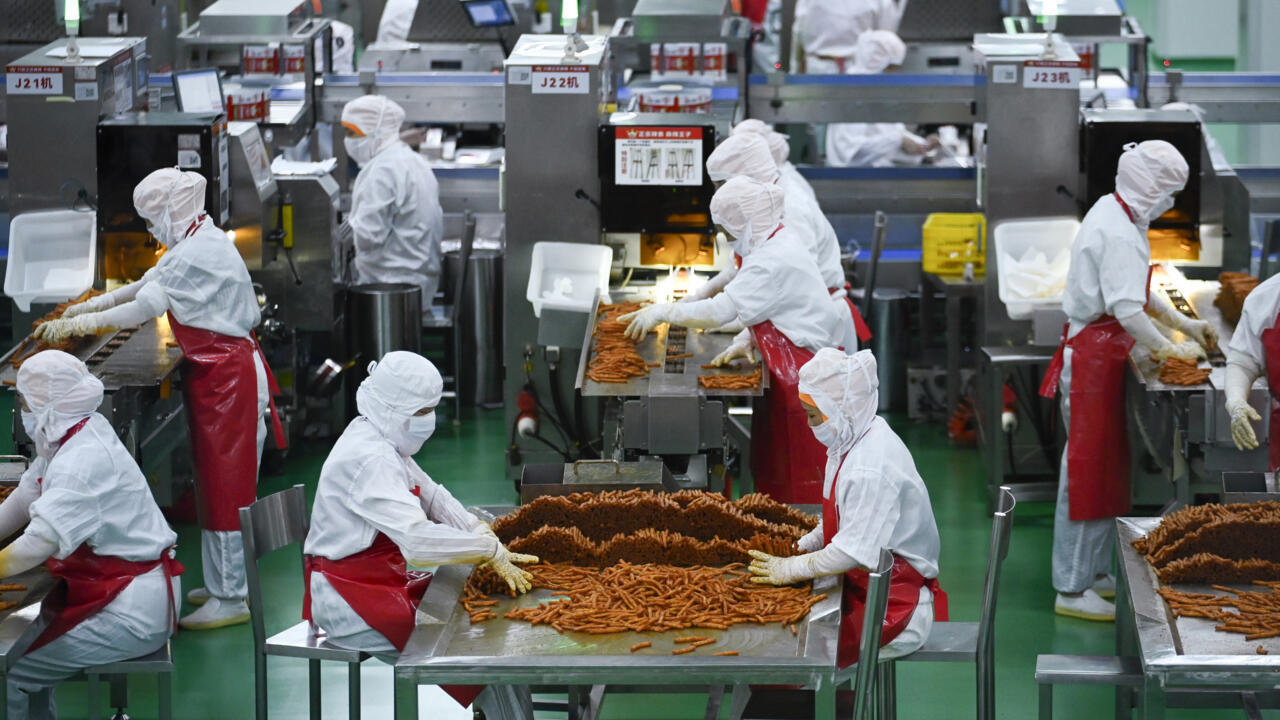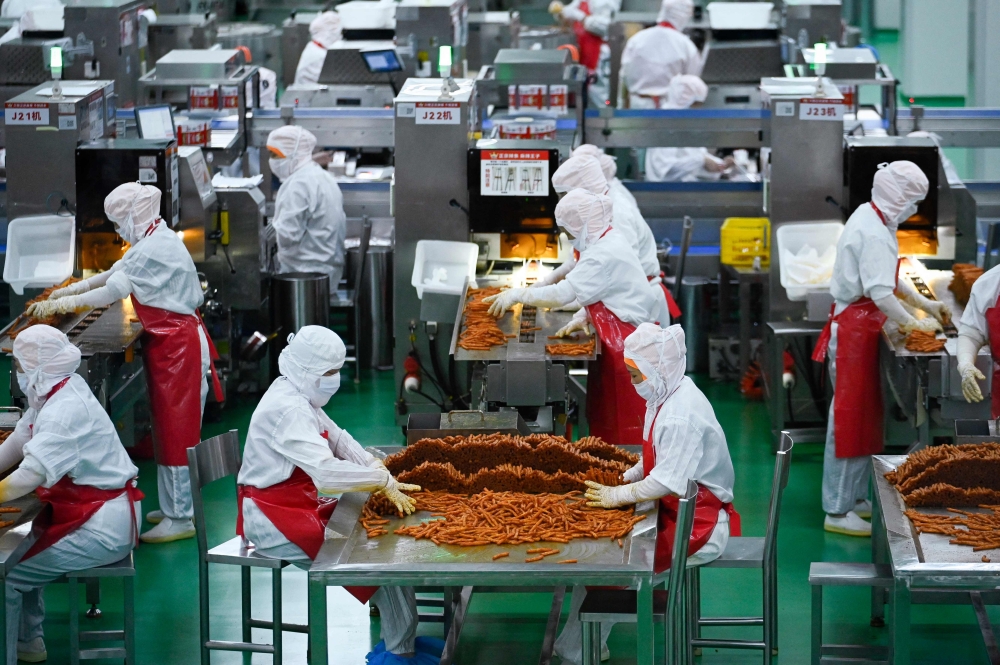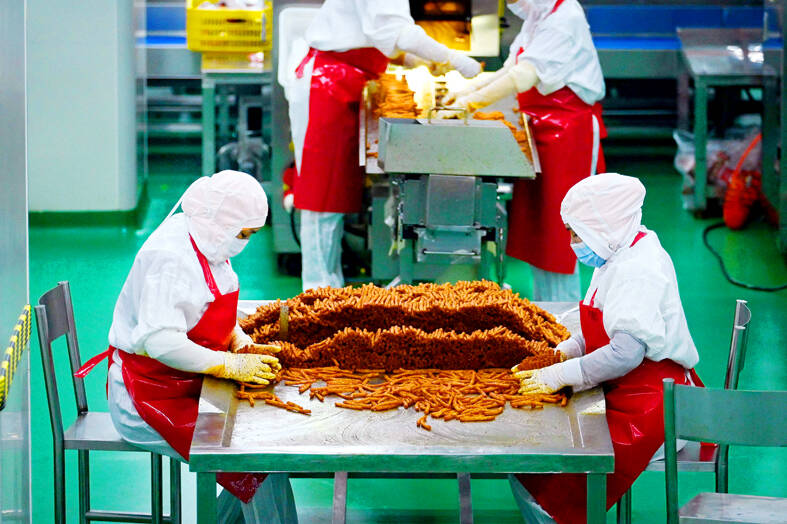
At a gleaming new factory in China’s central hinterland, masked workers in white uniform season and sift through mounds of latiao, a longtime popular snack that has found hungry fans overseas.Spicy, sweet and curiously chewy, Chinese latiao — literally “spicy strips” — are made by cooking wheat flour dough at a high temperature and pressure.Despite their reputation as junk food, the snacks originally developed as emergency supplies have grown into an industry worth more than 60 billion yuan (US$8.9 billion).
Workers prepare to package “latiao,” or spicy strips, at the Mala Wangzi factory in Pingjiang County, China.
The Mala Wangzi factory in Hunan Province’s Pingjiang turns out nearly 700 tonnes per day of the spongy, red-colored strips, which look like squashed French fries covered in oil.The company sells all of that domestically, but latiao have acquired new legions of foreign fans spurred by online enthusiasm for Chinese culture, or “Chinamaxxing.”
“Latiao are now exported to more than 160 countries worldwide, showing that the market is moving increasingly toward internationalization,” Mala Wangzi vice president Li Manliang said.Some brands have expanded into East and Southeast Asia, where they are growing rapidly, while consumers from the US to Australia are snapping up the snacks in specialist grocery stores, e-commerce platforms and via TikTok.The country’s largest latiao producer, Hong Kong-listed Weilong, made 117 million yuan from overseas sales last year, up nearly 50 percent from 2024.TikTok and Instagram are awash with videos of foreigners trying the fiery snacks.One influencer gained 1.5 million views by chowing down on a model house made entirely of the glutinous strips.In another TikTok video with 2.6 million views, an Australian reviewer tucked into a giant latiao.Latiao were created in Pingjiang in 1998 as an emergency staple food, after devastating floods wiped out the local soybean crop. They became ubiquitous in supermarkets across China, but gained a reputation as unhealthy and unsanitary — an image latiao brands have spent years trying to counter.At the Mala Wangzi facility, an employee livestreamed the factory floor to showcase its hygienic conditions.Li said these were based on standards used in the pharmaceutical industry.The recipe has also changed to make the snack healthier, he said. “We’re reducing the use of oil, salt, sugar and additives, and using more natural raw ingredients,” he added.Mala Wangzi has opened pop-up museums around the country, held more than 4,000 latiao-themed weddings for superfan couples, and sponsored e-sport events, music festivals, and animation conventions.