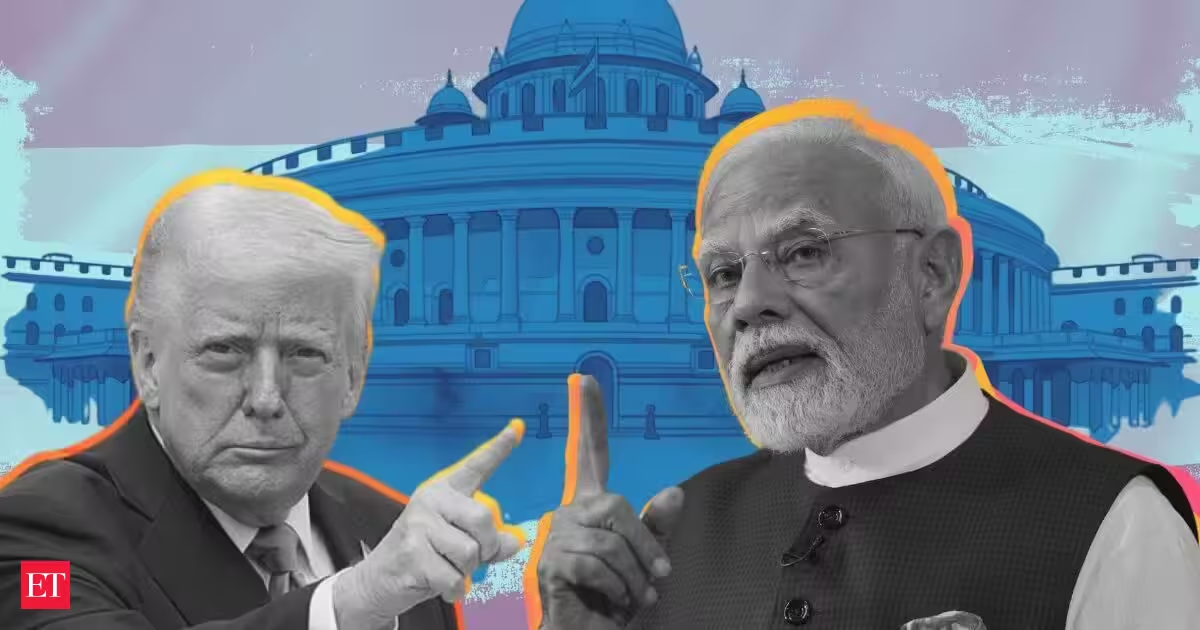
New Delhi: India should seek greater details from the US on its allegation that over 40 countries, including India, are operating a shadow trans-shipment network to help China evade high tariffs, detect misuse, protect legitimate exporters and challenge unsupported allegations, GTRI said.The US on Thursday accused Chinese exporters of routing goods through these countries to evade higher US tariffs.The US report, specifically, targets India's Pune-Gujarat-Chennai corridor for pumps and compressors.The Global Trade Research Initiative (GTRI) said, "India should ask the US to disclose the country, product and shipment-level basis of its allegations, including India's share of the USD 67 billion estimate"."It should also investigate pumps and compressors by matching firm-level Chinese imports with US-bound exports and verifying domestic value addition. This would detect any misuse, protect legitimate exporters and allow India to challenge unsupported allegations with credible evidence," GTRI founder Ajay Srivastava said.TRANS-SHIPMENT: It means routing goods through a third country before they reach the final destination, often to hide their true origin or avoid higher tariffs.For example, a Chinese company shipping a product to India, and then that item is re-exported to the US by doing basic value addition, like a change in packaging and labelling. If the product is falsely presented as Indian-origin, rather than Chinese-origin, the exporter could potentially avoid the higher US tariff on Chinese goods.Why is it called a "shadow" trans-shipment network?The US allegation appears to go beyond normal transit or legitimate re-exporting. It suggests that some businesses may be deliberately using third countries to conceal the Chinese origin of goods and evade US tariffs.Importantly, trans-shipment itself is not illegal. It becomes problematic if there is misdeclaration of origin, false documentation, or tariff evasion.US REPORT: The White House report, The Great Transhipment Scam: Rise, Scope, and Costs, released on August 13, 2026, accuses Chinese exporters of routing goods through more than 40 countries to evade higher US tariffs.The 25-page report was prepared by the White House Office of Trade and Manufacturing Policy, headed by Peter Navarro, the top trade advisor to US President Donald Trump.Its central argument is that the Section 301 tariffs imposed on China since 2018 reduced direct Chinese exports to the US, but encouraged a global transhipment industry."Chinese goods are allegedly relabelled, repackaged, re-invoiced or subjected to minor processing in lower-tariff countries before entering the US under a different origin. The report calls this the Shadow Transhipment Network," he said.US imports from China fell from USD 525.8 billion in 2017 to USD 327.5 billion in 2025. However, total US imports rose sharply from USD 2.41 trillion to USD 3.50 trillion.India is placed in Tier 1 alongside Canada, the EU, Israel, Japan, Mexico, South Korea and Taiwan. The report cites a US Commerce estimate that USD 67 billion of goods were transshipped through India, Mexico and Vietnam in 2025, causing USD 28 billion in tariff losses.It does not disclose India's share, identify an Indian exporter or cite a fraudulent shipment, he said.The report specifically targets India's Pune-Gujarat-Chennai corridor for pumps and compressors.However, GTRI's examination shows substantial Indian manufacturing capacity in these product groups. In FY26, India exported liquid pumps worth USD 1.61 billion globally, including USD 414.5 million to the US, while importing USD 326.4 million from China.India also exported air pumps and gas compressors worth USD 1.48 billion globally, including USD 335.4 million to the US, while importing USD 1.63 billion from China."India's large global exports weaken any presumption that its US shipments are simply Chinese goods being rerouted," Srivastava said.There are weaknesses in the report, he said, adding that the US already applies strict non-preferential origin rules based on substantial transformation.Yet the report states these rules remain complex, inconsistent and open to misuse, and calls for tougher statutory standards. This could increase uncertainty and compliance costs for legitimate manufacturers using imported inputs without necessarily improving the detection of deliberate customs fraud.The proposed AI-enabled "Detective Border" could lead to more inspections, shipment delays, retrospective duties and penalties, he said.
India should seek greater details on alleged China trans-shipment network: GTRI
India has requested further information from the US regarding the claims of a shadow trans-shipment network. According to a US report, Chinese exporters are allegedly routing goods through more than forty countries to avoid tariffs, specifically targeting India's Pune-Gujarat-Chennai corridor for pumps and compressors. The GTRI advises India to examine its manufacturing and export data to confirm these allegations.
657 words~3 min read