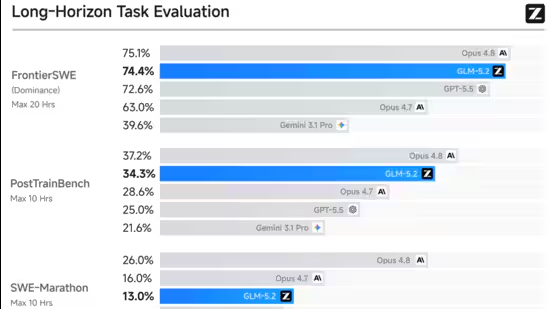
Chinese artificial intelligence firm Zhipu, also known as Z.ai, has unveiled its flagship GLM-5.3 model, saying it beat Anthropic’s frontier Mythos 5 model in a key cybersecurity test, as China races to counter Western advances in AI defence.Beijing-based Zhipu said GLM-5.3 achieved a success rate of 84.5 per cent on CyberGym, a benchmark that measures whether models can identify and validate security flaws from source code.That was above Anthropic’s Mythos at 83.8 per cent and OpenAI’s GPT-5.6 Sol at 83.6 per cent, according to Zhipu.However, the Chinese model did not match those foreign systems on ExploitBench, which gauges how far AI models climb the exploitation ladder. Its score of 54.4 per cent trailed Mythos’ 78 per cent and GPT-5.6 Sol’s 76.5 per cent.AI development should not be a solo performance by one nation, but a symphony of global collaborationZhipuZhipu said it had tested the model with security teams in China against real-world codebases, identifying 2,436 vulnerabilities across 269 projects after expert review. Of those, 1,097 were rated medium to high severity, according to the company.
Zhipu launches GLM-5.3 model as China seeks Mythos-level edge in cyber defence
Company says GLM-5.3 outperformed leading US systems in cybersecurity tests, beating Anthropic’s Mythos 5 and OpenAI’s GPT-5.6 on CyberGym.
TL;DRAI
Zhipu's GLM-5.3 beat Anthropic's Mythos in code vulnerability detection (84.5% vs 83.8%), showing China's AI security push. But it lags badly in real-world exploitation (54.4% vs 78%), exposing the gap between finding flaws and weaponizing—key for enterprises evaluating threat modeling AI.
175 words~1 min read