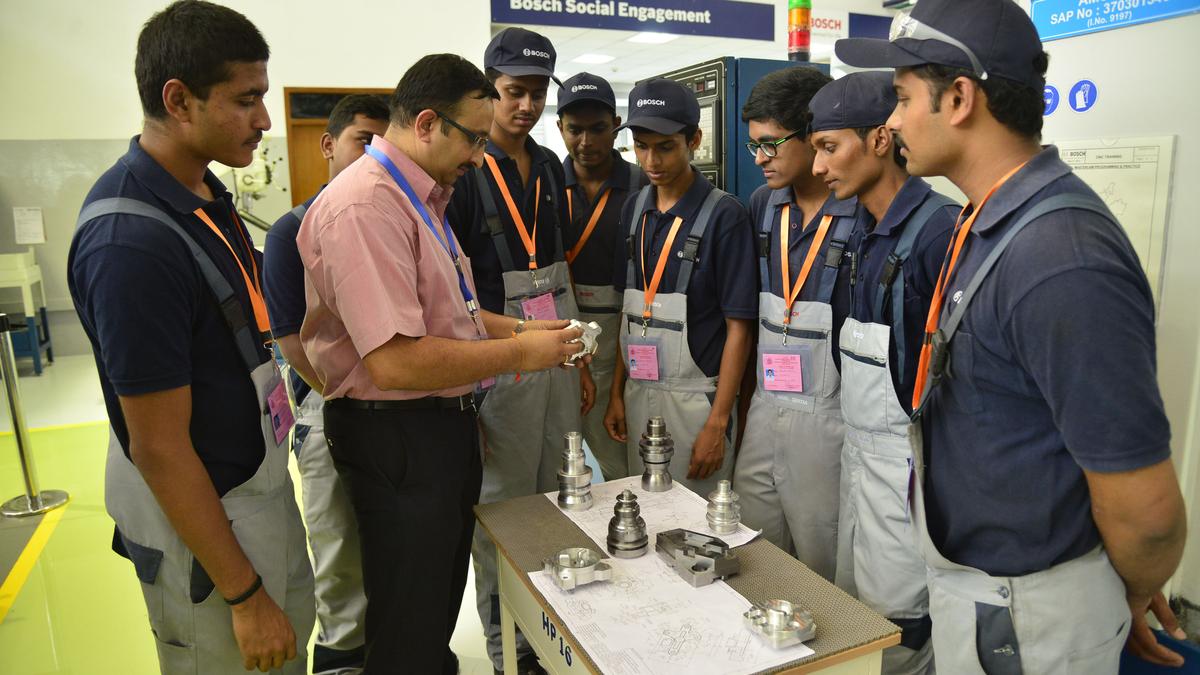
Under the National Education Policy (NEP) 2020, the University Grants Commission (UGC) and the All India Council for Technical Education (AICTE) launched the Apprenticeship-Embedded Degree Programme (AEDP). Designed to combine academic coursework with mandatory, credit-bearing on-the-job training (OJT), the initiative allows up to 50% of an undergraduate degree to be completed within industry settings through subsidized schemes such as the National Apprenticeship Training Scheme (NATS) and National Apprenticeship Promotion Scheme (NAPS).Government figures indicate substantial scale. According to Prof. M. Jagadesh Kumar, Chairman of the NEP 2020 Review Committee at the Ministry of Education, “In 2025, NAPS engaged 11.84 lakh apprentices. Similarly, 5.23 lakh were engaged under NATS. The third-party evaluations showed that approximately 72% of surveyed NAPS apprentices reported receiving full-time job offers. On the other hand, the NATS evaluation indicated a 74% full-time employment outcome. These are encouraging national results.”However, accounts from students across various sectors and institutions point to operational friction, administrative pressures, variable working conditions, and recruitment challenges following completion of these programmes.Campus administration and institutional directivesStudents attempting to navigate multiple job offers or adjust academic schedules often face opposition from university placement cells concerned about institutional relationships with recruiters.One final-year engineering student from a tier-three institution reported receiving two separate offers: a one-year apprenticeship at a multinational firm offering a ₹50,000 monthly stipend, and a full-time employment offer at a startup with a ₹14 LPA base salary. “When the student attempted to decline the apprenticeship offer to take the full-time role, placement officials and college administrators insisted that opting out would damage the university’s corporate standing. The student was instructed to accept the apprenticeship role, with administrators threatening academic audits and delaying degree certification,” he says.Addressing these institutional constraints, Prof. Furqan Qamar, former Secretary-General of the Association of Indian Universities, noted that higher educational institutions operate under significant administrative limitations:“Universities are struggling with multiple directives from regulatory bodies and governments. This leaves little scope for them to experiment and frees students for one or two semesters from the coursework. Industries are rarely located in the immediate vicinity of campuses, making it impossible to seamlessly blend internship and studies. Industry is also unable to provide paid quality internships to all students. They often complain about the quality of students that they take as interns, while students report that they are being used for doing errands rather than being given the opportunity to learn skills,” Prof. Qamar says.On-the-job conditions and stipend structureStudent experiences within workplaces vary widely by sector. In some banking and corporate branches, apprentices report being assigned menial or sales-heavy tasks rather than structured skill-building activities.An apprentice placed at a UCO Bank branch reported receiving no dedicated workspace or system access during their first month, describing the work as repetitive and lacking direct learning outcomes. Another apprentice at Canara Bank reported being assigned primarily to phone sales for financial products, noting that contract terms penalized early departure by requiring the repayment of one month’s stipend.Financial constraints also affect apprentices posted away from home. On typical stipends of approximately ₹15,000 per month, students report spending ₹8,000 to ₹10,000 on basic rent and living expenses, limiting financial viability during the training period.Post-apprenticeship outcomes and market receptionWhile national data reports conversion rates above 70%, several graduates report difficulty transitioning into permanent roles, as well as skepticism from prospective employers regarding apprenticeship credentials.A Commerce graduate who cleared CFA Level II completed an apprenticeship in credit risk at a global bank in Mumbai. “At the conclusion of the term, the entire cohort of apprentices was released without full-time conversion and replaced with a new batch. During subsequent job searches, the candidate reported that recruiters frequently lost interest upon learning that past experience was gained through an apprenticeship rather than regular employment,” she says.Similarly, engineering students evaluating 12-month apprenticeships express concern that companies may utilize short-term apprentice cohorts primarily for legacy software maintenance or temporary workload distribution without establishing long-term hiring pipelines.Industry perspectives and mentorship gapsIndustry representatives and startup founders offer a different perspective, pointing to misaligned candidate expectations regarding compensation and basic skill development.One startup founder who ran an AI-focused training and development internship noted that a majority of applicants inquired about stipend figures before asking about skill acquisition or project domain. However, industry sources also acknowledge that some companies utilize internship and apprenticeship models to complete technical projects at minimal cost without providing adequate mentorship.At the entry-level, candidates in non-technical domains such as sales and Go-To-Market (GTM) functions report a different hurdle: employers setting high pre-requisite expectations for entry-level applicants, making it difficult for freshers to secure foundational training.Regulatory framework and quality controlsTo address potential workplace abuses and ensure academic value, regulatory guidelines incorporate specific oversight mechanisms.Prof. M. Jagadesh Kumar highlighted the structured requirements governing the Apprenticeship-Embedded Degree Programme, “For an Apprenticeship Embedded Degree Programme, quality monitoring is a shared responsibility. The UGC’s 2025 guidelines require a tripartite agreement among the student, the institution, and the employer. Before training begins, they must define the work, syllabus, facilities, attendance, learning outcomes, assessment and a time-bound method for monitoring progress. The apprenticeship must be connected with the degree subject.”According to the UGC framework, performance evaluation is divided among three parties: Employer Assessment: 30–40% weightage, Faculty Mentor Visits: 30–40% weightage and Student Output (Logbook, Presentation, Viva): 20–40% weightageFaculty mentors are assigned groups of 20 to 30 apprentices to track attendance and daily learning logs. “If an employer defaults, the institution can, with the student’s choice, move the student to another establishment or back to the conventional programme,” Prof. Kumar added. “Importantly, it is the responsibility of the institutions to undertake confidential student feedback, sample workplace audits, and ensure timely stipend payments. UGC guidelines already place AEDP qualifications at par with regular degrees for recruitment.”Prof. Santosh Mehrotra, Visiting Senior Fellow at the Centre for Economic & Social Studies, Hyderabad, emphasizes that structural monitoring and industry alignment are essential to make the system work, “First, we must ensure apprenticeships are offered at every level. Making apprenticeships mandatory is essential to give work experience and job preparedness to graduates. But we must also monitor quality so companies do not misuse apprentices as cheap labor—even though employers pay the majority of the stipend with the government covering only around 25%. Apprenticeships should be mandatory for all registered medium and large firms across manufacturing, services, construction, and utilities.”“Second, we need a mechanism where employers have skin in the game. Industry must be actively engaged in designing courses and curricula while young people are still in education. Otherwise, students are trained in skills that are not in demand. The only people who actually know which skills are needed are employers themselves—not the bureaucrats designing these programs.”
Apprenticeship degrees promise jobs, but students face low-quality work and weak hiring
Apprenticeship degrees promise jobs but face challenges with quality work and hiring practices, impacting students' career prospects.
1,107 words~5 min read