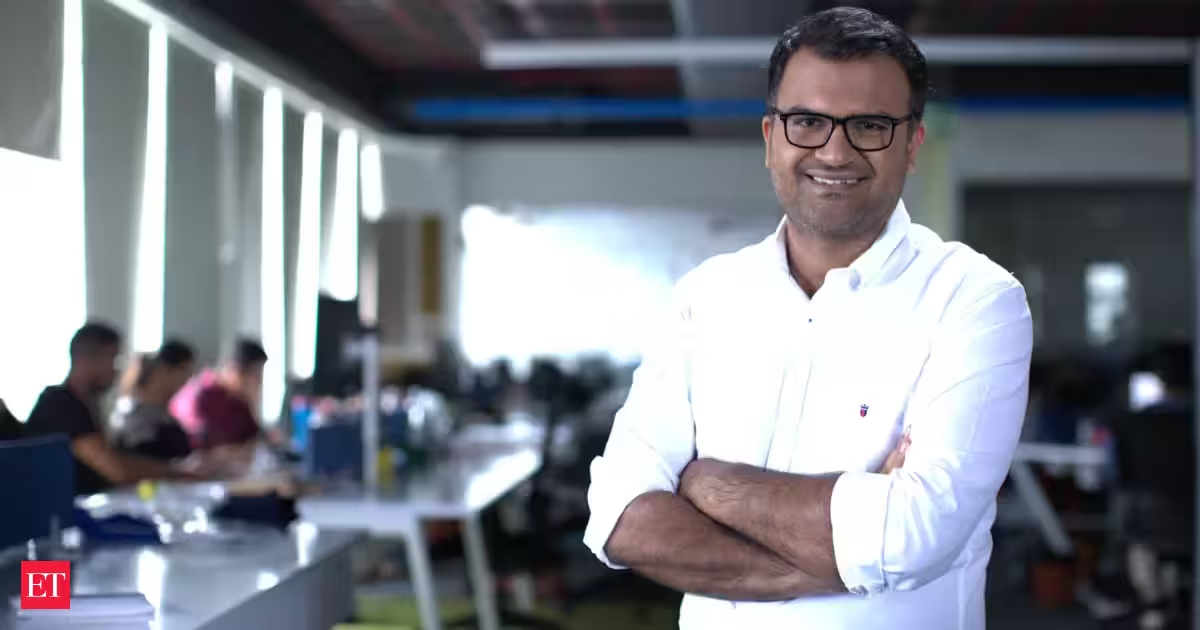
Scaler AI Labs, the research and engineering business of education platform Scaler, is working with three frontier artificial intelligence companies in San Francisco, with teams of researchers, engineers and students in India solving technical problems to improve AI models, cofounder Anshuman Singh told The Economic Times."Scaler AI Labs sources problems from these frontier labs and gets them solved from the India office through a combination of researchers, engineers and students, including students from Scaler School of Technology," Singh said."The output then goes back into the labs, while whatever Scaler AI Labs learns through these engagements shapes Scaler’s online and offline curriculum and programmes," he added.The company declined to name the three AI labs, citing confidentiality agreements.Singh, who is based in San Francisco, said the business is intended to keep Scaler close to advances in areas including large language models, robotics and physical AI."The whole reason of being set up in here (San Francisco), working close with wherever the frontier is, be it robotics, physical AI, the LLMs or the actual AI models, is that if we are deeply involved in improving the models, then we get to see what models are able to do before anybody else does," he said."A lot of the improvement in the current modelS has happened in the last nine months because of a lot of work that we have done from India, from the Scaler campus," Singh said.Scaler AI Labs has full-time researchers and engineers who work alongside students, including those from Scaler School of Technology (SST), its four-year residential undergraduate programme, Singh said."The employees are researchers and engineers from some of the top companies in India. They and the students work together to solve some of the problems that we are facing, and then the output goes back to the frontier AI labs," he said.Finding where AI models failA key part of the work involves identifying where AI models struggle with specialised technical problems and building evaluations, or test cases, around those failures, Singh said."If I have to actually make the model better on coding, or let’s say the work that an SRE would do, the first thing is I must be the best SRE out there," he said."I must be able to design systems and then I must be able to see that for a very nuanced problem, where is AI going wrong in its trajectory? And then I take those wrong paths and I’m able to design a bunch of evals, which is like designing a bunch of test cases for AI to fail on," Singh added.Such evaluations can then be used in reinforcement learning processes aimed at improving how models perform on those tasks, he said."I can do reinforcement learning using those evals to finally have the model become better at those things," Singh said. "You need an extremely good engineer with extreme depth, where I am able to use that depth to train models or make models themselves better, maybe design better agents,” he said.Frontier work feeds into curriculumSingh said exposure to problems being tackled by frontier AI companies also gives Scaler an early view of how model capabilities are changing, which it uses while designing its education programmes."You probably are looking at what the world is going to look like a year from now, two years from now or four years from now, depending on how long your programme is," he said.Scaler says it updates its curriculum every three months. Singh said the bigger advantage, however, comes from direct exposure to problems that AI developers are trying to solve."Our thesis right from the beginning has been that the way we are different from conventional institutes is that we can actually iterate really, really fast on where the world is going," he said. "We can keep the curriculum very focused on where the industry is, and all of our design is around being extremely industry relevant."The company has also changed how students are trained and assessed as AI tools become a bigger part of engineering work, Singh said. Students can use AI tools in parts of their learning and assessments, but are still expected to understand the concepts and make the decisions themselves, he said."There’s a common conception that because AI can write code now, I don’t need to learn coding. I should directly jump to building stuff just using AI," Singh said. "I think the right use of AI is that you shouldn’t let, at least in your learning phase, AI do the thinking for you. You should continue to do the thinking," he added.Preparing students for new AI-era rolesSingh said technology jobs are evolving broadly in two directions, towards engineers with deep technical expertise who can improve models and towards engineers with wider business understanding who can deploy AI inside enterprises.One role emerging from the second category is the forward deployed engineer, or FDE."You need engineers who have a mix of deep business understanding and good AI understanding, and hence are able to translate the internal business processes into an AI agentic layer," Singh said. “That job didn’t exist before,” he added.The other category includes AI engineers and researchers capable of fine-tuning open models for specific business use cases and deploying them locally, he said."Every enterprise right now is basically preparing a bunch of these cases which are business critical and can be solved by local models," Singh said. "There you need a lot of research engineers and people who are well-versed with fine-tuned models, which is AI engineers and AI scientists," he added.Singh said the shift does not reduce the importance of engineering fundamentals. Instead, he expects the bar for people entering technology jobs to rise as AI agents take over the tasks traditionally assigned to junior engineers."I think very soon the first job is not going to be an entry-level person, but rather the person who is managing these agents to get the work done and agents are doing what an entry-level person is supposed to do," he said.
Scaler AI Labs works with three frontier AI firms, feeds learnings into curriculum: co-founder Anshuman Singh
Singh said exposure to problems being tackled by frontier AI companies also gives Scaler an early view of how model capabilities are changing, which it uses while designing its education programmes.
TL;DRAI
Scaler AI Labs risolve problemi tecnici per 3 frontier AI firms con team in India; il feedback plasma la curriculum, aggiornata ogni 3 mesi. Nuovi ruoli AI emergono (FDE, research engineers) mentre AI agents automatizzano task entry-level.
993 words~5 min read